Get a paper cut or a scraped knee and you’ll see it: bright red blood. But your veins look blue or green through your skin. So which is it? Here’s what really colors your blood, and the trick behind those blue-looking veins.
The red comes from hemoglobin
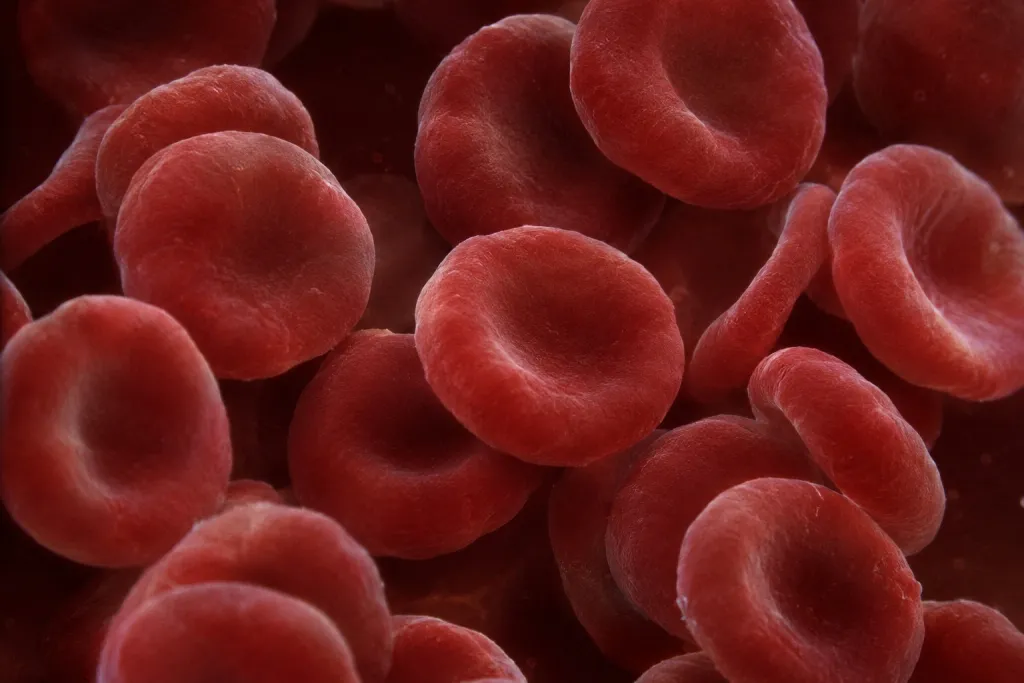
Your blood is packed with trillions of tiny red blood cells, shaped like little doughnuts without holes. Their job is to pick up oxygen in your lungs and deliver it to every part of your body.
To carry oxygen, each red blood cell is stuffed with about 270 million molecules of a protein called hemoglobin (say it: HEE-muh-glow-bin). At the center of each hemoglobin is iron, the same element in nails and in the rocks on Mars. Iron grabs onto oxygen, and the way it’s held inside hemoglobin makes it soak up blue and green light and reflect red. That’s why blood is red.
Bright red and dark red
Blood that’s full of oxygen, fresh from your lungs and traveling in your arteries, is bright cherry red. After it drops off its oxygen and heads back to the heart in your veins, it’s a darker maroon red. But it’s always red, never blue.
Explain it like I’m 5
Your blood has tiny delivery trucks that carry air all over your body. Each truck has a little bit of iron inside, and iron holding air looks red. So your blood is red!
So why do veins look blue?
It’s a light trick. When light shines on your skin, red light travels deeper into your skin than blue light does. The dark red blood in your veins soaks up a lot of the red light, while more blue light bounces back from the skin around them. Your brain compares the vein to the skin next to it and sees blue. If you could see the blood itself, it would be dark red.
What else is in your blood?
- Plasma (about 55%): a pale yellow liquid, mostly water, that carries everything else plus food and waste.
- Red blood cells (about 44%): carry oxygen.
- White blood cells and platelets (about 1%): white blood cells fight germs, and platelets rush to cuts to help form a scab.
Not every animal has red blood! Octopuses, squid and horseshoe crabs have blue blood, because they use copper instead of iron to carry oxygen.
Try it: build a jar of model blood
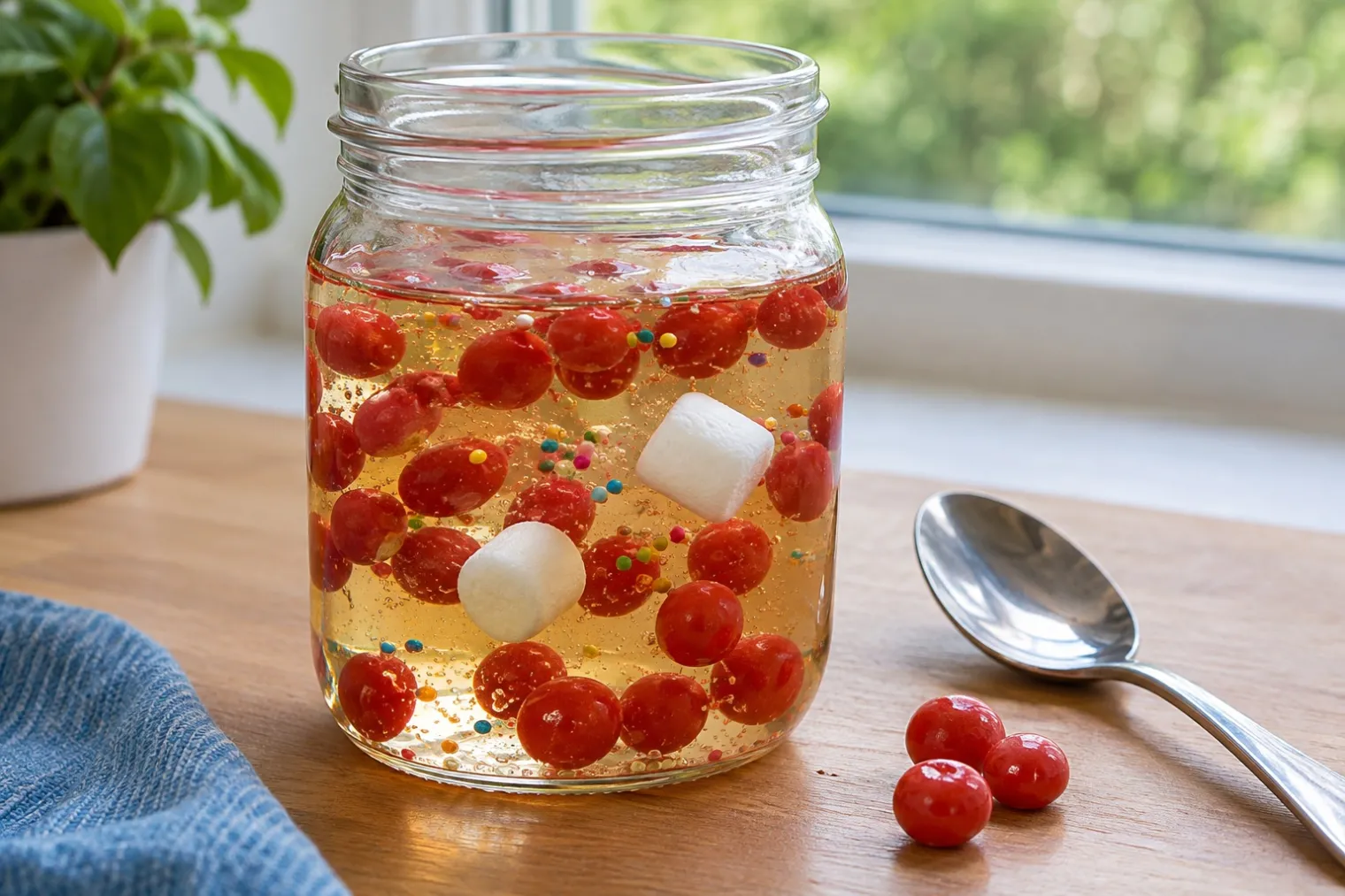
You need: a clear jar, light corn syrup, red cinnamon candies or red hots (or dried cranberries), a few large white beans or mini marshmallows and some sprinkles.
- Fill the jar a little more than halfway with corn syrup. That’s the plasma.
- Add red candies until the jar is almost full. These are red blood cells, and there should be lots!
- Add just 2 or 3 white beans or marshmallows for white blood cells.
- Sprinkle in a pinch of sprinkles for platelets. Stir gently and look at your blood!
What’s happening: your jar shows the real recipe: lots of red cells, very few white cells and tiny platelets, all floating in liquid plasma. Red cells outnumber white cells about 600 to 1 in real blood, which is why blood looks so red.
Keep exploring: How Does the Heart Work? · Why Is Mars Red? · Why Do We Need Sleep?
Words to know
- Hemoglobin
- An iron-containing protein in red blood cells that carries oxygen.
- Red blood cell
- A tiny cell that carries oxygen around the body.
- Plasma
- The yellowish liquid part of blood.
- Artery
- A blood vessel that carries blood away from the heart.
- Vein
- A blood vessel that carries blood back to the heart.
- Platelets
- Tiny cell pieces that help blood clot when you get a cut.
For grown-ups: the real science
Hemoglobin is a tetramer, each subunit containing a heme group: an iron(II) ion coordinated within a porphyrin ring. The porphyrin’s conjugated electron system produces strong absorption in the blue-violet (Soret band near 415 nm) and green-yellow (Q bands), so transmitted and reflected light is red. Oxygen binding shifts the absorption spectrum, so oxyhemoglobin appears bright red and deoxyhemoglobin darker. Arterial oxygen saturation is about 95–100%; venous is about 70–75%, so venous blood is still substantially oxygenated.
Veins look blue because of wavelength-dependent scattering and absorption in skin: red light penetrates deeper and is strongly absorbed by blood in the vein, so less red is returned from the vein region relative to surrounding tissue, and visual contrast processing produces a bluish percept (Kienle et al., Applied Optics, 1996). Many mollusks and arthropods use copper-based hemocyanin, which is blue when oxygenated.
Questions kids ask next
How much blood is in my body?
Roughly 7 to 8% of your body weight. A kid has about 2 to 3 quarts (liters), and an adult has about 5 quarts.
Why do scabs turn dark?
As blood dries out and the iron in hemoglobin changes, it turns from red to dark brown.
How fast does blood travel?
Blood makes a full trip around your body in about one minute when you’re resting.
Do any animals have green blood?
Yes! Some lizards in New Guinea have bright green blood, because it’s full of a green waste pigment called biliverdin.