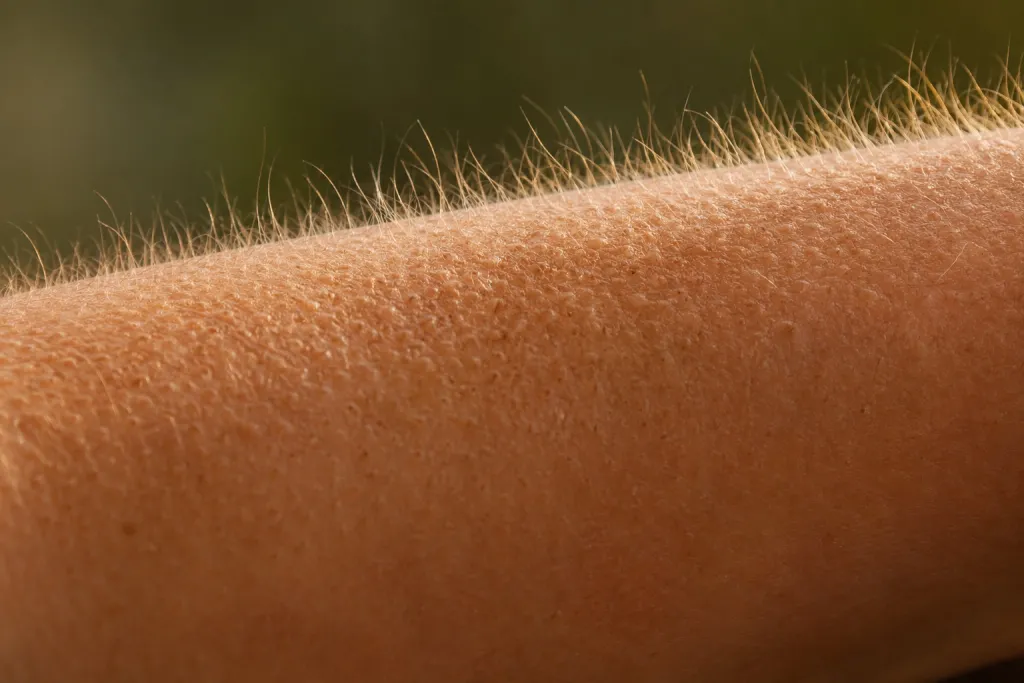
Step out of a warm bath into a chilly room, hear a spooky noise or listen to a song you love, and suddenly your arms are covered in little bumps. Goosebumps! They’re named after the bumpy skin of a plucked goose. But why does your skin do this?
Tiny muscles, tiny hairs
Almost all of your skin has hair, even if it’s thin and hard to see. Each hair grows out of a little pocket in the skin called a follicle. Attached to each follicle is a tiny muscle called an arrector pili (say it: uh-REK-ter PIE-lie), which means “hair raiser.”
When those muscles squeeze, they pull the hairs up straight, and the skin around each hair puckers into a bump. You can’t decide to do it. Your nervous system does it automatically, just like it makes your heart beat faster.
Explain it like I’m 5
Every little hair on your arm has a teeny muscle. When you’re cold or surprised, the muscles pull the hairs up to stand tall, and that makes little bumps on your skin.
Why cold gives you goosebumps
Think of a cat or a bird on a cold day. They fluff up! Standing hair or feathers trap a layer of air close to the skin, and that trapped air works like a warm blanket. Long ago, our ancestors were much hairier, and goosebumps helped keep them warm. Today our body hair is too thin to trap much air, so goosebumps don’t warm us very much. They’re mostly a leftover.
Why fear gives you goosebumps
When an animal feels scared, its body gets ready to fight or run. Part of that is fluffing up to look bigger, like a scared cat with a puffy tail or a porcupine raising its quills. In people, fear releases a chemical called adrenaline, which makes your heart pound and also sets off goosebumps, the same old “look bigger” trick.
Why music and movies give you goosebumps
Some people get chills from a beautiful song, a cheering crowd or an exciting movie scene. Scientists call these “musical chills.” Strong feelings switch on the same body system that fear does, so the hair muscles squeeze even though you’re happy. Not everyone gets them, and that’s normal.
There may be one more job for those tiny muscles. In 2020, scientists studying mice discovered that the hair-raising muscles also help hair follicles grow new hair, especially in the cold.
Try it: goosebump detective

You need: a magnifying glass, an ice cube in a small plastic bag and a favorite exciting song.
- Look at the skin on your forearm with the magnifying glass. Find the tiny hairs and notice how they lie flat.
- Hold the bagged ice cube on the inside of your wrist for about 20 seconds.
- Look at your forearm again. Are the hairs standing up? Do you see bumps?
- Warm up, then play your song loud and watch your arm during the best part. Did you get chills?
What’s happening: the cold sends a signal to your nervous system, which tells the hair muscles to squeeze, even on skin you didn’t touch. If the song gave you goosebumps too, your feelings set off the very same muscles.
Keep exploring: Why Do Bears Hibernate? · Why Do We Have Eyebrows? · Why Does Hair Turn Gray?
Words to know
- Follicle
- The tiny pocket in your skin that a hair grows out of.
- Arrector pili
- The tiny muscle attached to each hair that makes it stand up.
- Adrenaline
- A chemical your body releases when you’re scared or excited.
- Nervous system
- Your brain, spinal cord and nerves, which control your body.
- Reflex
- Something your body does automatically, without you deciding.
For grown-ups: the real science
Goosebumps (piloerection, or cutis anserina) occur when the smooth-muscle arrector pili contract in response to sympathetic nervous system signals, mediated by norepinephrine. Triggers include cold exposure, fear and strong emotion. In mammals with dense fur, piloerection improves insulation and makes the animal appear larger to threats; in humans it is largely vestigial.
Shwartz et al. (Cell, 2020) showed in mice that sympathetic nerves and the arrector pili muscle form a niche that regulates hair follicle stem cells, with cold-induced nerve activity promoting hair growth. Emotional “chills” or frisson in response to music are associated with dopamine release in reward circuits (Salimpoor et al., Nature Neuroscience, 2011) and vary widely between people.
Questions kids ask next
Can I give myself goosebumps on purpose?
Most people can’t, but a few people really can, just by thinking about it. Scientists are still studying how they do it.
Do animals get goosebumps?
Yes! A cat’s puffy tail, a dog’s raised hackles and a porcupine’s raised quills all come from the same kind of muscles.
Why do I get goosebumps on my arms but not my face?
You can get them almost anywhere there’s hair, but they’re easiest to see on arms and legs, where the hairs are longer.
Why are they called goosebumps?
Because the skin of a goose with its feathers plucked is covered in little bumps where the feathers grew. In some languages they’re called “chicken skin” instead.