Every sound you hear starts with something shaking back and forth. Those tiny shakes are called vibrations, and they travel through the air (and through string, water and wood) until they reach your ears. These sound experiments let kids see, feel and hear vibrations at work, using rubber bands, cups, spoons and a few other things from around the house. A couple of them are TryScience classics from years ago, like the musical coat hanger.
No ideas match all of those. Try turning off a filter.
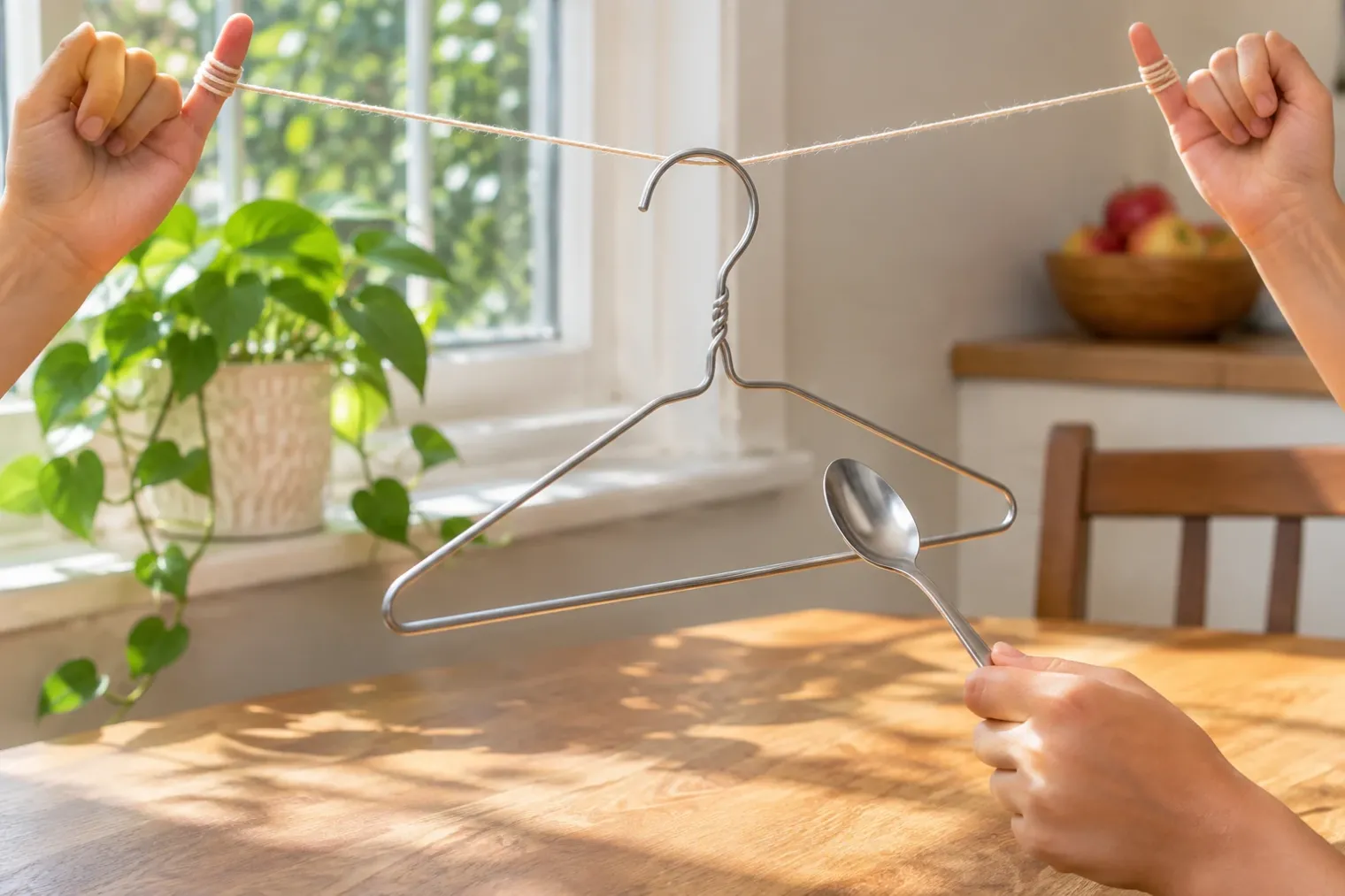
Musical Coat Hanger
Tie a metal coat hanger to the middle of a string, wrap the string ends around your fingers, and press your fingers to your ears. When someone taps the hanger with a spoon, you’ll hear a deep, ringing “bonggg” like a church bell. Everyone standing next to you only hears a little clink.
Quick how-to
- Cut a piece of string about 3 feet long and tie the hook of a metal hanger to the middle.
- Wrap one string end around each pointer finger and gently press your fingertips into your ears (not inside them).
- Lean forward so the hanger swings free, and bump it against a table or have a friend tap it with a spoon.
- Now take your fingers out of your ears and try again. What changed?
Why it works: sound travels better through solids than through air. The vibrations run straight up the tight string into your fingers and ears, so you hear rich, low sounds that mostly get lost in the air.
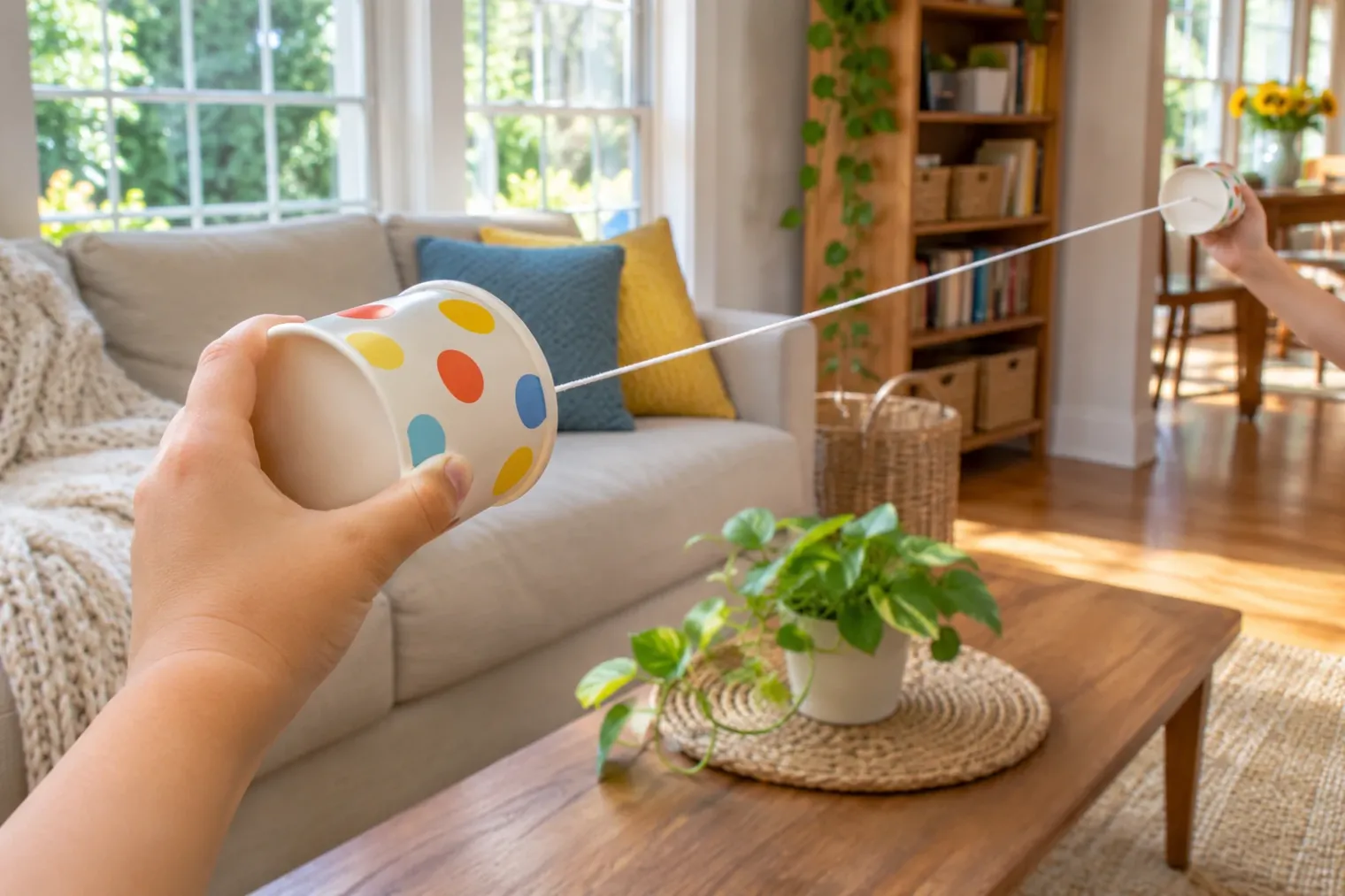
Cup and String Telephone
Two cups and a long string make a phone that really works. Whisper into one cup, and a friend across the room can hear you clearly through the other. Then test what makes it work better or worse.
Quick how-to
- Poke a small hole in the bottom of two paper or plastic cups.
- Thread a long string (10 to 30 feet) through each hole and tie a knot or tape a paper clip inside so it can’t pull out.
- Walk apart until the string is tight. One person talks into a cup while the other listens.
- Now let the string go slack, or pinch it with your fingers. Can you still hear?
Why it works: your voice makes the bottom of the cup vibrate. The tight string carries those vibrations to the other cup, which shakes the air into sound again. A loose or pinched string stops the vibrations.

Water Glass Xylophone
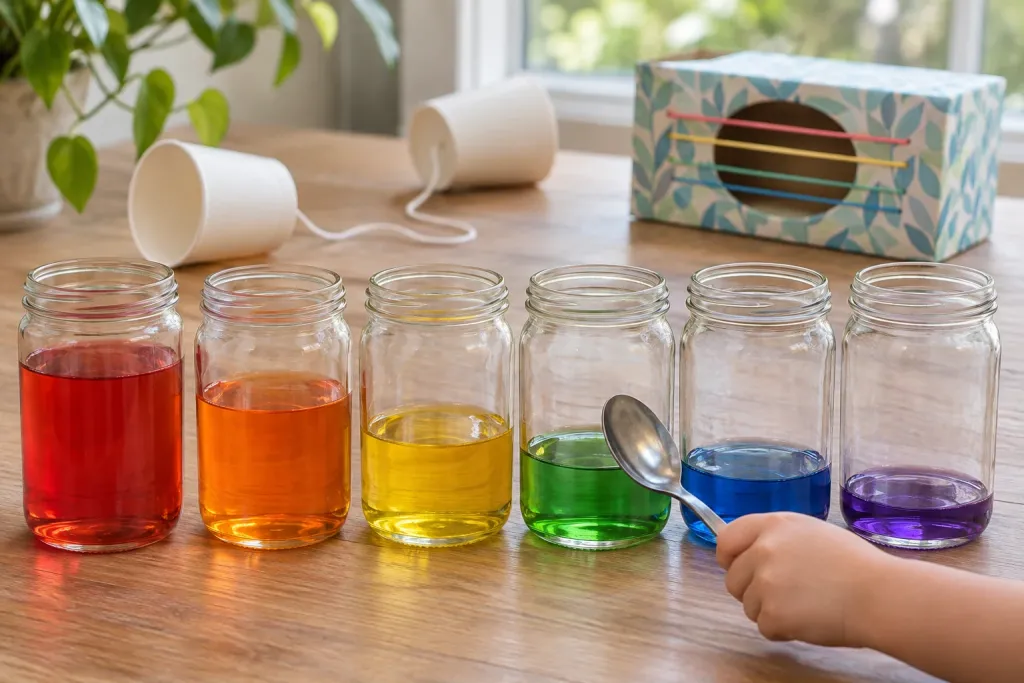
Line up glasses or jars with different amounts of water, tap them with a spoon, and you have an instrument. Add food coloring to make it rainbow, then try to tune it well enough to play a simple song.
Quick how-to
- Set out 5 to 8 matching glass jars or glasses.
- Pour a little water in the first, a bit more in the next, and so on, until the last one is almost full.
- Tap each glass gently with a metal spoon. Which is highest? Which is lowest?
- Add or pour out water to tune the notes.
Why it works: when you tap, the glass and water vibrate together. More water makes them vibrate more slowly, which sounds lower. Less water vibrates faster for a higher note. How fast something vibrates is called its pitch.
Balloon Honker
Blow up a balloon, stretch the neck out flat with your fingers and let the air squeak out slowly. Pull wider for a high squeal, relax for a low honk. It’s silly, loud, and the fastest way to show how a stretched material makes sound.
Quick how-to
- Blow up a balloon and pinch the neck closed.
- Hold the neck with both hands and gently pull it sideways so it stretches into a thin slit.
- Let a little air out. Pull tighter, then looser, and listen to the pitch change.
Why it works: escaping air makes the rubber flap open and shut very fast. Stretching it tighter makes it vibrate faster, so the sound gets higher. Your vocal cords work in a similar way. Latex balloons aren’t safe for kids under 8 without a grown-up close by.
Rubber Band Guitar
Stretch rubber bands of different thicknesses around a tissue box or an open shoebox and strum. Thin and thick bands make different notes, and a pencil slid under the bands works like a guitar bridge.
Quick how-to
- Stretch 4 to 6 rubber bands of different widths around an empty tissue box, over the opening.
- Slide two pencils under the bands, one near each end of the hole.
- Pluck each band and compare the sounds. Then press one band down to make it shorter and pluck again.
Why it works: thin, tight, short bands vibrate fastest and make the highest notes. The hollow box makes the sound louder, the same way a real guitar’s body does.
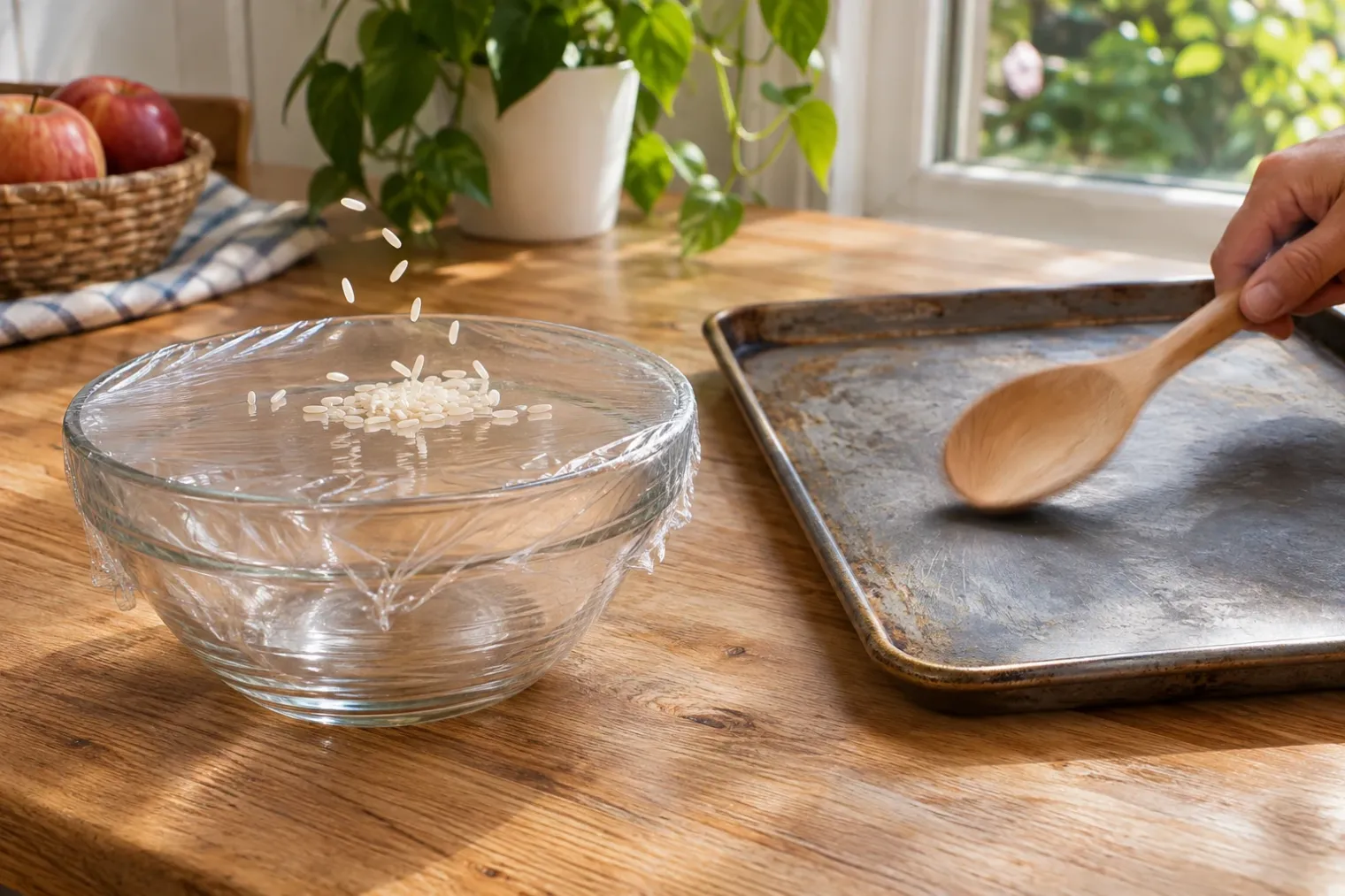
Dancing Rice Drum
Stretch plastic wrap tightly over a bowl, sprinkle some dry rice on top, and then bang a pot nearby or hum into a tube. The rice jumps and dances without anyone touching it. It’s the easiest way to actually see sound.
Quick how-to
- Stretch plastic wrap tight over a bowl and hold it with a rubber band.
- Sprinkle a pinch of uncooked rice or sugar on top.
- Hold a baking sheet close to the bowl and bang it with a spoon, or hum loudly through a paper towel tube pointed at the wrap.
Why it works: the loud sound sends vibrations through the air. When they hit the plastic wrap, it shakes, and the rice bounces. Your eardrum works the same way.
Bottle Organ
Blow across the tops of bottles filled with different amounts of water to make a foghorn sound. Then tap the same bottles with a spoon. Surprise: the notes go the opposite way!
Quick how-to
- Fill 4 or 5 glass bottles with different amounts of water.
- Rest your bottom lip on the edge of a bottle and blow straight across the top until it hums.
- Compare the notes from each bottle, then tap each one with a spoon and compare again.
Why it works: blowing makes the air inside vibrate. Less air space (more water) vibrates faster, so it’s higher. Tapping shakes the glass and water instead, and more water makes that slower and lower.
Straw Oboe
Flatten one end of a drinking straw, snip it into a point, and blow. With a little practice you’ll get a buzzy, kazoo-like note. Snip the straw shorter while you play and listen to the note climb.
Quick how-to
- Flatten one end of a plastic or paper straw by pressing it between your teeth or fingers.
- Cut the flat end into a V shape.
- Put the V end in your mouth, close your lips around it, and blow hard until it buzzes.
- A grown-up snips the far end shorter while you keep blowing.
Why it works: the two flaps of the V act like a reed, opening and closing very fast. A shorter straw holds a shorter column of air, which vibrates faster and sounds higher.
Clucking Chicken Cup
A paper cup, a piece of string and a damp paper towel turn into a noisemaker that sounds just like a chicken. Little kids think it’s hilarious, and it shows how a tiny vibration can get really loud.
Quick how-to
- Poke a small hole in the bottom of a paper cup.
- Thread a 12-inch piece of cotton string through and tie a paper clip on the inside end.
- Wet a small piece of paper towel, wrap it around the string near the cup, and pull down in short, jerky tugs.
Why it works: the towel grabs and slips on the string, making it vibrate. The string shakes the bottom of the cup, and the cup amplifies the sound, making it much louder.
Sound Through Water and Wood
Does sound travel best through air, water or wood? Press your ear to a table while a friend scratches the far end, then listen to two spoons clinking inside a zip-top bag of water. The results surprise most kids.
Quick how-to
- Have a friend lightly scratch one end of a long table. Listen with your head up, then with your ear pressed to the table.
- Fill a zip-top bag with water and seal it. Hold it to your ear while a friend clinks two spoons against the other side.
- Compare it to the same clink through the air. Rank air, water and wood from quietest to loudest.
Why it works: sound moves by bumping particles into each other. Particles are packed closer together in liquids and solids than in air, so sound travels faster and often clearer through them. That’s why whales can hear each other from very far away.
How does sound work?
Every sound starts with a vibration. When a guitar string, a drum or your vocal cords shake back and forth, they push on the air around them. Those pushes travel outward as sound waves, a bit like ripples spreading on a pond. When the waves reach your ear, they make your eardrum vibrate, and your brain turns that into the sounds you hear.
Fast vibrations make high-pitched sounds, like a whistle. Slow vibrations make low-pitched sounds, like a tuba. Big vibrations are loud, and small vibrations are quiet. Sound needs something to travel through, like air, water or wood. In space, where there’s no air, there’s no sound at all.
For grown-ups: the real science
Sound is a longitudinal mechanical wave: particles oscillate parallel to the direction the wave travels, creating alternating compressions and rarefactions. Pitch corresponds to frequency (measured in hertz), and loudness to amplitude (perceived on the logarithmic decibel scale). Healthy young ears hear roughly 20 to 20,000 Hz. Sound travels about 343 meters per second in room-temperature air, roughly 1,480 m/s in water and several thousand m/s in many solids, because stiffer media transmit vibrations faster. Instruments set a source vibrating (a string, reed, membrane or air column) and use a resonating body to amplify particular frequencies.
Keep exploring: Make a Lung Model · What Do Scientists Do? · Winter Science Experiments
Questions kids ask next
What is the easiest sound experiment for kids?
The dancing rice drum and the musical coat hanger both take about 5 minutes and use things you already have. The cup and string telephone is the classic, and it works for preschoolers too.
Can sound travel through space?
No. Sound needs particles to bump into each other, and space is almost empty. Astronauts talk to each other by radio, which uses waves that can travel through empty space.
Why do I sound different on a recording?
When you talk, you hear your voice through the air and through the bones in your head, which makes it sound deeper. A recording only catches the sound through the air.
What makes a sound high or low?
How fast something vibrates. Fast vibrations make high sounds, and slow vibrations make low sounds. Shorter, thinner and tighter things usually vibrate faster.