
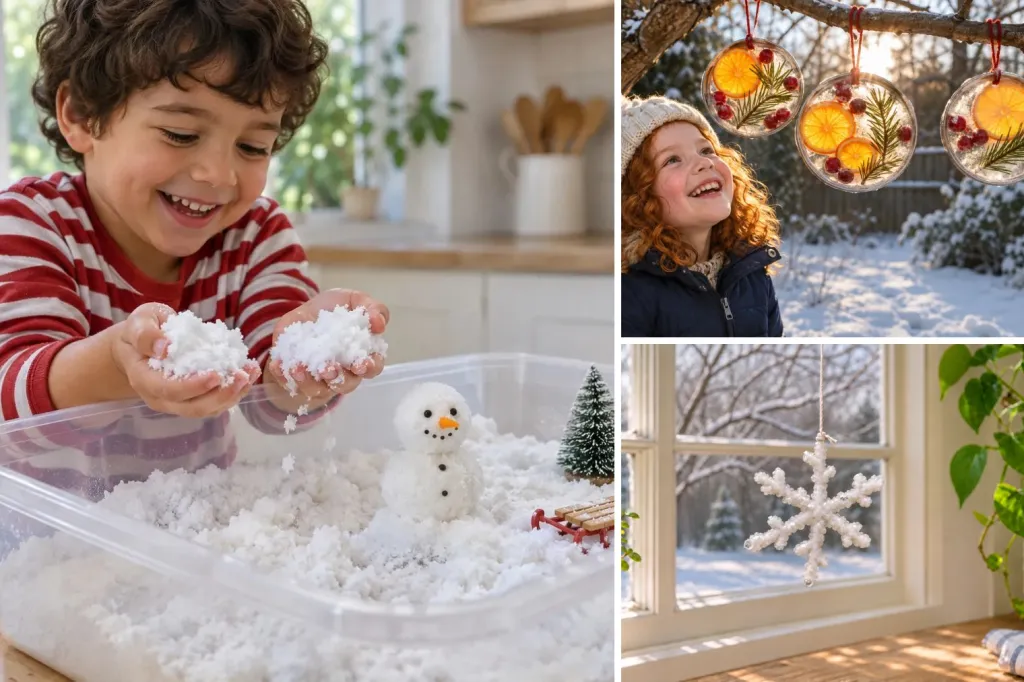
Cold days are perfect science days. Ice, snow, salt and frost are full of surprises, and most of these experiments use stuff already in your kitchen. Snowed in? Plenty of them work without a single snowflake. Getting ready for the holidays? Pair this list with our Christmas science experiments.
No ideas match all of those. Try turning off a filter.
Ice Cream in a Bag
Shake a little bag of milk, sugar and vanilla inside a big bag of salty ice, and about 10 minutes later you have real, spoonable ice cream. It’s the tastiest way to learn why salt makes ice colder, and kids will happily take turns shaking.
Quick how-to
- Seal 1/2 cup milk or half-and-half, 1 tablespoon sugar and a splash of vanilla in a small zip-top bag.
- Fill a gallon bag halfway with ice and add 1/3 cup salt.
- Tuck the small bag inside, seal it, wrap it in a towel and shake for 5 to 10 minutes.
- Rinse the small bag, open it and eat!
Why it works: salt makes the ice melt, and melting ice soaks up heat. The salty slush gets far colder than plain ice, cold enough to freeze the milk.
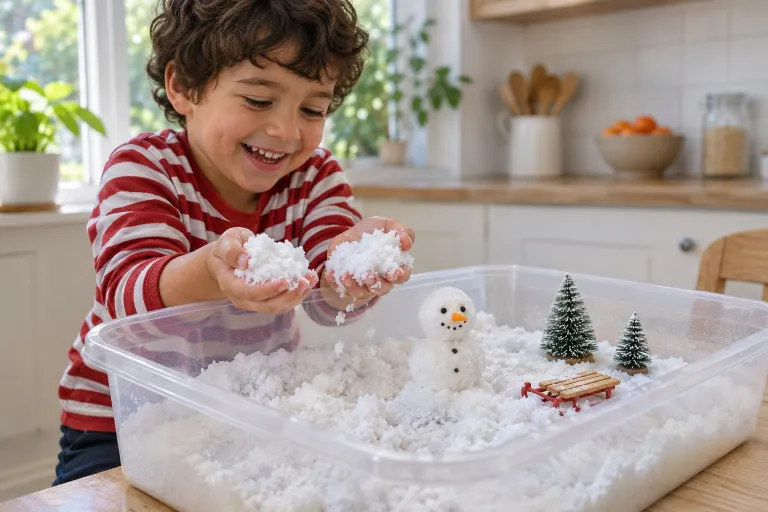
Two-Ingredient Fake Snow
Mix baking soda and hair conditioner into soft, packable snow that actually feels cool to the touch. Build tiny snowmen, sled toy figures through it or make snowballs, no snow boots required. It’s also the perfect base for the Snow Volcano below.
Quick how-to
- Pour 2 cups of baking soda into a bin.
- Mix in about 1/2 cup of white conditioner, a spoonful at a time.
- Squish it with your hands until it packs like snow. Too sticky? Add more baking soda.
Why it works: a little baking soda dissolves in the conditioner’s water, and that soaks up heat, so the snow feels cool. It’s not for eating.
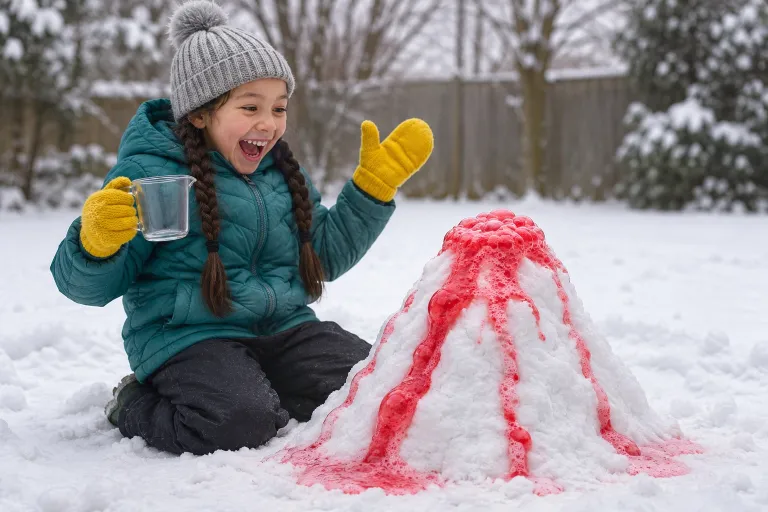
Snow Volcano
Pack snow into a mountain around a hidden cup of baking soda, pour in red “lava” and watch it foam down the white slopes. Do it outside on a snowy day or on a tray of fake snow. Have extra vinegar ready, because nobody stops at one eruption.
Quick how-to
- Stand a small cup in the snow and pack snow around it into a cone.
- Add 3 tablespoons of baking soda, a squirt of dish soap and red food coloring to the cup.
- Pour in 1/2 cup of vinegar and step back.
Why it works: vinegar and baking soda react and make carbon dioxide gas. The soap traps the gas in bubbles, which pile up into foamy lava.
Ice Fishing With Salt
Can you lift an ice cube with just a piece of string? It seems impossible until you add a pinch of salt. Wait one minute, pull gently, and up comes your ice “fish.” It’s the fastest setup on this list, and kids love showing it off.
Quick how-to
- Float an ice cube in a glass of water and lay a piece of string across it.
- Sprinkle a pinch of salt over the string and wait about 60 seconds.
- Gently lift the string. The ice comes up with it!
Why it works: salt melts a little dip under the string, then the cold ice refreezes the water around it and locks the string in place.
Frost in a Can
Fill a metal can with ice and salt, then watch real frost grow on the outside in about 10 minutes, pulled right out of the air. It’s the same frost that coats car windows on a cold morning, made on your kitchen counter.
Quick how-to
- Peel the label off a clean metal can and dry the outside.
- Fill it with layers of crushed ice and salt, about 3 tablespoons in all.
- Stir for 30 seconds, then wait 5 to 10 minutes without touching the can.
Why it works: the salty ice makes the can colder than freezing, so invisible water vapor in the air freezes right onto it as frost.
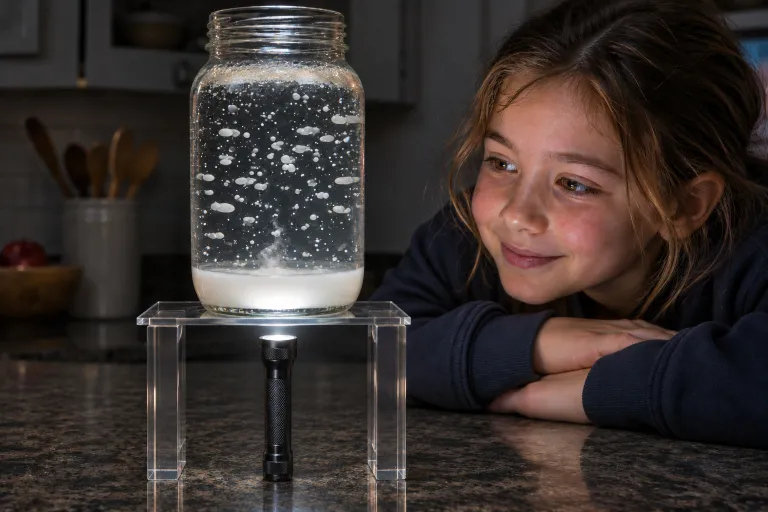
Snowstorm in a Jar
A fizzy tablet turns a jar of oil into a swirling blizzard of white “snow” blobs. Turn off the lights and shine a flashlight underneath, and it becomes the coziest science lamp of the winter.
Quick how-to
- Fill a clear jar three-quarters full with baby oil or vegetable oil.
- Stir white washable paint into 1/4 cup of water and pour it in.
- A grown-up drops in a piece of an Alka-Seltzer tablet. Watch it snow!
Why it works: the tablet makes gas bubbles in the water, which carry white blobs up through the oil. At the top they pop and the blobs fall like snow.
Blubber Glove
How do polar bears swim in freezing water? Make a “blubber glove” from shortening and two plastic bags, then dunk both hands into ice water. The bare hand gives up fast. The blubber hand barely feels the cold.
Quick how-to
- Spread about a cup of shortening inside a zip-top bag.
- Push a second bag, inside out, into the first and tape the edges together.
- Wear it on one hand and an empty double bag on the other, then dunk both in ice water.
Why it works: fat is an insulator, so heat has a hard time moving through it. Blubber keeps an animal’s body heat in, even in icy water.

Frozen Suncatchers
Freeze berries, orange slices and pine sprigs into ice ornaments, hang them outside, and check each day to see which melts first. They glow like stained glass in the winter sun. If it’s below freezing outside, let nature do the freezing.
Quick how-to
- Arrange berries, orange slices or pine in a pie tin or muffin cups.
- Add a loop of string, cover with water and freeze overnight.
- Hang one in the sun and one in the shade. Which melts first?
Why it works: water freezes at 32°F (0°C). Sunlight adds energy, so the suncatcher in the sun melts faster than the one in the shade.
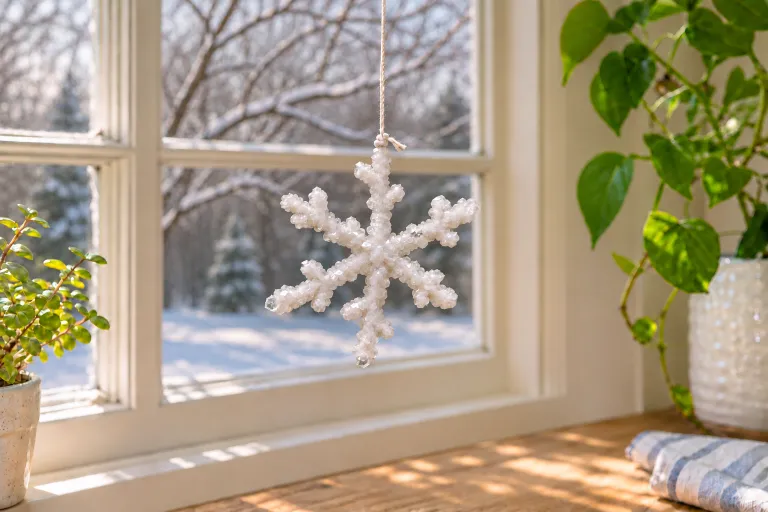
Crystal Snowflakes
Shape a snowflake from pipe cleaners, hang it in a borax solution, and wake up to a sparkly crystal snowflake that catches the light like real ice. Hang it in a window for a decoration that lasts all winter.
Why it works: hot water holds lots of dissolved borax. As it cools, the borax comes back out as crystals on the pipe cleaner. A grown-up mixes the solution, and it’s not for eating.
Catch and Study Snowflakes
On a snowy day, catch flakes on chilled black paper and look closely with a magnifying glass. Count the arms, spot plates, needles and stars, and see if the snowflakes change on colder days. It’s real science, and you need almost nothing.
Quick how-to
- Chill a piece of black paper or dark felt in the freezer for 15 minutes.
- Hold it out in falling snow for a few seconds.
- Study the flakes with a magnifying glass before they melt. How many arms do you see?
Why it works: water molecules lock together in a six-sided pattern when they freeze, so almost every snowflake has six arms.
Frozen Bubbles
On a very cold, still day, blow a bubble outside and watch ice crystals swirl across it until it freezes into a fragile glass ball. Save this one for the coldest morning of the year: it works best around 15°F (−9°C) or colder.
Quick how-to
- Mix 1 cup warm water, 2 tablespoons dish soap and 1 tablespoon corn syrup or sugar. Let it cool outside for a few minutes.
- Blow a bubble gently with a wand or straw and let it land on snow, a mitten or a cold plate.
- Watch closely as ice crystals spread across it.
Why it works: a bubble’s skin is a super-thin layer of water. In very cold air it freezes in seconds, and the sugar helps it last long enough to watch.
Build a Bear Den
Which den keeps a “bear” warmest? Fill two jars with warm water, tuck one into a box of leaves or shredded paper, leave the other out in the cold, and check them after half an hour. It’s a fun way to learn how animals survive the winter.
Quick how-to
- Fill two jars with the same warm tap water and close the lids.
- Pack one into a box stuffed with leaves, paper or a towel. Leave the other uncovered.
- Put both somewhere cold for 30 to 40 minutes. Which bear stayed warmer?
Why it works: leaves, paper and fur trap air, and trapped air slows heat from escaping. That’s how dens keep hibernating bears cozy.
Ice Excavation
Freeze small toys inside a block of ice, then hand kids salt, droppers of warm water and spoons to rescue them. Little scientists test which tool melts ice fastest, and it can keep a group busy for half an hour or more.
Quick how-to
- Drop small plastic toys into a container of water and freeze overnight.
- Pop out the ice block onto a tray and set out salt, warm water in droppers or squeeze bottles, and spoons.
- Rescue the toys! Which tool works best?
Why it works: warm water adds heat to melt the ice, and salt makes ice melt even below freezing. Together they carve tunnels fast.
No snow? No problem.
Fake Snow, Frost in a Can and Ice Cream in a Bag all work indoors with kitchen supplies, so they’re perfect for a snow day stuck inside or a winter with no snow at all.
Questions parents ask
Which winter experiments need real snow?
Only Catch and Study Snowflakes needs falling snow, and Frozen Bubbles needs a very cold day. The Snow Volcano works with real snow or a batch of fake snow. Everything else works indoors any time.
Which are best for toddlers and preschoolers?
Fake Snow, Snow Volcano, Frozen Suncatchers and Ice Excavation are all great for ages 3 to 5. Little kids love squishing, fizzing and melting, and the steps are simple with a grown-up nearby.
Can we do these in a classroom?
Yes. Ice Fishing, Frost in a Can and the Blubber Glove make great stations because they’re quick and low-mess. Ice Cream in a Bag is a class favorite too; just have kids work in pairs and bring extra towels.
What supplies should I grab first?
Ice, salt, baking soda, vinegar, zip-top bags and food coloring cover more than half of this list. Most of it is probably already in your kitchen.