Have you ever wondered why the sky is blue, how ants find their way home, or what’s inside a volcano? Then you already think like a scientist. Scientists are professional question-askers. The difference is that they don’t stop at wondering. They go out and find the answers.
Scientists ask questions and test ideas
A scientist is anyone who studies the world carefully to learn how it works. Some scientists look at tiny things like germs and atoms. Others study giant things like oceans, planets and whole galaxies. But they all do the same basic job: they ask a question, come up with a possible answer, and then test it to see if it’s right.
That possible answer is called a hypothesis. Scientists don’t just believe their hypothesis. They try to prove it wrong. If it survives lots of tests, other scientists start to trust it.
Explain it like I’m 5
Scientists are like detectives for nature. They notice something interesting, make a guess about why it happens, and then look for clues to see if their guess was right.
What does a scientist do all day?
It depends on the kind of scientist, but most of them spend their time doing a mix of these jobs:
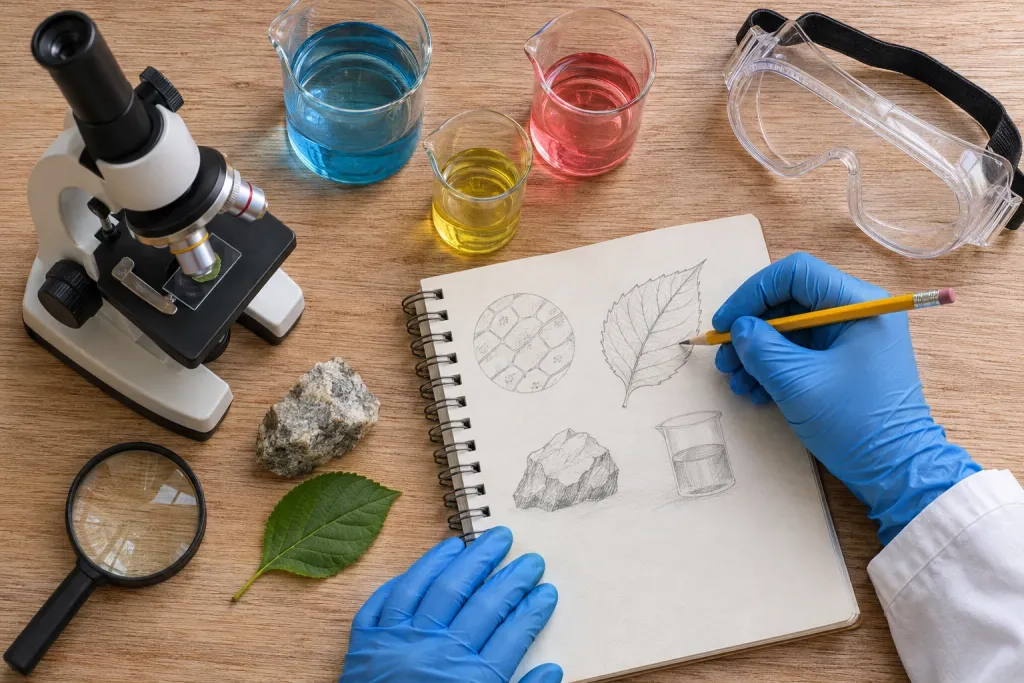
- Observing. Watching closely and noticing details, whether through a microscope, a telescope or just their own eyes.
- Experimenting. Setting up fair tests where they change one thing at a time to see what happens.
- Measuring and recording. Writing down numbers, taking photos and keeping careful notes so nothing gets forgotten.
- Working in the field. Lots of scientists work outside: in rainforests, on boats, in deserts, at volcanoes or even in Antarctica.
- Using computers. Many scientists write code, build computer models and study huge piles of data.
- Working as a team. Science is rarely done alone. Scientists work with other scientists, sometimes from all over the world.
- Sharing what they learn. Scientists write reports, give talks and publish papers so others can check their work and build on it.
20 types of scientists
There are hundreds of kinds of scientists. Here are 20 of the most interesting, grouped by what they study.
Living things
- Biologist: studies all living things.
- Zoologist: studies animals and how they live.
- Botanist: studies plants, from tiny mosses to giant trees.
- Marine biologist: studies life in the ocean, like whales, coral and octopuses.
- Entomologist: studies insects.
- Microbiologist: studies germs and other living things too small to see.
- Geneticist: studies DNA and how living things pass traits to their babies.
Earth and space
- Geologist: studies rocks, mountains and earthquakes.
- Volcanologist: studies volcanoes.
- Meteorologist: studies weather and makes forecasts.
- Oceanographer: studies the ocean’s water, waves and currents.
- Astronomer: studies stars, planets and galaxies.
- Paleontologist: studies fossils to learn about dinosaurs and ancient life.
Matter, energy and machines
- Chemist: studies what things are made of and how they react and change.
- Physicist: studies energy, forces, light and motion.
- Engineer: uses science to design and build things, like bridges, robots and rockets. (Engineers aren’t always called scientists, but they use science every day.)
- Computer scientist: studies computers and how to make them solve problems.
People and the past
- Archaeologist: digs up objects people left behind long ago to learn how they lived.
- Medical scientist: studies diseases and finds new medicines and vaccines.
- Psychologist: studies how people think, feel and learn.
Where do scientists work?
Almost anywhere. Scientists work in labs, hospitals, universities, museums, zoos, farms, factories and government agencies like NASA. Some work on ships or at research stations near the South Pole. Astronauts on the International Space Station run science experiments while orbiting Earth.
How do you become a scientist?
Most professional scientists go to college and study science, and many keep studying for years after that. But the skills that matter most start right now: being curious, asking good questions, noticing details, keeping notes and not giving up when an experiment doesn’t work the first time. Mistakes are part of science. Lots of big discoveries happened because an experiment went “wrong.”
Try it: be a scientist today
Run a real experiment with the same steps scientists use. Your question: which brand of paper towel soaks up the most water?
- Hypothesis: pick the paper towel you think will win and write down why.
- Make it fair: cut one same-sized square from each kind of paper towel.
- Test: pour the same amount of water, like a quarter cup, into a bowl for each towel. Dip a square in, count to 10, and lift it out.
- Measure: pour the leftover water into a measuring cup. Less water left means the towel soaked up more.
- Record and share: write your results in a table and tell someone what you found. Was your hypothesis right?
Next question: does a wet towel or a folded towel soak up more? Every answer leads to a new question. That’s science!
Keep exploring: Who Was Isaac Newton? · Strawberry DNA Extraction · Spaghetti Bridge Challenge
Words to know
- Scientist
- A person who studies the world carefully to learn how it works.
- Hypothesis
- A possible answer to a question that you can test.
- Experiment
- A test to find out if a hypothesis is right.
- Observation
- Something you notice using your senses or tools.
- Data
- The facts and measurements collected during an experiment.
- Fair test
- An experiment where you change only one thing at a time.
For grown-ups: the real science
The tidy “scientific method” taught in school is a simplification. Real research loops back on itself, and it can start from an observation, a surprising result, a new tool or a pattern in data rather than a formal hypothesis. What makes it science is that claims must be testable, results must be reproducible, and work goes through peer review, where other experts examine methods and conclusions before publication.
The broad fields are often split into the life sciences, physical sciences and earth and space sciences, with social sciences, formal sciences like mathematics and computer science, and applied fields like engineering and medicine alongside them. Many of today’s biggest questions are interdisciplinary, so it’s common for a biologist to write code or a chemist to work with climate scientists. Kids build scientific thinking best through open-ended investigation: let them predict, test, and be wrong.
Questions kids ask next
Do scientists wear lab coats?
Some do, especially chemists and medical scientists, because lab coats protect their clothes and skin. But a geologist on a mountain or a marine biologist on a boat wears outdoor gear instead.
Can kids be scientists?
Yes. Anyone who asks questions and tests ideas carefully is doing science. Kids have discovered fossils, spotted comets and helped with real research through citizen science projects like bird counts.
What tools do scientists use?
Microscopes, telescopes, thermometers, scales, rulers, beakers, computers and notebooks are some of the most common. Big projects use giant tools like satellites, research ships and particle colliders.
What happens if an experiment fails?
Scientists learn from it. A result that proves a hypothesis wrong is still useful information. They change something and try again.
Who was the first scientist?
Nobody knows for sure. People have studied nature for thousands of years. Thinkers like Aristotle in ancient Greece and Ibn al-Haytham, who tested ideas about light with experiments around 1,000 years ago, are often called some of the first scientists.