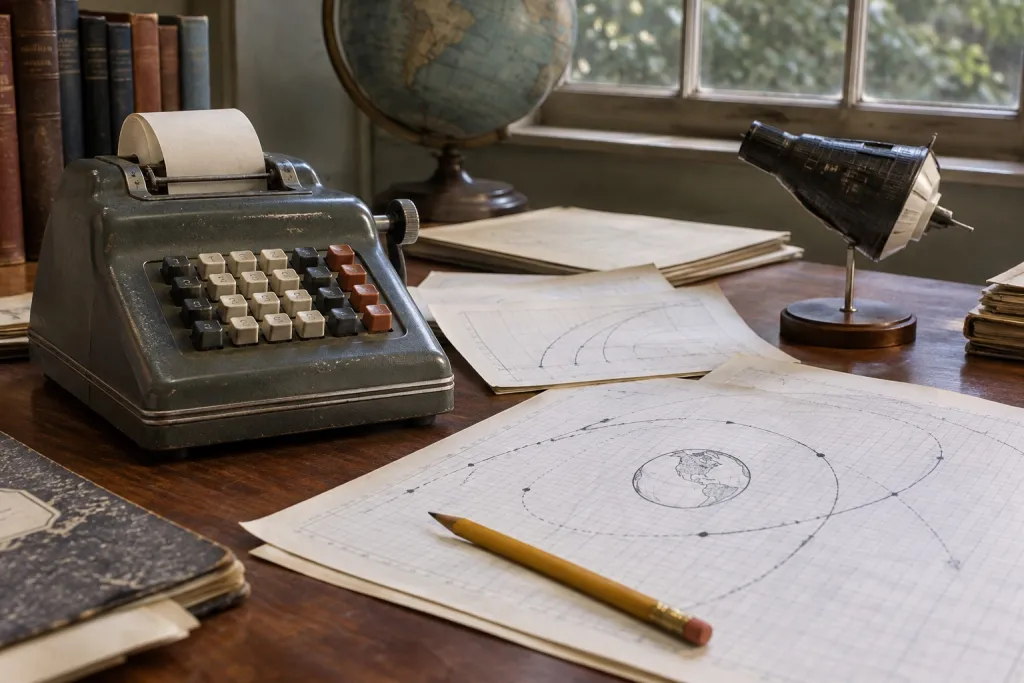
When astronaut John Glenn was getting ready to become the first American to orbit Earth in 1962, NASA had a brand-new electronic computer to work out his flight. But Glenn didn’t fully trust the machine. He asked for one person to double-check the numbers by hand: Katherine Johnson. “If she says they’re good,” he said, “then I’m ready to go.”
A girl who loved to count
Katherine Coleman was born on August 26, 1918, in White Sulphur Springs, West Virginia. She loved numbers from the start and counted everything: steps, dishes, stars in the sky. She was so quick at school that she skipped ahead several grades and started high school at just 10 years old.
At that time, schools in her area were segregated, and the local schools for Black students stopped after eighth grade. Her family moved during the school year so she and her siblings could keep learning. She graduated from West Virginia State College at 18 with degrees in mathematics and French, and later was one of the first Black students to attend graduate school at West Virginia University.
A “computer” who wore skirts
In 1953, Katherine got a job at NACA, the agency that later became NASA, at Langley in Virginia. Back then, a “computer” was a person who did complicated math by hand. She joined a group of Black women mathematicians called the West Area Computing unit, who had to work, eat and use restrooms separately from their white coworkers because of segregation.
Katherine didn’t just do the math she was handed. She asked questions, like why she couldn’t attend the important meetings with the engineers. Eventually, she did. Her skill and curiosity got her moved to the Flight Research Division, where she helped figure out how to send people into space.
Her math went to space
- 1961: she calculated the trajectory, the exact path, for Alan Shepard, the first American in space.
- 1962: she checked the computer’s numbers for John Glenn’s flight around Earth.
- 1969: she helped calculate paths for Apollo 11, the first mission to land people on the Moon, including how the lander would meet back up with the spacecraft orbiting the Moon.
- 1970: her backup plans and charts helped the crew of Apollo 13 get home safely after an explosion damaged their spacecraft.
Explain it like I’m 5
Katherine Johnson was amazing at math. She figured out exactly where rockets should go so astronauts could fly around Earth, go to the Moon and get home safely. Astronauts trusted her math so much they asked her to check it!
Honors and a famous movie
Katherine worked at NASA for 33 years. In 2015, President Barack Obama awarded her the Presidential Medal of Freedom, one of the highest honors in the United States. The 2016 book and movie Hidden Figures told the story of her and her coworkers Dorothy Vaughan and Mary Jackson. NASA named a research building after her, and she lived to be 101, passing away in 2020.
Her advice to kids? Stay curious, and ask questions. She said she always wanted to know “why” and “how” things worked.
Try it: be a human computer
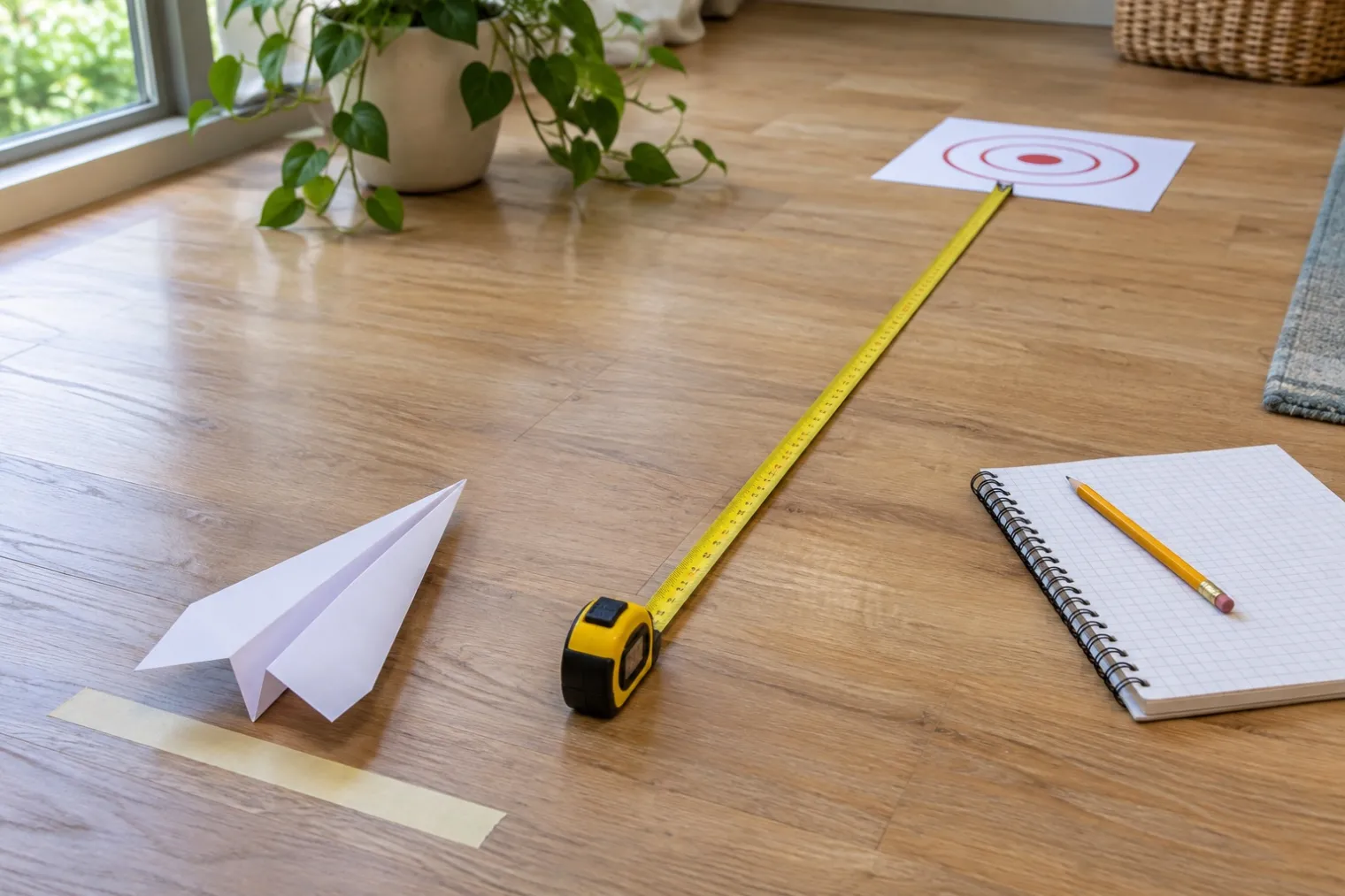
You need: a paper airplane, a tape measure, a piece of paper for a “landing target,” a pencil and a notebook.
- Mark a launch line. Throw your plane 5 times the same way, and measure how far it flies each time. Write each distance down.
- Find the average: add up all 5 distances and divide by 5.
- Use your average to place the landing target where you predict the plane will land.
- Launch 3 more times. How close did you get? Adjust your math and try again.
What’s happening: you used measurements and math to predict where a flying object would land, the same basic idea Katherine Johnson used to predict where a space capsule would splash down. Her math was far more complicated, but it started the same way: careful measuring, careful checking.
Keep exploring: Who Was Isaac Newton? · What Is Gravity? · Who Invented the Light Bulb?
Words to know
- Mathematician
- A person who studies and uses math to solve problems.
- Trajectory
- The path a moving object, like a rocket, travels.
- Orbit
- A curved path around a planet, moon or star.
- NASA
- The U.S. space agency that sends astronauts and spacecraft into space.
- Segregation
- Unfairly keeping people apart because of their race.
For grown-ups: the real science
Katherine Johnson (1918–2020) joined the National Advisory Committee for Aeronautics at Langley Memorial Aeronautical Laboratory in 1953, initially in the segregated West Area Computing section led by Dorothy Vaughan, before being reassigned to the Flight Research Division. In 1960 she co-authored, with engineer Ted Skopinski, a report on determining azimuth angle at burnout for placing a satellite over a selected Earth position, one of the first times a woman in the division received author credit. She computed the trajectory for Alan Shepard’s 1961 Freedom 7 flight and launch windows for Mercury missions.
For John Glenn’s Friendship 7 orbital flight (1962), Glenn requested that she verify the IBM 7090’s orbital equations by hand. She later worked on Apollo 11’s lunar rendezvous trajectories, backup procedures used during Apollo 13, the Space Shuttle and Earth Resources Satellite programs, retiring in 1986. She received the Presidential Medal of Freedom in 2015, and NASA dedicated the Katherine G. Johnson Computational Research Facility in 2017. Her story was popularized by Margot Lee Shetterly’s 2016 book Hidden Figures and the film adaptation.
Questions kids ask next
Did Katherine Johnson go to space?
No. She worked on Earth, figuring out the math that kept astronauts safe in space.
What tools did she use?
Mostly pencils, paper, slide rules and mechanical calculating machines. Later, she also worked with and checked electronic computers.
Who were the other “Hidden Figures”?
Dorothy Vaughan, who led the West Area Computing unit and became an expert computer programmer, and Mary Jackson, who became NASA’s first Black female engineer.
How old was she when she finished college?
Just 18! She graduated with top honors in 1937.