Leonardo da Vinci is famous for painting the Mona Lisa. But if you peeked inside his notebooks, you’d find something surprising: page after page of machines. Flying machines, diving gear, giant weapons, gears and pulleys, and even a mechanical knight. More than 500 years ago, Leonardo was dreaming up ideas that wouldn’t become real for centuries.
Who was Leonardo da Vinci?
Leonardo was born in 1452 near the small town of Vinci, in Italy. (“Da Vinci” just means “from Vinci.”) He trained as an artist, but he was curious about everything: birds, water, the human body, plants, light and machines. He carried notebooks everywhere and filled them with drawings and notes. More than 7,000 pages survive today. He often wrote backward, from right to left, so you need a mirror to read it easily.
Leonardo’s most amazing inventions
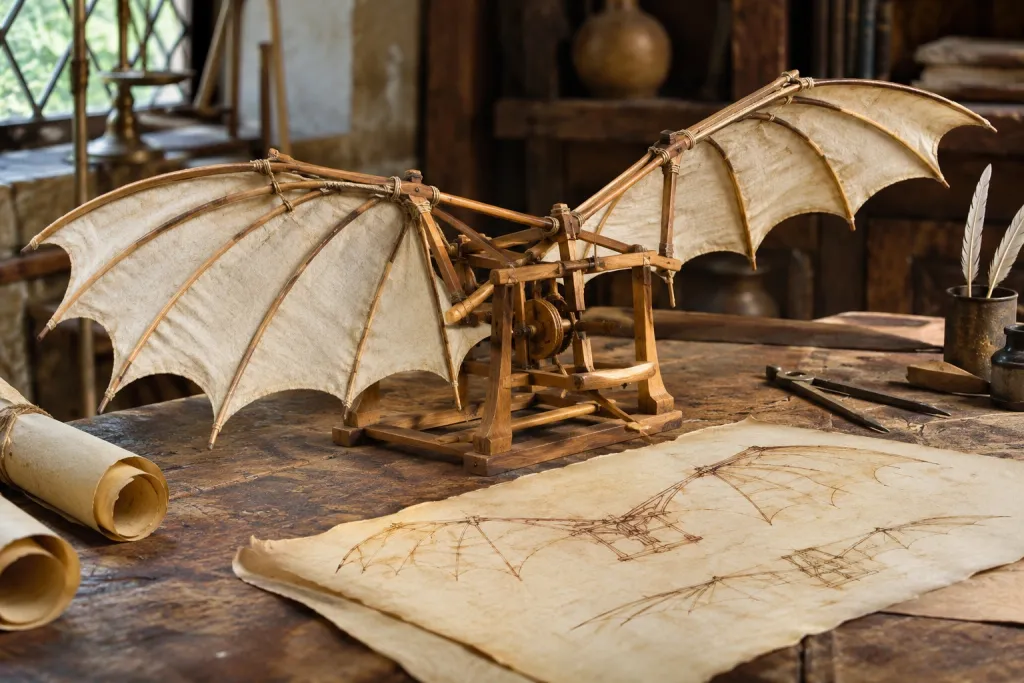
- Flying machines. Leonardo studied birds and bats for years and designed machines with flapping wings, called ornithopters, that a person would power with arms and legs. Humans aren’t strong enough to fly that way, but his studies of how wings work were remarkable.
- The aerial screw. A spiral sail meant to twist up into the air, a little like a helicopter’s spinning blades. It couldn’t have flown, but the idea of lifting by spinning was way ahead of its time.
- A parachute. He sketched a pyramid-shaped parachute made of linen over a wooden frame. In 2000, a skydiver built one from his design and floated safely down from 10,000 feet.
- A diving suit. A leather suit with breathing tubes connected to a float at the surface, so divers could stay underwater.
- A robot knight. Around 1495, he designed a suit of armor that could sit up, move its arms and turn its head using gears, pulleys and cables. Modern engineers built a working model from his notes.
- A self-driving cart. A spring-powered cart that could roll along a set path on its own, sometimes called the first robot car.
- An armored vehicle. A round, cone-topped vehicle meant to roll into battle, an early idea of a tank.
Explain it like I’m 5
A long, long time ago, a man named Leonardo loved to draw and wonder. He watched birds and drew machines to help people fly, swim underwater and even a robot! Most of his ideas stayed in his notebooks, but they were super clever.
Why weren’t most of them built?
In Leonardo’s time, there were no engines, no electricity and no lightweight metals like aluminum. Many of his machines needed power or materials that didn’t exist yet. Also, his notebooks were scattered after he died in 1519, and many weren’t studied for hundreds of years. By then, other inventors had come up with similar ideas on their own.
Leonardo the scientist
Leonardo’s real superpower was observation. He studied how water swirls, how birds use the wind, how muscles and bones work and how light makes shadows. His drawings of the human body and heart were so accurate that doctors still admire them. He showed that art and science go together: drawing carefully helps you understand how things work.
Try it: build a Leonardo-style paper spinner
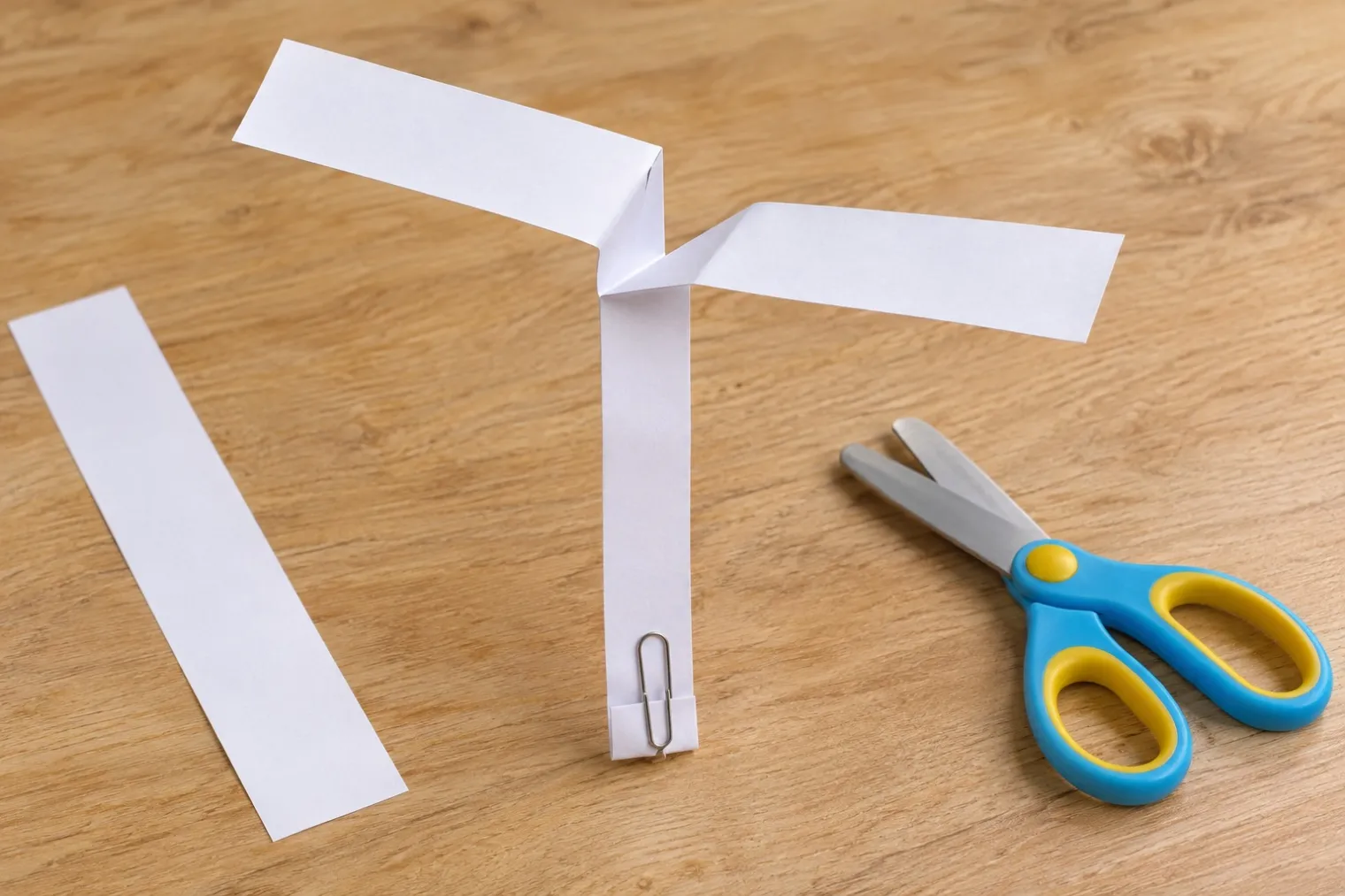
You need: a strip of paper about 2 inches wide and 8 inches long, scissors and a paper clip.
- Cut a slit down the middle of the strip from the top, about halfway down. These are your two blades.
- Fold one blade forward and the other backward, so they make a T shape.
- Fold up the bottom end a couple of times and add a paper clip for weight.
- Hold it up high and let go. Watch it spin! Try longer or shorter blades and see what changes. Draw your results like Leonardo would.
What’s happening: as the spinner falls, air pushes up on the angled blades and makes them twist, so it spins and slows its fall. It’s the same idea Leonardo explored with his aerial screw and that helicopters use today. Testing, changing one thing and recording results is how inventors work.
Keep exploring: Who Invented the Light Bulb? · Who Was Isaac Newton? · How Does the Heart Work?
Words to know
- Inventor
- A person who creates new machines or ideas.
- Renaissance
- A time in Europe, about 600 to 400 years ago, of big new ideas in art and science.
- Ornithopter
- A flying machine with wings that flap like a bird’s.
- Mirror writing
- Writing backward so it reads normally in a mirror.
- Observation
- Watching something carefully to learn about it.
For grown-ups: the real science
Leonardo da Vinci (1452–1519) left an estimated 7,000+ surviving manuscript pages, now dispersed across collections such as the Codex Atlanticus (Milan), the Codex Leicester (owned by Bill Gates) and the Royal Collection at Windsor. His left-handed mirror script may simply reflect left-handed writing comfort rather than secrecy. His “Codex on the Flight of Birds” (c. 1505) contains careful analyses of wing motion and air resistance.
Skydiver Adrian Nicholas tested a parachute built to Leonardo’s design over South Africa in 2000. Roboticist Mark Rosheim reconstructed Leonardo’s mechanical knight (c. 1495) and self-propelled cart from notebook fragments. Historians caution that many “inventions” were concept sketches, some borrowed from earlier engineers such as Mariano di Jacopo (Taccola), and that their influence was limited because the notebooks went unpublished for centuries. His anatomical studies, including accurate depictions of heart valves, are considered his most significant scientific contribution.
Questions kids ask next
Did Leonardo invent the helicopter?
Not really. His aerial screw couldn’t fly, and real helicopters came over 400 years later. But he’s famous for exploring the idea of lifting off by spinning.
Why did he write backward?
Nobody knows for sure. He was left-handed, and writing right to left may have kept him from smudging the ink. Some people think he wanted to keep his ideas private.
How many paintings did he make?
Surprisingly few. Only about 15 to 20 paintings are agreed to be his, partly because he spent so much time on science and inventions.
Can I see his notebooks?
Many pages have been scanned and put online by museums and libraries, so you can explore his drawings from home.