Ask almost anyone who invented the light bulb and they’ll say Thomas Edison. He’s a big part of the story, but not the whole thing. The light bulb was built step by step by many inventors in different countries, each one fixing a problem the last one couldn’t solve.
How a light bulb works
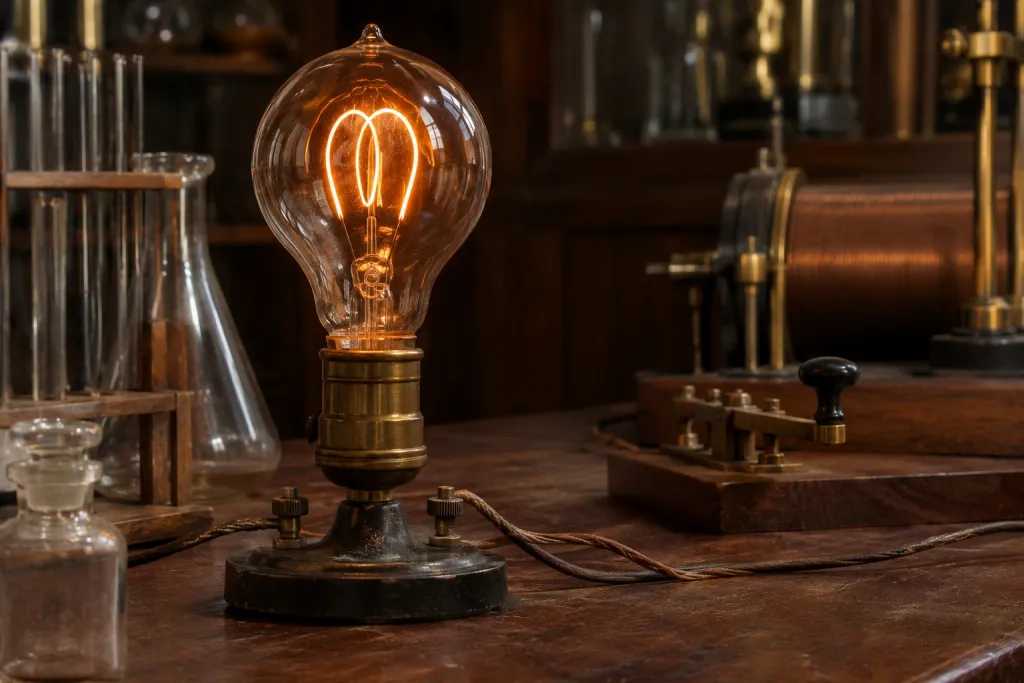
An old-style bulb, called an incandescent bulb, has a very thin wire inside called a filament. When electricity flows through it, the filament gets so hot, around 4,000°F (2,200°C), that it glows white. The hard part was finding a filament that could glow for hours without burning up or melting. The trick was to remove the air from the glass bulb, because without oxygen, the filament can’t burn.
The light bulb team
- Early 1800s, Humphry Davy (England): showed that electricity could make a dazzling spark of light jump between two pieces of carbon. Way too bright and power-hungry for a home, but it proved electric light was possible.
- 1840s–1870s, many inventors: tried filaments of platinum, carbon and more, sealed in glass. They worked for a short time, but were too expensive or burned out quickly.
- 1878–1880, Joseph Swan (England): showed off a carbon-filament bulb and later lit up the first house and public building with electric bulbs.
- 1879, Thomas Edison (USA): his team tested thousands of materials. In October 1879, a bulb with a carbonized cotton thread glowed for about 13 hours. Soon, carbonized bamboo filaments lasted over 1,000 hours. Edison also built the power plants, wires and meters to bring electricity into homes.
- 1882, Lewis Latimer (USA): a Black inventor and draftsman, patented a better way to make carbon filaments that made bulbs last longer and cost less. He also helped install electric lights in cities like New York and London.
Edison and Swan both claimed the invention, so they teamed up and formed one company in Britain, called Ediswan. Later, around 1910, filaments made of the metal tungsten made bulbs brighter and longer-lasting still.
Explain it like I’m 5
Making a light bulb was like a giant puzzle. Lots of people each figured out a piece. Thomas Edison and Joseph Swan put the big pieces together, and other inventors like Lewis Latimer made it even better.
“I have not failed”
Edison’s team tested thousands of filament materials, including fishing line, cork, paper, coconut hair and even beard hair, before finding ones that worked. Edison is often quoted as saying he hadn’t failed, he’d just found many ways that wouldn’t work. Whether he said those exact words or not, it’s a perfect description of how inventing really works: test, learn, try again.
Today’s light bulbs
Most homes now use LED bulbs. LEDs don’t use a hot filament at all. They make light when electricity flows through special materials, so they use far less energy and can last over 10 years. Three scientists won the Nobel Prize in 2014 for inventing the blue LED, which made bright white LED lights possible.
Try it: light a bulb with a battery and foil
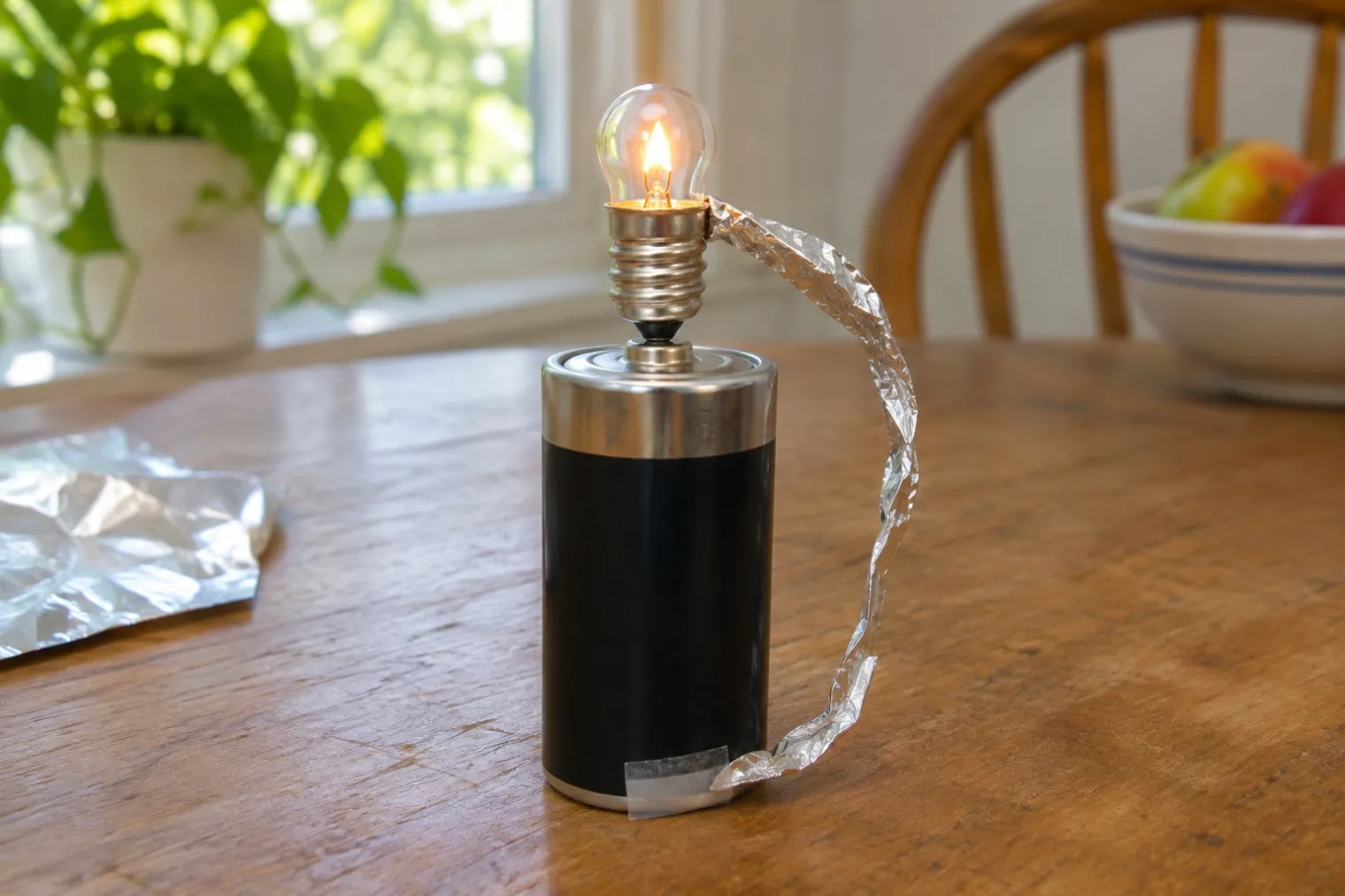
You need: a D or AA battery, a small flashlight bulb (or the bulb from an old flashlight), aluminum foil and tape.
- Tear off a strip of foil about a foot long and fold it lengthwise a few times to make a thin, flat “wire.”
- Tape one end of the foil to the flat bottom (−) of the battery.
- Wrap the other end of the foil around the metal side of the bulb’s base.
- Touch the bulb’s bottom tip to the bump (+) on top of the battery. Does it light? If not, check that the foil touches metal in both places.
What’s happening: you made a complete circuit, a loop electricity can flow through. Electricity travels from the battery, through the foil, through the tiny filament inside the bulb and back. The filament heats up and glows, just like Edison’s. Don’t leave it connected long, since the foil and battery can get warm.
Keep exploring: How Does a Battery Work? · Leonardo da Vinci’s Inventions · Who Was Katherine Johnson?
Words to know
- Filament
- The thin wire inside an old-style bulb that glows when it gets hot.
- Incandescent
- Giving off light because something is very hot.
- Circuit
- A complete loop that electricity can flow around.
- Patent
- An official document saying an invention belongs to the person who made it.
- LED
- Light-emitting diode, a modern light that uses very little energy.
- Inventor
- A person who creates something new.
For grown-ups: the real science
Humphry Davy demonstrated the carbon arc lamp to the Royal Institution in the early 1800s (a large public demonstration around 1808–1810). Warren de la Rue built a platinum-coil vacuum bulb in 1840, and dozens of inventors pursued incandescent designs over the next four decades. Joseph Swan demonstrated a carbon-filament lamp in Newcastle in 1878–79 and patented an improved version in 1880; his home, Cragside, and the Savoy Theatre were early adopters. Edison’s Menlo Park team achieved a long-lasting high-resistance carbon filament in October 1879, patented in January 1880, and, crucially, developed a complete distribution system (Pearl Street Station opened in 1882).
Lewis Latimer patented an improved process for manufacturing carbon filaments in 1882 and wrote one of the first books on incandescent lighting (1890); he later served on the Edison Pioneers. Edison and Swan formed the Edison and Swan United Electric Light Company in 1883. William Coolidge’s ductile tungsten (1910) became standard. Isamu Akasaki, Hiroshi Amano and Shuji Nakamura received the 2014 Nobel Prize in Physics for efficient blue LEDs.
Questions kids ask next
Did Edison steal the light bulb?
Not exactly. He built on other people’s ideas, like most inventors do, and Swan was working on the same thing at the same time. Edison’s big achievements were a practical, long-lasting bulb and the electric system to power it.
What did people use before light bulbs?
Candles, oil lamps and gas lights. They were smoky, dim and could easily start fires.
Why do old light bulbs get hot?
Most of the electricity in an incandescent bulb turns into heat, not light. That’s why LEDs, which stay cool, save so much energy.
Is there a light bulb that’s been on for over 100 years?
Yes! The Centennial Light in a fire station in Livermore, California, has been glowing almost nonstop since 1901.