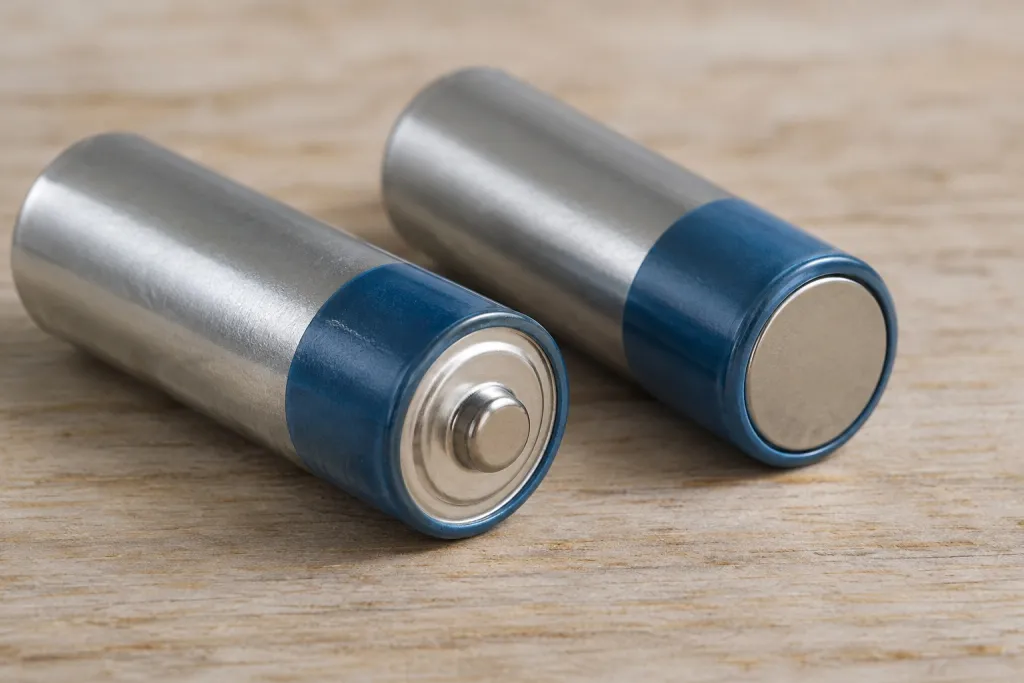
Batteries power remote controls, toys, flashlights, phones and even cars. Pop one in and things light up, beep and move. But a battery has no moving parts and nothing you can see happening. So where does the electricity come from? It’s made by chemistry.
What’s inside a battery
Every battery has three main parts:
- The negative end (−): made of a material that likes to give away tiny particles called electrons. In a regular AA battery, that’s zinc.
- The positive end (+): made of a material that likes to grab electrons. In an AA battery, it’s a mix with manganese dioxide.
- The electrolyte: a paste or liquid in between that keeps the two ends apart but lets charged particles called ions move through it.
How the electricity flows
The negative end is packed with extra electrons that “want” to get to the positive end. But the electrolyte blocks them from taking a shortcut through the middle of the battery. The only way across is the long way: out through a wire, through your flashlight bulb or toy motor, and back into the positive end. That path is called a circuit.
When you flip the switch on, you complete the circuit. A chemical reaction begins, electrons stream through the wire and that moving stream is electric current. As the electrons pass through the device, their energy lights the bulb or spins the motor. Inside the battery, ions move through the electrolyte to keep everything balanced.
Explain it like I’m 5
One end of a battery has tiny particles that really want to get to the other end. The only road they can take goes through your toy. As they rush through, they make the toy work!
Why batteries run out (and how recharging works)
A battery runs out when its chemicals are used up and the reaction can’t push electrons anymore. In a regular battery, that reaction only goes one way, so it’s done for good (please recycle it!).
In a rechargeable battery, like the lithium-ion battery in a phone or tablet, the reaction can run backward. Plugging in the charger pushes electricity back into the battery, which resets the chemicals so they’re ready to go again.
The first true battery was invented in 1800 by Italian scientist Alessandro Volta. He stacked discs of zinc and copper with cardboard soaked in salt water between them. The unit of electrical push, the volt, is named after him.
Try it: build a lemon battery
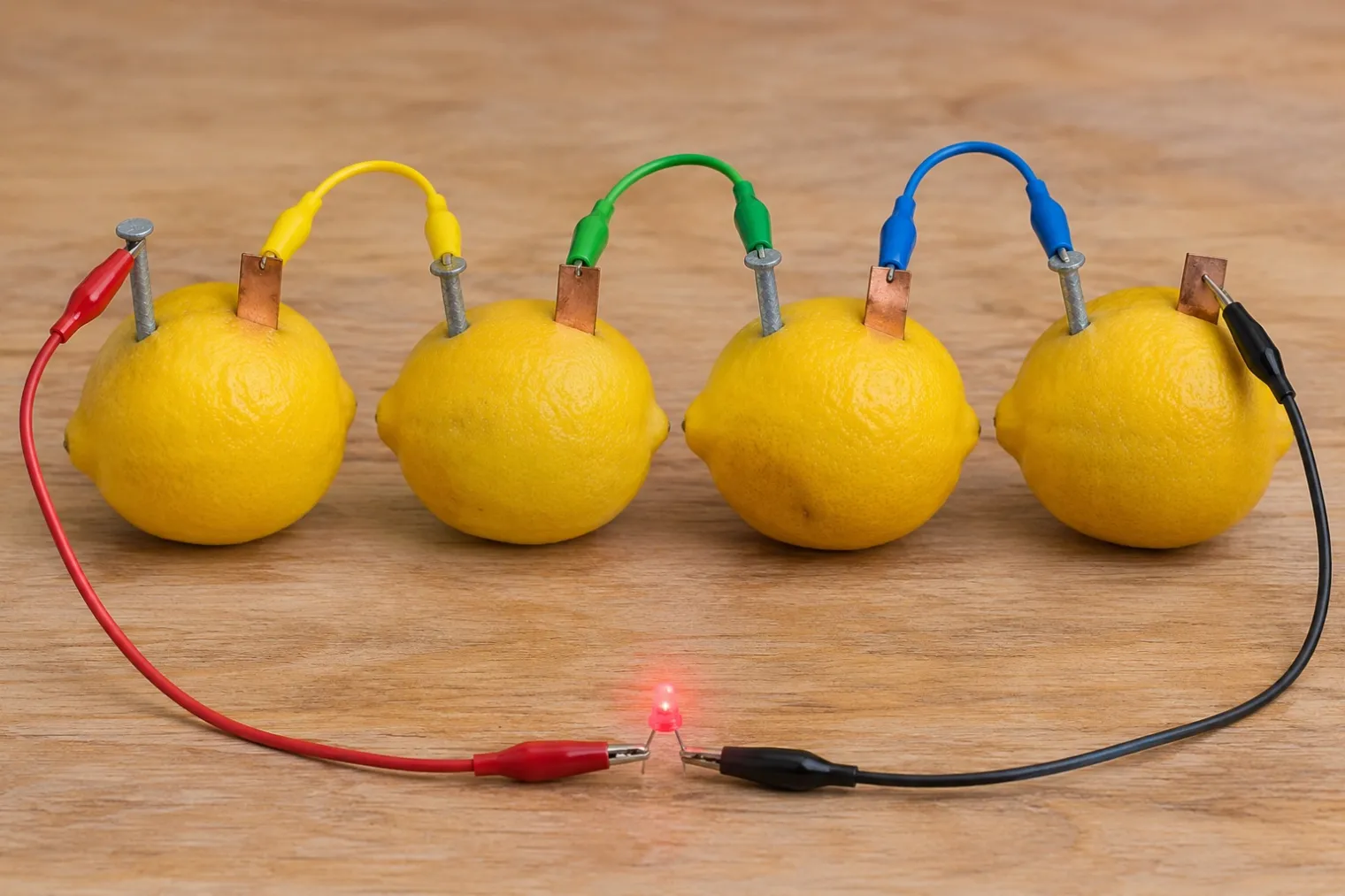
You need: 4 lemons, 4 galvanized (zinc-coated) nails, 4 pieces of copper (copper wire, or pennies made before 1982), 5 alligator-clip wires and a small red LED.
- Roll each lemon on the table to get the juice flowing. Push one nail and one piece of copper into each lemon, about an inch apart. Don’t let them touch.
- Line up the lemons. Clip a wire from the copper in lemon 1 to the nail in lemon 2. Then copper in lemon 2 to the nail in lemon 3, and copper in lemon 3 to the nail in lemon 4.
- Clip one wire to the nail in lemon 1 and another to the copper in lemon 4. These are your battery’s ends.
- Touch those two wires to the LED’s legs. The longer leg goes to the copper side. Dim the lights and look for a glow! If nothing happens, flip the LED around.
What’s happening: the zinc gives away electrons, the copper side takes them and the lemon juice is the electrolyte. One lemon makes about 0.9 volts, not quite enough to light an LED. Linking four together adds their push. Don’t eat the lemons afterward.
Keep exploring: Who Invented the Light Bulb? · How Do Magnets Work? · How Does the Heart Work?
Words to know
- Electron
- A tiny particle with a negative charge. Moving electrons make electricity.
- Circuit
- A complete loop that electricity can flow around.
- Electrolyte
- The paste or liquid inside a battery that lets charged particles move.
- Current
- The flow of electricity through a wire.
- Volt
- A measure of how hard a battery pushes electricity.
For grown-ups: the real science
A battery is one or more electrochemical cells converting chemical energy to electrical energy through redox reactions. Oxidation occurs at the anode (the negative terminal during discharge), releasing electrons into the external circuit; reduction occurs at the cathode. The electrolyte conducts ions but not electrons, forcing electron flow through the load. Cell voltage depends on the difference in electrode potentials: an alkaline Zn/MnO₂ cell gives about 1.5 V; a lithium-ion cell about 3.6–3.7 V.
In the lemon cell, zinc is oxidized and hydrogen ions from citric acid are reduced at the copper electrode (the copper itself is not consumed). Each cell gives roughly 0.9 V with very low current; series connection adds voltages, and LEDs typically need about 1.8–2 V (red) or more. Volta’s pile (1800) was the first device to produce a continuous current. Lithium-ion cells, recognized by the 2019 Nobel Prize in Chemistry, recharge by shuttling lithium ions between graphite and metal-oxide electrodes.
Questions kids ask next
Can I power my phone with lemons?
Not really. Lemons make a tiny current. You’d need hundreds of them hooked together, and it still wouldn’t work well.
Why shouldn’t you throw batteries in the trash?
Batteries contain metals and chemicals that can leak into soil and water, and lithium batteries can start fires in garbage trucks. Recycling centers can safely reuse the materials.
Why do batteries have + and − signs?
They show which end is which, so you put the battery in the right way. Backward, the electrons can’t flow the right way around the circuit.
Is there a battery in my body?
Sort of! Your nerves send tiny electrical signals by moving charged particles in and out of cells, a bit like how a battery works.