
Ever been in a car that stopped suddenly and felt your body lurch forward? Or yanked a tablecloth and watched the dishes stay put? That’s inertia at work. It’s one of the most important ideas in all of science, and you can feel it every single day.
Inertia means things keep doing what they’re doing
Inertia is the way every object resists a change in its motion. A ball sitting on the floor won’t start rolling by itself. And a ball that’s already rolling would keep rolling forever if nothing slowed it down. Objects are a little bit stubborn: they keep doing whatever they’re already doing until something makes them change.
That “something” is a force, which is just a push or a pull. A kick, a bump, gravity and friction are all forces.
Newton’s first law: the law of inertia
More than 300 years ago, Isaac Newton wrote this idea down as his first law of motion. In kid-friendly words, it says:
An object at rest stays at rest, and an object in motion stays in motion at the same speed and in the same direction, unless a force acts on it.
That’s why Newton’s first law is often called the law of inertia.
Explain it like I’m 5
Things are a little bit lazy. If they’re sitting, they want to keep sitting. If they’re zooming, they want to keep zooming. Something has to push or pull them to make them change. That lazy feeling is inertia.
More mass means more inertia
Every object has inertia, but heavy things have more. The amount of stuff something is made of is called its mass, and the more mass an object has, the harder it is to get it moving, stop it or turn it.
Think about pushing an empty shopping cart versus a full one. The full cart is harder to get rolling, and once it’s going, it’s harder to stop. A beach ball is easy to catch. A bowling ball rolling at the same speed? Not so much. That’s mass and inertia working together.
Inertia examples you can feel every day
- A sudden stop in the car. The car stops, but your body keeps moving forward until the seatbelt catches you. That’s exactly why seatbelts exist. Test it yourself with our egg car crash project.
- A bus pulling away. When the bus starts moving, you stumble backward. Your body wanted to stay where it was.
- The tablecloth trick. Pull a smooth tablecloth fast enough and the dishes stay on the table, because they tend to stay at rest.
- Shaking ketchup. Swing the bottle down and stop it suddenly. The ketchup keeps going, right out of the bottle.
- Shaking water off your hands. Your hands stop at the end of each shake, but the water drops keep flying.
- Tripping over a rock. Your foot stops, but the rest of your body keeps moving forward. Oops!
So why do rolling balls stop?
If moving things keep moving, why does a soccer ball always roll to a stop? Because there are hidden forces slowing it down. Friction rubs between the ball and the grass, and air pushes against it too. Take those forces away, and the ball really would keep rolling.
In space, there’s almost no air and nothing to rub against, so objects really do keep going. The Voyager spacecraft launched in 1977 and is still coasting through space today, billions of miles away, mostly on inertia.
Try it: the Newton’s Eggs trick
This classic trick looks like magic: one quick smack, and an egg drops straight down into a glass of water. It’s been a TryScience favorite for years.
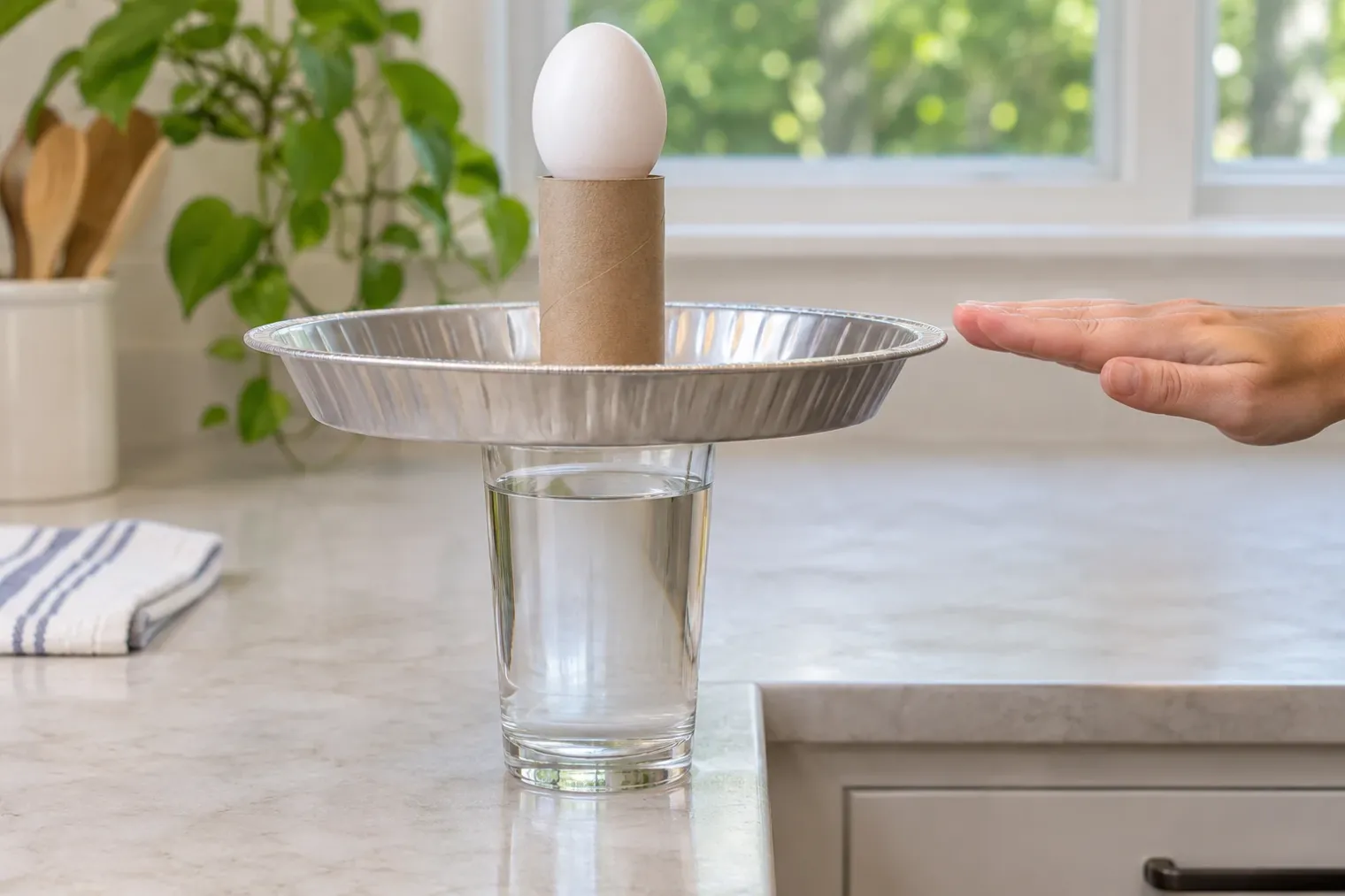
You need: a sturdy drinking glass, water, a metal pie pan or small baking sheet, an empty toilet paper tube, and an egg. Start with a hard-boiled egg until you get the hang of it.
- Set the glass near the edge of a counter or table, close to a sink, and fill it about three-quarters full of water.
- Lay the pie pan on top of the glass so it sticks out over the edge of the counter.
- Stand the toilet paper tube upright on the pan, right over the center of the glass. Set the egg on its side on top of the tube.
- Predict: what will happen to the egg if you knock the pan away?
- With a flat hand, smack the edge of the pan hard and fast, straight sideways, so it shoots out from under the tube. Don’t hit it upward.
- Plop! The pan and tube go flying, and the egg drops straight down into the water.
What’s happening: your hand pushes the pan, and the pan knocks the tube away, but nothing pushes the egg sideways. Thanks to inertia, the egg stays right where it was. Once there’s nothing underneath it, gravity pulls it straight down into the glass. The water cushions the landing so the egg doesn’t crack.
Easier version for little kids: lay an index card over a cup, put a coin in the middle of the card, and flick the card sideways with your finger. The card flies off, and the coin drops into the cup. Same science, no splash.
Grown-ups: use a sturdy, heavy-bottomed glass, keep faces back from the table, and wash hands after handling raw eggs. Once you’ve mastered it, a confident grown-up can try lining up two or three glasses under one long baking sheet for a multi-egg drop.
Keep exploring: Egg Car Crash Project · What Is Gravity? · Who Was Isaac Newton?
Words to know
- Inertia
- The way an object resists changes to its motion.
- Force
- A push or a pull.
- Mass
- How much stuff something is made of. More mass means more inertia.
- At rest
- Not moving.
- Friction
- A force that slows things down when two surfaces rub together.
- Newton’s first law
- Objects keep doing what they’re doing, staying still or moving straight at the same speed, unless a force acts on them. Also called the law of inertia.
For grown-ups: the real science
Inertia isn’t a force; it’s a property of matter, and mass is its measure. Galileo first described it in the early 1600s, rolling balls down ramps and reasoning that, without friction, a ball on a level surface would roll forever. Newton made it the first of his three laws of motion in the Principia (1687). The first law also defines the frames of reference where Newton’s laws hold, called inertial frames: ones that aren’t accelerating.
In the Newton’s Eggs trick, the pan is struck so fast that only a tiny horizontal force reaches the egg, through brief friction with the tube, for a very short time. The egg’s horizontal momentum barely changes, so it falls almost straight down. Spinning objects have an equivalent property called rotational inertia, or moment of inertia, which is why a figure skater spins faster when she pulls her arms in.
Questions kids ask next
Is inertia a force?
No. Inertia is a property every object has, not a push or a pull. It describes how much an object resists being pushed or pulled into changing its motion.
What’s the difference between inertia and momentum?
Inertia depends only on mass, so a parked truck has lots of inertia even though it isn’t moving. Momentum is mass times speed, so it only exists when something is moving. A rolling truck has lots of inertia and lots of momentum.
Do things have inertia in space?
Yes. Mass doesn’t change in space, so neither does inertia. Astronauts float, but pushing a heavy box on the space station is still hard to start and hard to stop.
What are Newton’s three laws of motion?
The first law is the law of inertia: things keep doing what they’re doing unless a force acts on them. The second law says a bigger force makes things speed up more, and heavier things need more force. The third law says every push comes with an equal push back, like a balloon zooming forward as air rushes out the back.
Why do we wear seatbelts?
Because of inertia. If a car stops suddenly, your body keeps moving forward at the car’s speed. A seatbelt provides the force that stops you safely with the car.