This post contains affiliate links. As an Amazon Associate, TryScience earns from qualifying purchases, at no extra cost to you. Learn more.
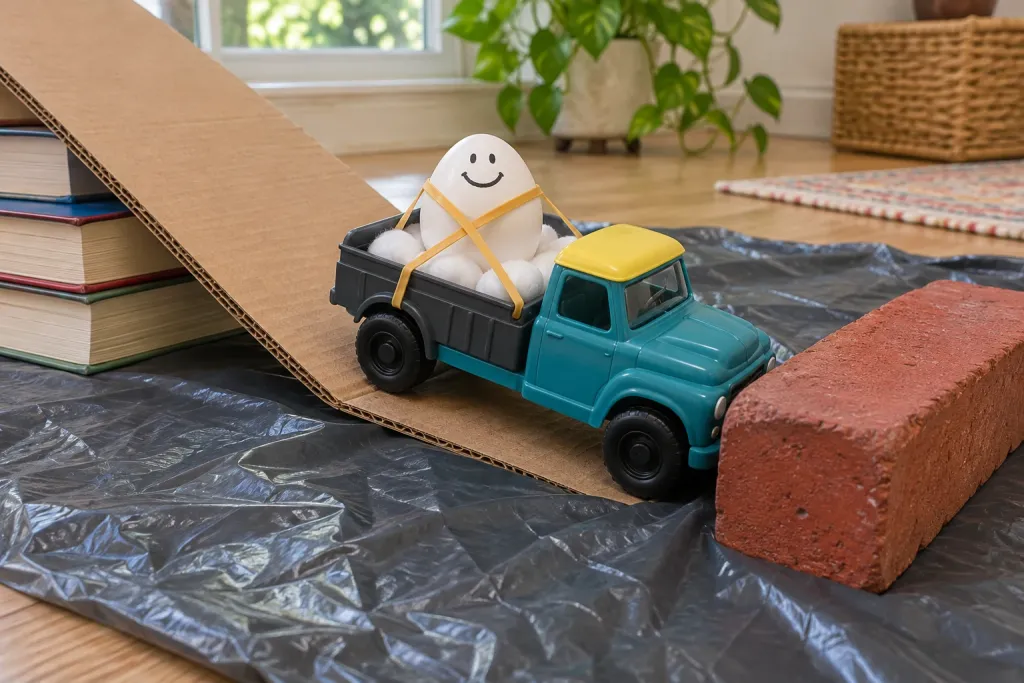
Meet your passenger: a raw egg with a face, a name and a very important job. Your mission is to send it down a ramp in a toy truck, crash it into a wall, and keep it from cracking. To do that, kids have to think like real car safety engineers, designing seatbelts, crumple zones and cushions, then testing them one smash at a time.
This egg car crash project has been a reader favorite on TryScience for years, and for good reason. It makes Newton’s first law of motion impossible to forget: the truck stops at the wall, but the egg keeps going. Below you’ll find the at-home toy truck version, the design ideas that work best, and tips if your kid has an egg car project due for school.
Grown-up safety check
- Raw eggs can carry germs like salmonella. Wash hands with soap after touching eggs or eggy materials, and wipe the crash zone with a disinfecting wipe when you’re done.
- Skip this one, or use plastic eggs filled with play dough, if anyone in the house has an egg allergy.
- Make sure your “wall” is heavy and stable so it can’t tip onto little feet, and an adult should handle any craft knives.
- Crashed eggs go in the trash, not back in the fridge.
What you need
Enough for about five crash tests. Most of it is already in your house.
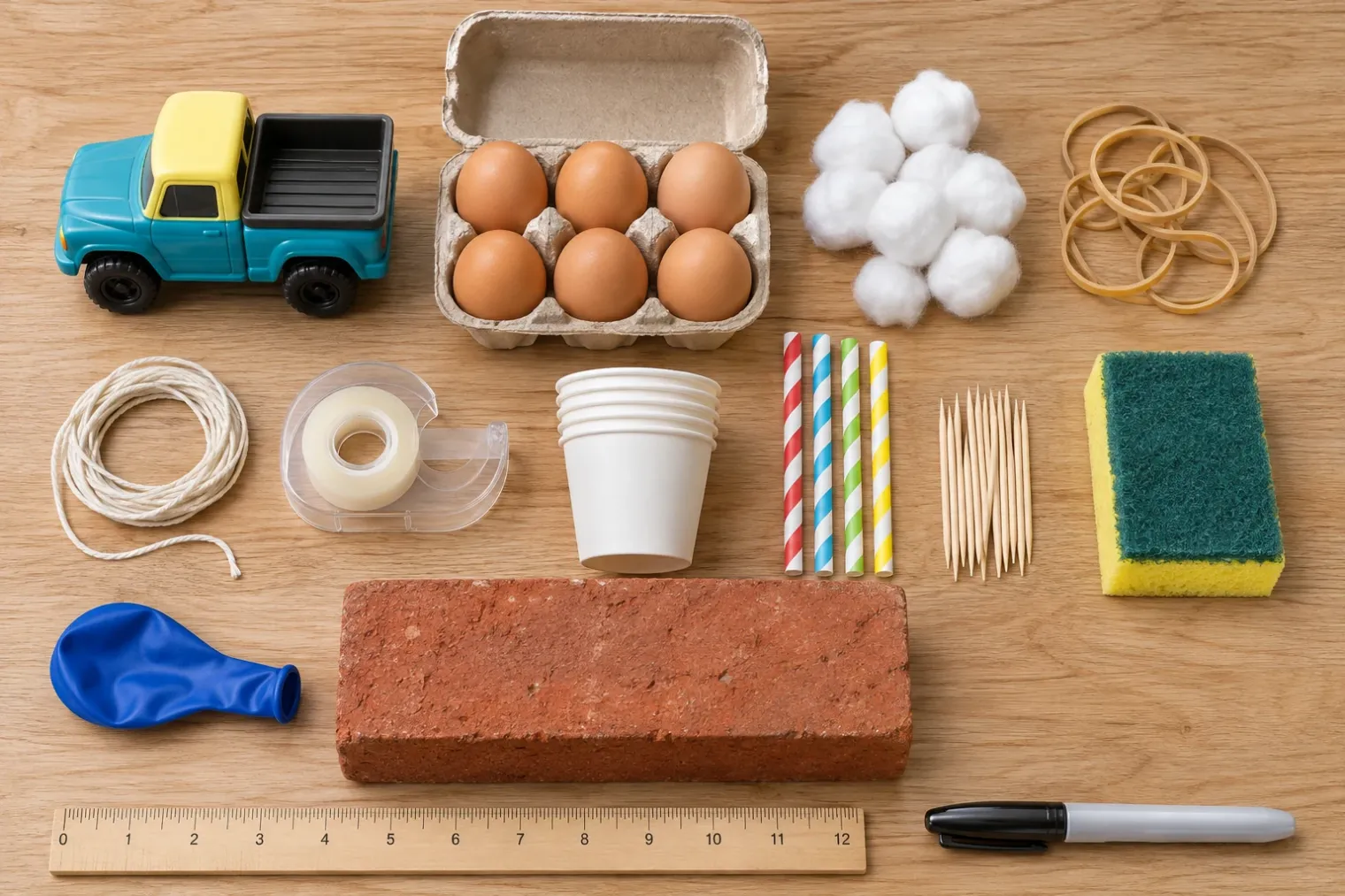
- A toy pickup or dump truckBig enough for an egg to ride in the back. Sturdy plastic works best.Shop toy trucks
- A rampA long piece of sturdy cardboard, a shelf board or a folding table leg propped on books.you have this
- A heavy “wall”A brick, a heavy pot or a tall stack of books at the bottom of the ramp.you have this
- Raw eggs, about 6One for each test, plus a spare for the inevitable early splat.you have this
- A trash bag or old shower curtainTo cover the crash zone.you have this
- Safety materialsCotton balls, rubber bands, string, tape, paper or foam cups, straws, toothpicks, sponges, bubble wrap, balloons.Shop craft supplies
- A permanent marker, ruler and paperFor your passenger’s face, measuring the ramp and keeping score.you have this
Let’s crash-test some eggs
Set up the crash zone
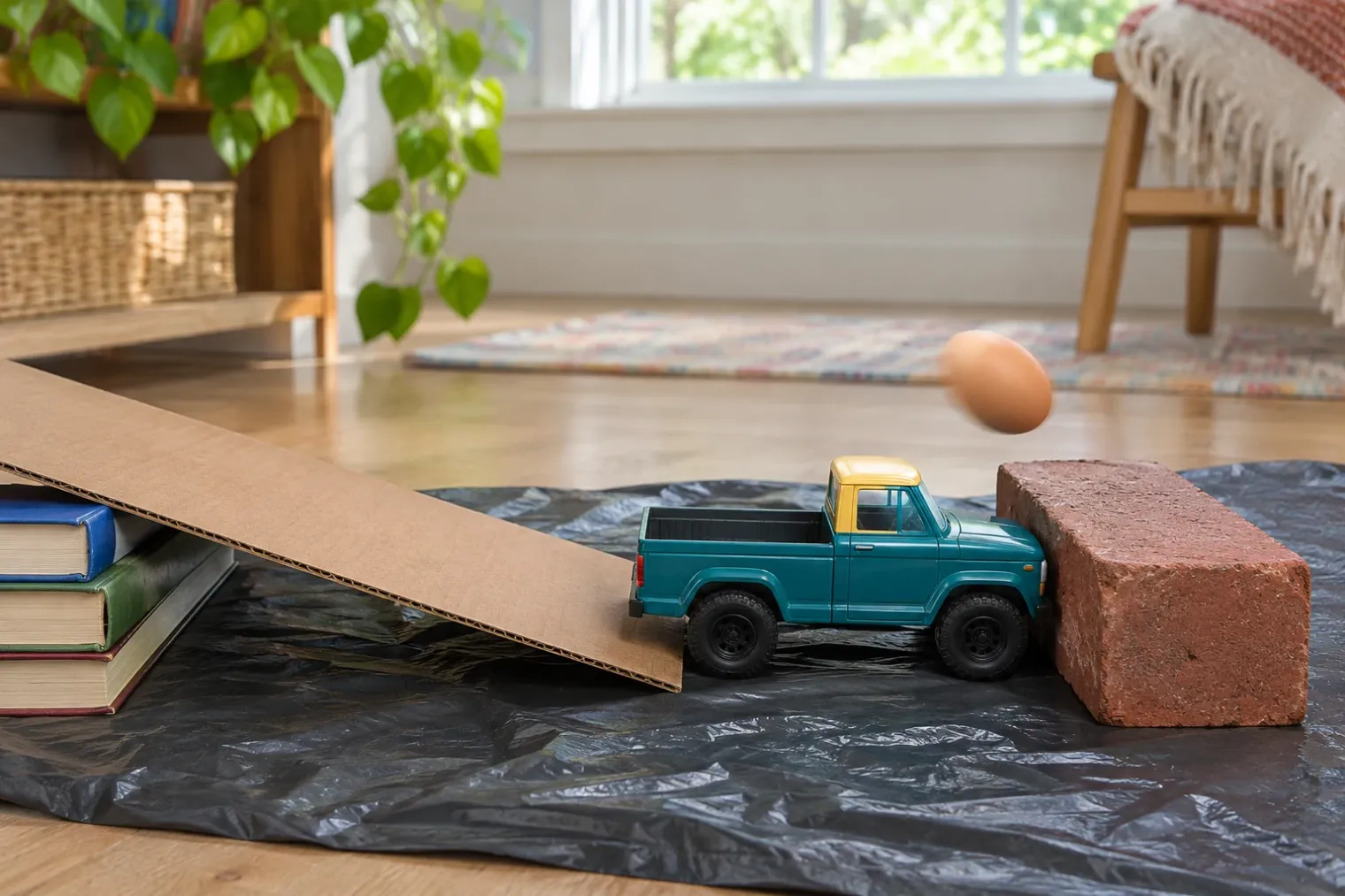
Spread a trash bag on the floor where the truck will run, all the way to the wall. Set your brick, pot or stack of books at the end so the truck will hit it head-on.
Meet your passenger
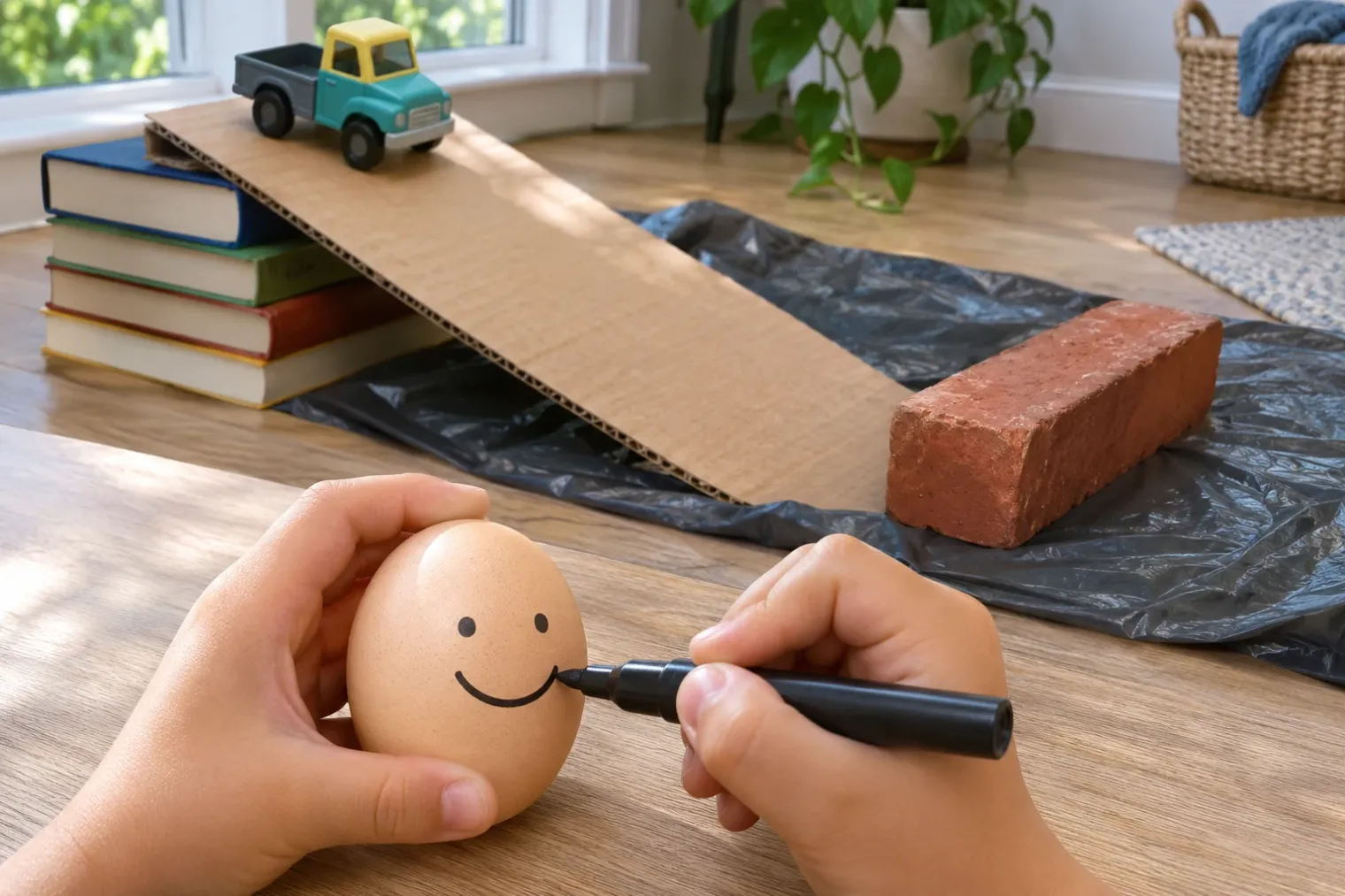
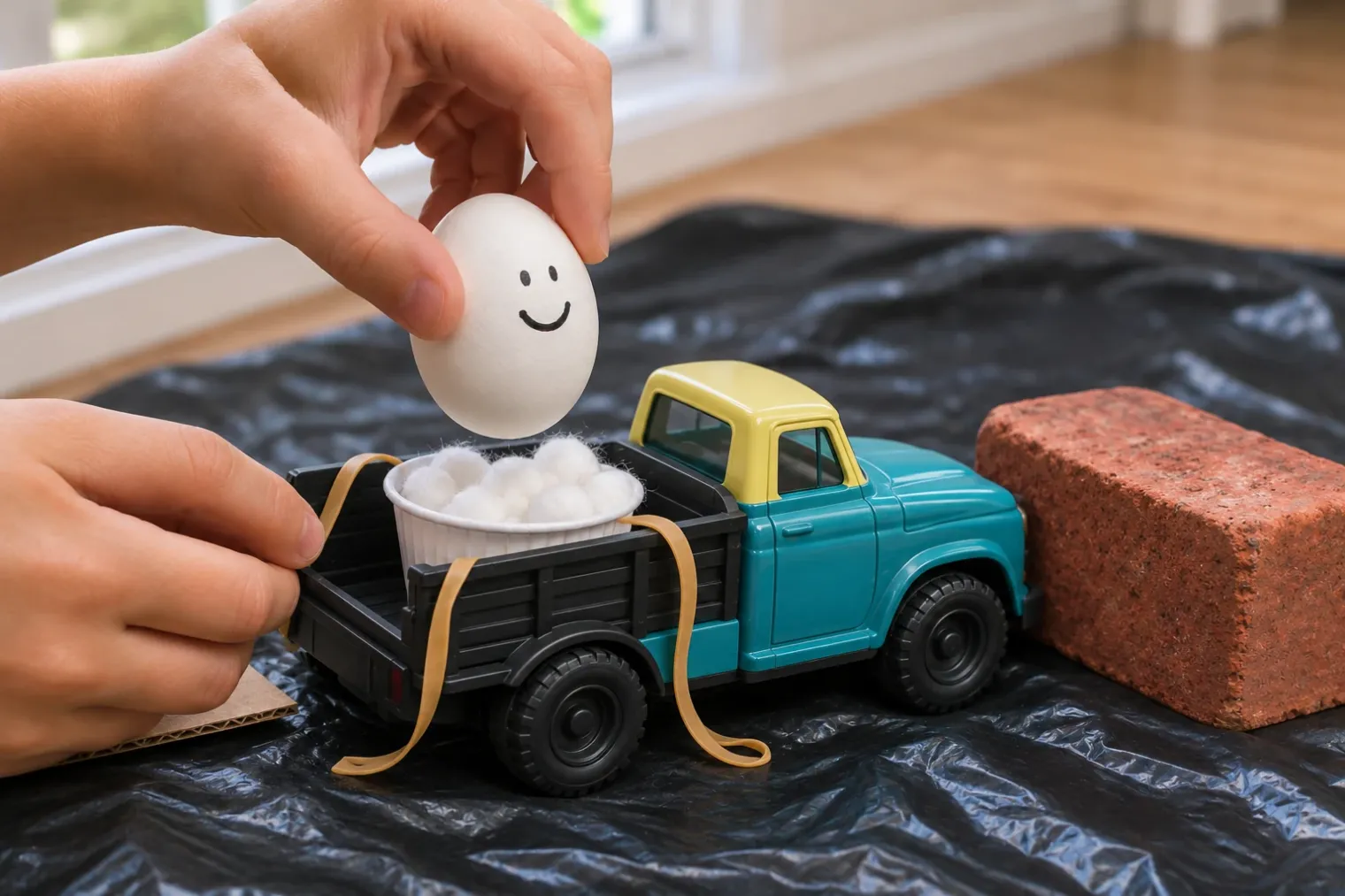
Draw a face on your egg with a permanent marker and give it a name. It sounds silly, but kids care a lot more about safety once Eggbert has a personality.
Build the ramp
Prop one end of your ramp on books so the truck rolls straight down into the wall. Measure how high the top is and mark a start line. Every test should start from that same spot, so the truck always crashes at the same speed.

Start low, about 6 inches. You can raise it later to make the challenge harder.
Do one crash with no protection
Set an egg loose in the back of the truck and let go from the start line. Don’t push, just release. Watch closely: when the truck stops, the egg keeps flying forward. This first run is your control, the test you’ll compare every design against.
Design a safety system
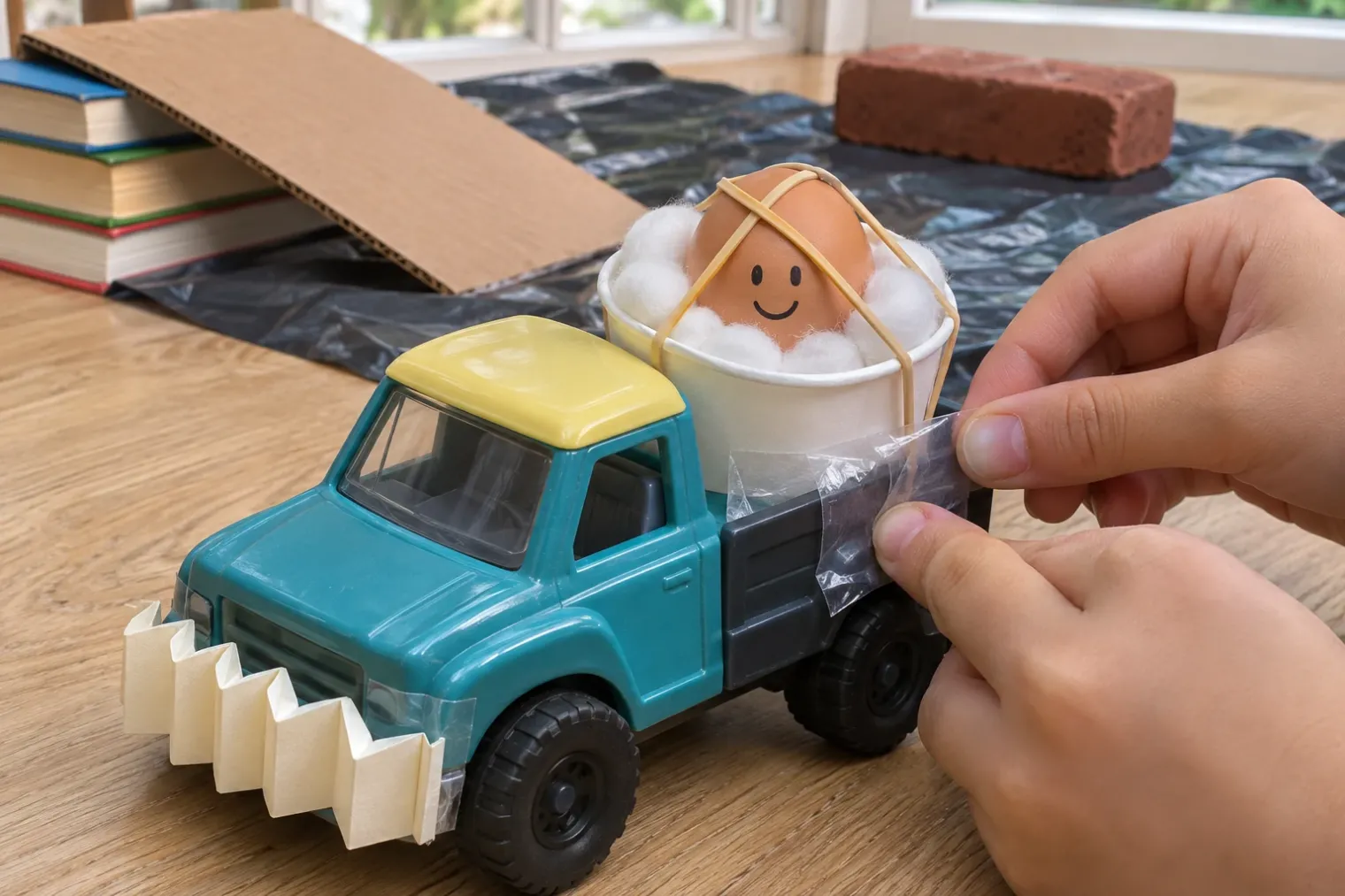
Now the engineering begins. Sketch a plan first, then build it in the truck bed using your safety materials. The best designs combine a seatbelt to hold the egg in, a cushion around it, and a crumple zone on the front of the truck. Stuck for ideas? See egg car design ideas that work below.
Add up the cost
Real car companies have to keep passengers safe and keep cars affordable. Give every material a pretend price and add up each design. Here’s the price list we use:
| Material | Price |
|---|---|
| Foam or paper cup | $500 each |
| Cotton ball | $100 each |
| Rubber band | $100 each |
| Toothpick or straw | $100 each |
| String | $50 per foot |
| Tape | Free |
The winning design is the cheapest one that keeps the egg safe.
Crash test!
Buckle your passenger in, set the truck on the start line and let go. Count down from three for maximum drama.
Inspect the passenger
Carefully unbuckle the egg and check it all over. Did it stay in the truck? Is it cracked, broken or perfect? Write down the result, the ramp height and the cost of the design.
Improve and try again
Change one thing at a time, then crash again. Once an egg survives, raise the ramp a few inches and see if your design still holds up. Compare your notes at the end: which design was the cheapest one that kept the egg safe, and why did it work?
What’s happening?
This project is all about Newton’s first law of motion: an object that’s moving keeps moving at the same speed and in the same direction unless a force stops it. Scientists call that stubbornness inertia.
When the truck rolls down the ramp, the egg moves at the same speed as the truck. When the truck smacks into the wall, the wall pushes back and stops the truck. But nothing is holding the egg, so it keeps going forward at the same speed until it hits the cab, the floor or the wall. That’s exactly what happens to people in a real car crash, and it’s why seatbelts were invented.
Your safety devices work in two ways. A seatbelt holds the egg to the truck so it doesn’t fly forward. Cushions and crumple zones make the stop slower and gentler. Stopping something over a longer time takes a smaller push, which is why catching a water balloon with soft, giving hands works better than stiff ones. Real cars use both: belts and airbags hold you in place, and the front of the car crumples on purpose so the people inside slow down more gently.
For grown-ups: a little deeper
The force on the egg depends on how quickly its momentum changes. Momentum is mass times velocity, and the average force equals the change in momentum divided by the time it takes to stop (F = Δp ÷ Δt). The egg’s momentum change is set by the ramp, so the only way to reduce the force is to stretch out the stopping time. Double the stopping time and you halve the average force. That’s the physics behind crumple zones, airbags and padded dashboards. A higher ramp means a faster truck, and because kinetic energy grows with the square of speed, small increases in ramp height make crashes much harder to survive. Heavier cars carry more momentum too, which is why adding weight usually makes the challenge harder, not easier.
Egg car design ideas that work
Whether you’re using a toy truck or building a car from scratch, these are the features that keep eggs in one piece. The strongest designs use at least three of them together.
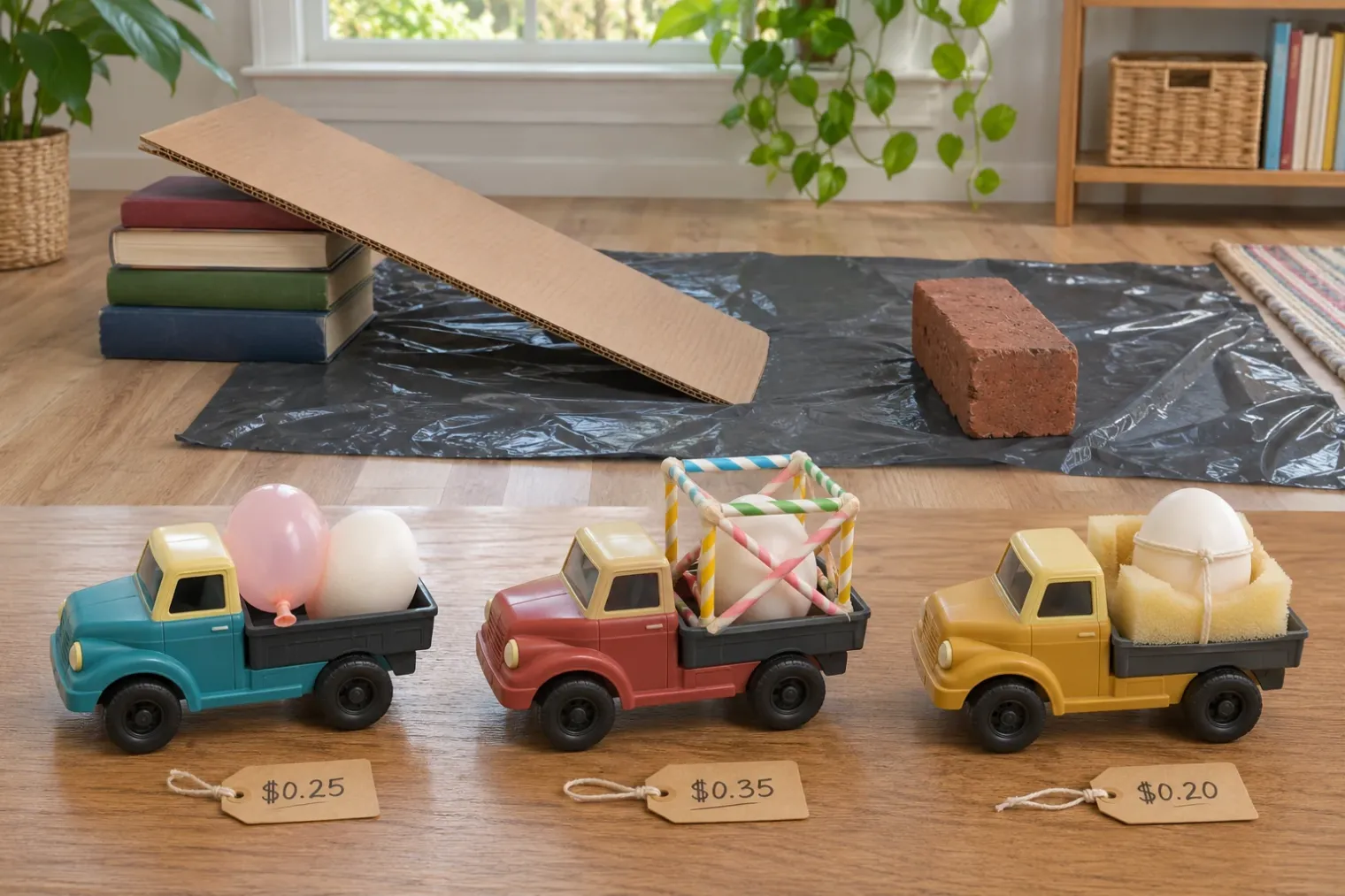
- A snug seatbeltCross two rubber bands or strips of string over the egg in an X so it can’t slide forward. Snug, not tight enough to squeeze.
- A crumple zoneTape an accordion-folded strip of paper, a paper cup or a cut-down toilet paper tube to the front bumper. It crushes on impact so the egg doesn’t have to.
- A cushioned seatNest the egg in a cup lined with cotton balls, a cut sponge or a few layers of bubble wrap so it has room to sink in gently.
- An airbagA balloon blown up just a little, or a sandwich bag with a puff of air, taped in front of the egg acts like a real airbag.
- A roll cageStraws or craft sticks taped into a frame over the egg keep it from bouncing out and protect it if the car flips.
- Egg pointing forwardAn egg is strongest at its rounded ends, like a dome. Lay it lengthwise so the end, not the side, faces the wall.
Designs that usually fail: a hard box with no padding (it stops just as suddenly as the truck), cushions so loose the egg bounces around, and anything that glues the egg directly to the car. Too much weight can backfire too, because a heavier car hits harder.
Doing an egg car project for school?
Lots of middle and high school science classes assign an egg car crash or egg car collision project, where students build their own car to protect an egg. The physics is the same as the toy truck version. These tips help you score well:
- Read the rules first. Most projects limit size, weight, materials or budget, and many require the egg to be easy to remove and inspect after the crash.
- Find out how you’re scored. Many teachers grade on egg survival plus speed or distance. A car that’s safe but crawls down the ramp may lose points, so keep it light and make sure the wheels spin freely.
- Use at least three safety features. A seatbelt, a crumple zone and a cushion are a strong combination, and they’re easy to explain in your write-up.
- Build a sturdy base. Cardboard or foam board with straw-and-skewer axles is a classic. Wobbly wheels steer the car off the ramp before it ever reaches the wall.
- Practice with spare eggs. Test at home with the same ramp angle your class will use, and bring extra eggs on test day.
- Show your physics. Measure the car’s mass and time how long it takes to go down the ramp. Speed equals distance divided by time, and momentum equals mass times speed. Explaining Newton’s first law and why your features stretch out the stopping time is often worth as many points as the egg surviving.
Make it a real experiment
Turn your crash tests into a science fair project: change just one thing, keep everything else the same, and compare the results.
- Seatbelt vs. no seatbeltSame truck, same ramp. How much difference does one rubber band make?
- Low ramp vs. high rampRaise the ramp an inch at a time. At what height does your best design finally fail?
- Cushion showdownCotton balls vs. sponge vs. bubble wrap. Which one protects best for the lowest cost?
Free printable: an egg car crash test log with a passenger profile, a design sketch box, a budget sheet and a results table.
Newton’s first law examples you see every day
Once kids spot inertia in the egg car, they’ll start seeing it everywhere. (Want the full story? Read what is inertia? and try the Newton’s Eggs trick.)
- Sudden stops in the car. When a driver brakes hard, your body keeps moving forward until the seatbelt stops it.
- Standing on a bus. When the bus pulls away, you stumble backward. Your body wanted to stay put while the bus moved.
- The tablecloth trick. Yank a tablecloth fast and the dishes stay where they are, because they tend to stay at rest.
- A rolling ball. A soccer ball would roll forever if friction and air didn’t slowly stop it. In space, where there’s almost nothing to slow things down, objects really do keep drifting.
- Shaking ketchup. Swing the bottle down and stop it suddenly, and the ketchup keeps going, right out onto your fries.
Want more physics? Learn what gravity is and how it pulls your truck down the ramp in the first place.
Questions and troubleshooting
How do you protect an egg in a car crash project?
Hold the egg in place with a snug seatbelt, surround it with something soft like cotton or sponge, and add a crumple zone to the front of the car. Together they keep the egg from flying forward and make the stop slower and gentler, which lowers the force on the shell.
Why does my egg keep flying out of the truck?
That’s inertia: the truck stops, but the egg doesn’t. Add a seatbelt across the front of the egg and a short wall or roll cage so it can’t escape over the top.
Why does the egg crack even with cushions?
Usually the cushion is too thin or too hard, so the egg still stops almost instantly. Give it more room to sink in, add a crumple zone up front, or lower the ramp and work your way back up.
Can we use hard-boiled eggs?
Hard-boiled eggs are great for practice runs because they’re less messy, but their shells crack in a similar way. For the final test, use raw eggs. That’s where the suspense is.
What is Newton’s first law in simple words?
Things keep doing what they’re already doing. If something is still, it stays still, and if it’s moving, it keeps moving the same way, until a push or pull changes it. That’s called inertia.
What age is this project good for?
The toy truck version works well from about age 8, and younger kids can do it with a grown-up’s help. The build-your-own egg car version is a common middle and high school physics project.
How do I clean up?
Roll the trash bag up from the edges toward the middle and throw it away with the broken eggs. Wipe the truck and the floor with a disinfecting wipe, and everyone washes hands with soap.