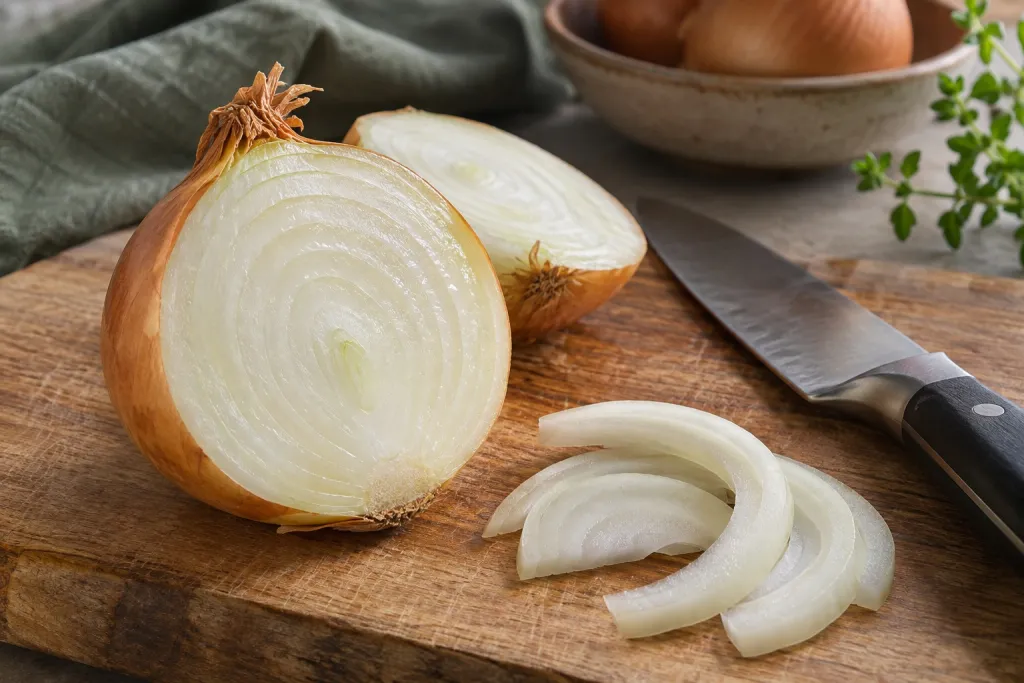
You’re not sad. You’re just helping make dinner. So why are tears rolling down your face? Blame the onion. It’s armed with a clever chemical trick, and the knife sets it off.
An onion’s secret defense
Onions grow underground, where animals like to dig them up and nibble them. Onions can’t run away, so they protect themselves with chemistry. Inside each onion cell, certain chemicals are stored in separate compartments, like ingredients in separate jars. As long as the onion is whole, nothing happens.
What happens when you cut it
- The knife breaks cells open. Thousands of tiny compartments burst.
- Chemicals mix. Sulfur-containing chemicals meet helper chemicals called enzymes, which change them very quickly.
- A gas forms. The reaction makes a gas with a long name, syn-propanethial-S-oxide. Scientists just call it the tear factor.
- It floats to your eyes. The gas drifts up and touches the wet surface of your eyes, where it bothers sensitive nerves.
- Tears to the rescue. Your brain tells your tear glands to flush the eyes, so out come the tears.
Explain it like I’m 5
An onion has a hidden stinky spray. When you cut it, the spray floats into the air and tickles your eyes. Your eyes make tears to wash the spray away.
Tricks that actually help
- Chill the onion first. 30 minutes in the fridge slows the chemical reaction, so less gas forms.
- Use a sharp knife. A sharp blade slices cleanly through fewer cells. A dull knife crushes them and releases more gas.
- Cut the root end last. The root area holds more of the tear-making chemicals.
- Get some airflow. Cutting near a fan or a stove hood blows the gas away from your face.
- Wear goggles! Swim goggles keep the gas off your eyes completely. They look silly, but they work best of all.
Cooking changes the chemicals too. That’s why cooked onions taste sweet and mild and don’t make you cry.
Try it: the cold onion test
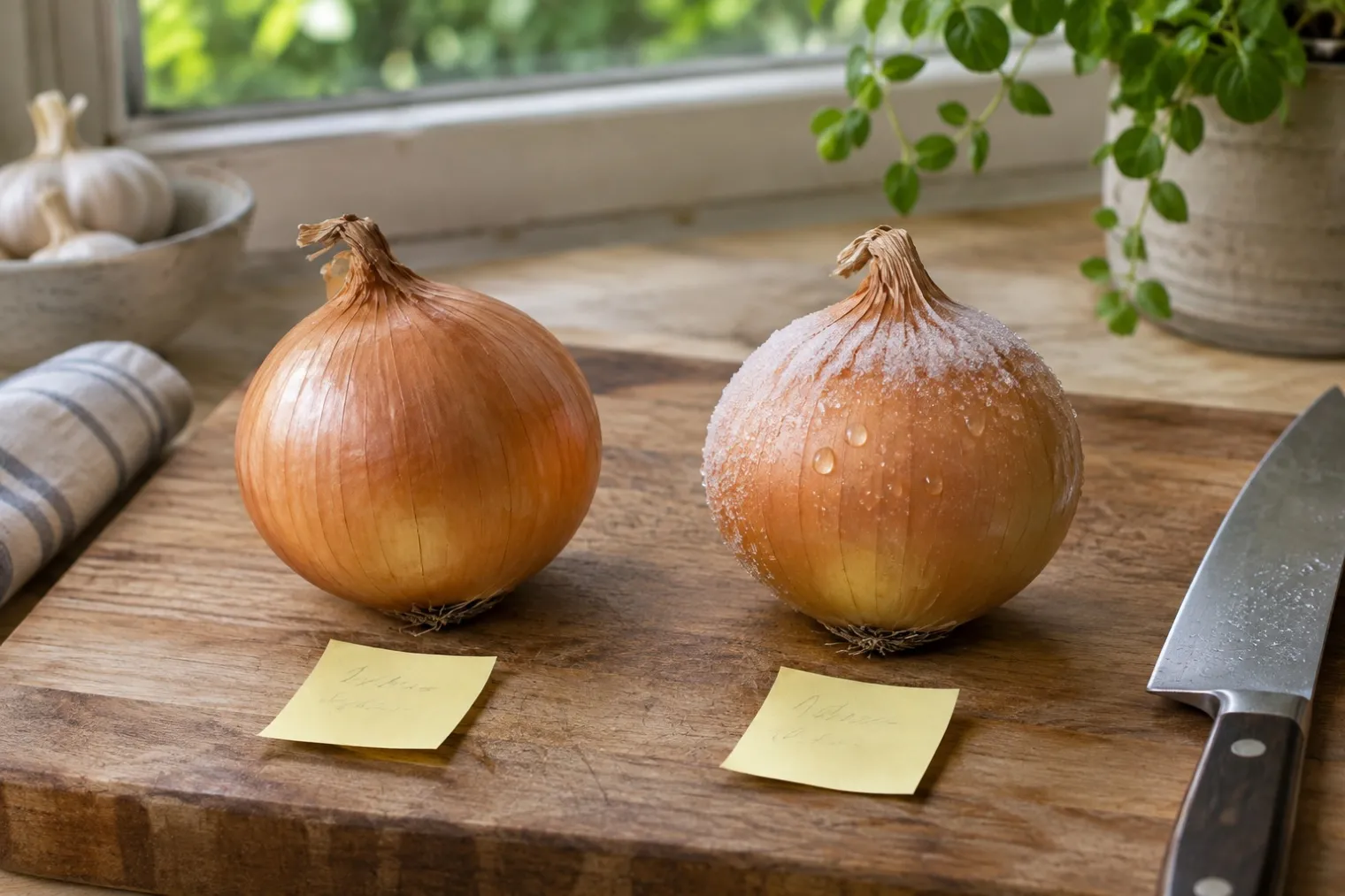
You need: 2 onions the same size, a fridge, a sharp knife, a cutting board and a grown-up to do the cutting.
- Put one onion in the fridge for 30 to 45 minutes. Leave the other on the counter.
- Have a grown-up chop the room-temperature onion. Stand nearby and rate how much your eyes sting from 1 to 10.
- Wait until your eyes feel normal. Then the grown-up chops the cold onion the same way. Rate it again.
- Compare your scores. Bonus: try it again with swim goggles on!
What’s happening: most people sting less with the cold onion. Chemical reactions slow down when they’re cold, and the tear gas also floats into the air more slowly. Save the chopped onions for dinner!
Keep exploring: Why Do We Sneeze? · Why Are Plants Green? · What Is Heat?
Words to know
- Cell
- The tiny building block that all living things, including onions, are made of.
- Enzyme
- A natural helper chemical that makes reactions happen fast.
- Chemical reaction
- When substances mix and change into something new.
- Tear glands
- Small glands above your eyes that make tears.
- Sulfur
- A natural element that gives onions and garlic their strong smell.
For grown-ups: the real science
Onion cells store S-alk(en)yl cysteine sulfoxides (mainly isoalliin) in the cytoplasm and the enzyme alliinase in the vacuole. Tissue damage brings them together; alliinase produces 1-propenesulfenic acid, which a second enzyme, lachrymatory factor synthase (identified by Imai et al., Nature, 2002), rapidly converts to the volatile syn-propanethial-S-oxide. The compound activates TRPA1 channels on corneal sensory nerve endings (trigeminal nerve), triggering reflex tearing.
Chilling slows both enzyme activity and volatility. Sharp blades reduce cell rupture; a 2024 study of onion cutting (Cornell, high-speed imaging) found that duller blades and faster cuts eject more aerosolized droplets. Researchers in Japan and New Zealand have developed “tearless” onions with reduced lachrymatory factor production.
Questions kids ask next
Does garlic make you cry too?
No. Garlic is a cousin of the onion and uses similar chemistry, but it doesn’t have the enzyme that makes the tear gas. Instead it makes allicin, which gives garlic its strong smell.
Is onion gas harmful to my eyes?
No. It stings, but it doesn’t hurt your eyes, and the tears wash it away in a few minutes.
Do all onions make you cry the same?
No. Sweet onions, like Vidalias, usually have fewer sulfur chemicals, so they sting less. Strong yellow onions are often the worst.
Is there a no-cry onion?
Yes! Scientists and farmers have grown special onions that make very little tear gas, and some are sold in stores.