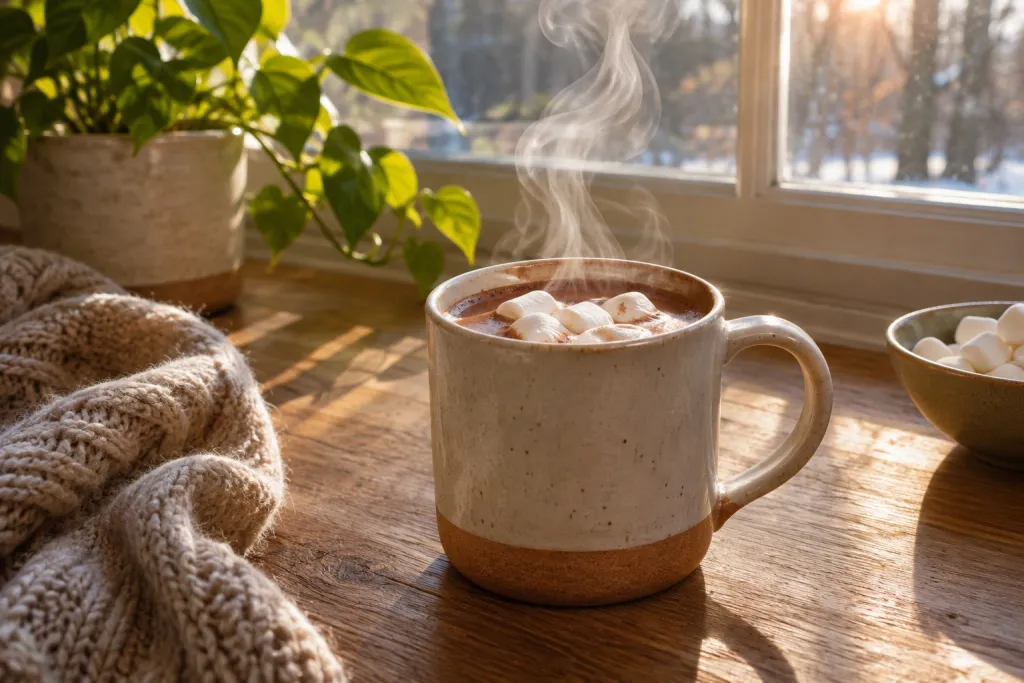
You feel heat from a mug of cocoa, a sunny sidewalk and a cozy blanket. But what is heat, exactly? You can’t hold it in a jar or see it. The answer is hiding inside everything, too tiny to see.
Everything is jiggling
Everything around you, your desk, the air, even you, is made of particles called atoms and molecules. They’re far too small to see, and they’re never perfectly still. They wiggle, vibrate and bounce around all the time.
Heat is the energy of that motion. When particles move fast, the thing feels hot. When they move slowly, it feels cold. Temperature is how we measure how fast, on average, the particles are moving.
Explain it like I’m 5
Everything is made of teeny-tiny dancers. When they dance fast and wild, things feel hot. When they dance slow and sleepy, things feel cold.
Heat always moves from hot to cold
Heat is always on the move, and it only goes one way: from hotter things to colder things. Your cocoa cools down because its heat flows into the cooler air. An ice cube melts in your hand because heat flows from your warm hand into the ice. There’s no such thing as “cold” flowing. Cold is just less heat.
The three ways heat travels
- Conduction (touching): fast-jiggling particles bump into their neighbors and pass the energy along. That’s why a metal spoon in hot soup gets hot all the way to the handle.
- Convection (flowing): in liquids and gases, warm parts rise and cooler parts sink, carrying heat around in a loop. That’s how a heater warms a whole room and how water heats up in a pot.
- Radiation (rays): heat can travel as invisible infrared light, even through empty space. That’s how the Sun warms Earth and how you feel a campfire’s warmth on your face.
Why metal feels colder than wood
Touch a metal spoon and a wooden spoon that have been in the same drawer. The metal feels colder, but they’re actually the same temperature! Metal is a good conductor: it pulls heat out of your fingers quickly, so your skin cools and you feel “cold.” Wood is an insulator: it moves heat slowly, so your fingers stay warm. Insulators like wool, fluffy feathers and foam are why coats and coolers work.
Try it: watch heat make things move
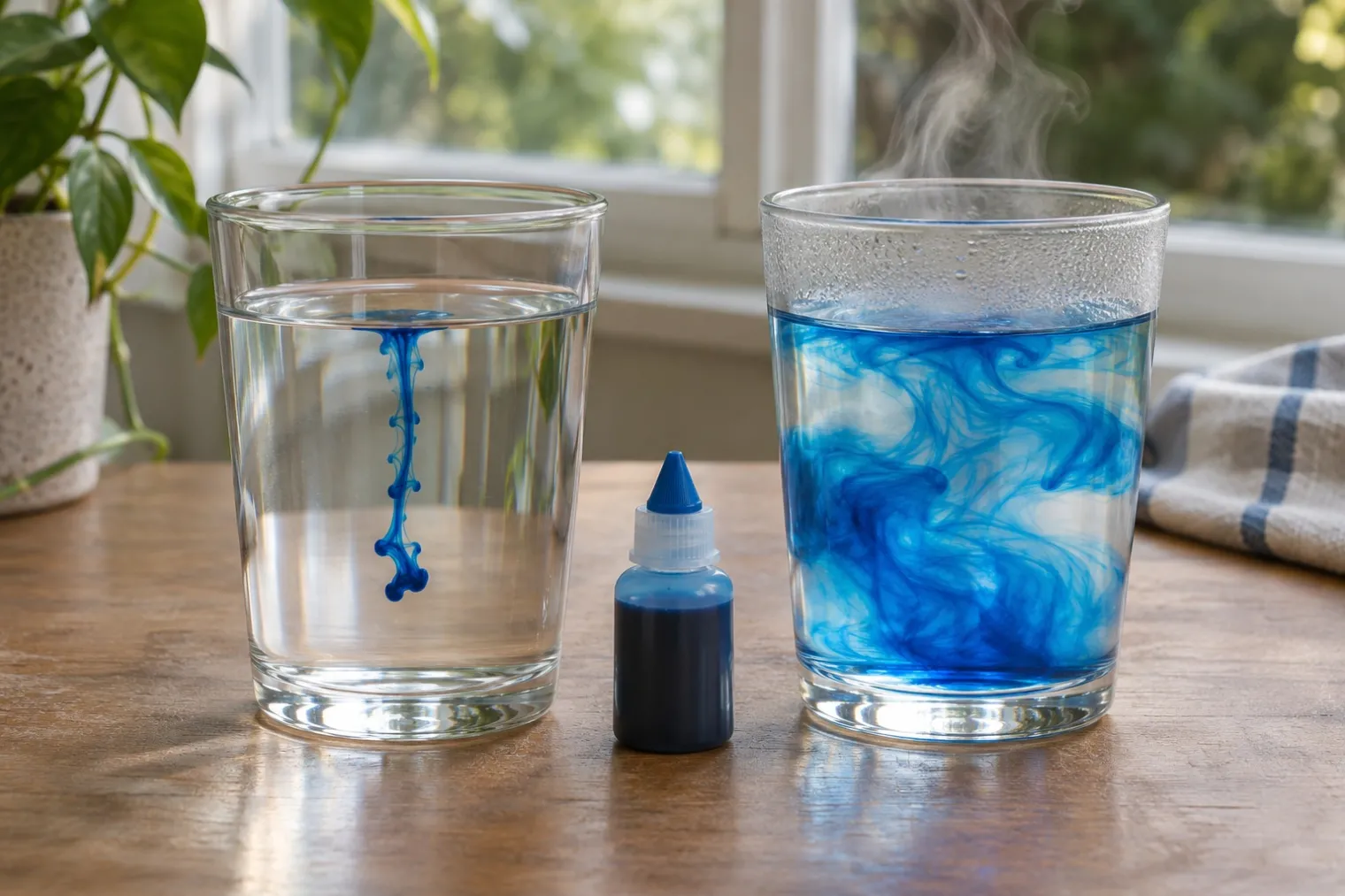
You need: 2 clear glasses, cold water (from the fridge), hot tap water (a grown-up pours) and food coloring.
- Fill one glass with cold water and one with hot water. Let them sit still for a minute.
- Gently add one drop of food coloring to each glass at the same time. Don’t stir!
- Watch closely for 2 minutes. Which glass gets colorful faster?
What’s happening: the color spreads much faster in the hot water. Hot water’s particles are moving faster, so they bump the color around more quickly. You’re seeing the invisible jiggling that heat is made of.
Keep exploring: Why Does Ice Float? · How Do Hurricanes Form? · Why Does Salt Melt Ice?
Words to know
- Heat
- Energy that flows from hotter things to colder things.
- Temperature
- A measure of how fast an object’s particles are moving.
- Conduction
- Heat moving through touching objects.
- Convection
- Heat carried by moving liquids or gases.
- Radiation
- Heat traveling as invisible rays, like sunlight.
- Insulator
- A material that slows down the movement of heat.
For grown-ups: the real science
Strictly, heat is energy transferred between systems because of a temperature difference; the energy stored in random particle motion is thermal (internal) energy. Temperature is proportional to the average kinetic energy of particles. The second law of thermodynamics says spontaneous heat flow goes from higher to lower temperature. Diffusion rates rise with temperature because molecular speeds increase, which is what the food-coloring demo shows (convection currents in the hot glass add to the effect).
Perceived coldness depends on the rate of heat flow from skin, which depends on a material’s thermal effusivity (a mix of conductivity, density and heat capacity). Metals have high effusivity, so they feel colder than wood at the same room temperature. Absolute zero (−273.15°C, 0 K) is the lowest possible temperature, where particle motion reaches its minimum.
Questions kids ask next
Is cold the opposite of heat?
Not really. Cold is just less heat. Even an ice cube has some heat in it, because its particles are still jiggling a little.
What is the coldest anything can get?
Absolute zero, −459.67°F (−273.15°C). At that point, particles would move as little as possible. Scientists have gotten incredibly close but can never quite reach it.
Does a coat make heat?
No. Your body makes the heat. A coat is an insulator that traps that heat and slows it from escaping into the cold air.
Why does hot air rise?
When air heats up, its particles spread apart, so the air gets lighter for its size. The heavier cool air sinks underneath and pushes the warm air up. That’s how hot air balloons fly.