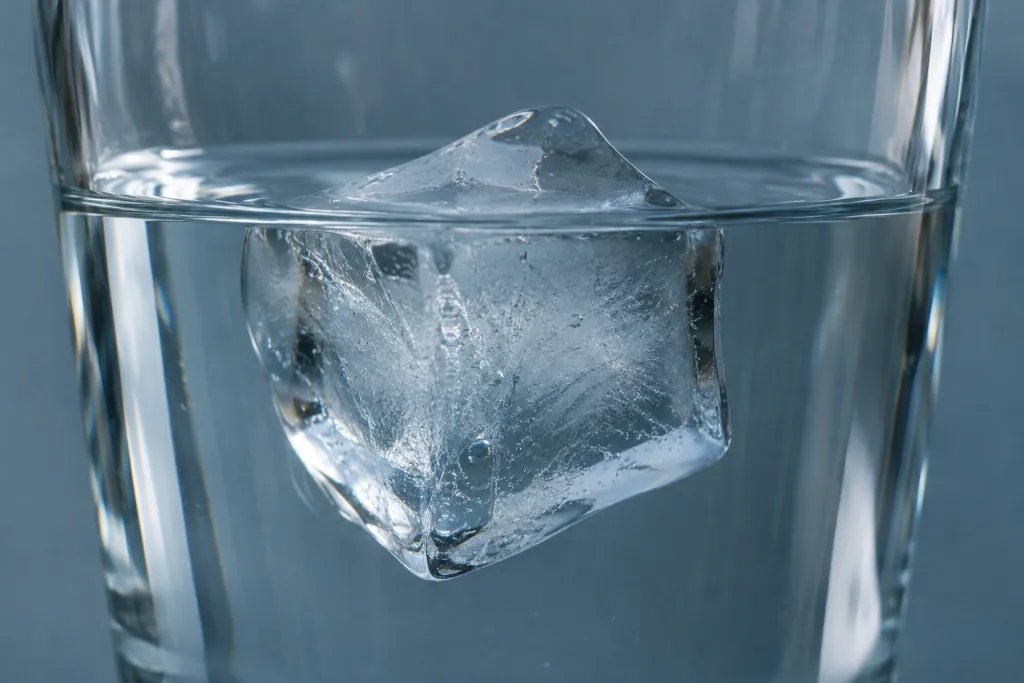
Drop an ice cube in a glass of water and it bobs right back up. You’ve probably never thought twice about it. But ice floating is actually a little bit weird. For almost every other substance, the solid form is heavier for its size than the liquid, so it sinks. Water is a rule-breaker.
Floating is about density
Whether something floats depends on its density: how much stuff is packed into a certain amount of space. A beach ball and a bowling ball are about the same size, but the bowling ball is packed with much more material, so it’s denser. Things that are less dense than water float. Things that are denser sink.
Water spreads out when it freezes
Water is made of tiny molecules, each one an oxygen atom with two hydrogen atoms (H₂O). In liquid water, the molecules tumble around and crowd close together. When water freezes, the molecules link up into a neat, six-sided pattern, a bit like a honeycomb, with open space in the middle of each ring.
All that open space means ice takes up about 9% more room than the water it came from. Same amount of water, more space, so ice is less dense. And less dense means it floats!
Explain it like I’m 5
When water freezes, its tiny pieces hold hands in a big circle, leaving space in the middle. That makes ice puffier and lighter than water, so it floats on top.
Why floating ice is great for fish
In winter, lakes and ponds freeze from the top down. The ice on top works like a lid that keeps the water underneath from freezing solid. Fish, frogs and turtles spend the winter in the liquid water below. If ice sank, lakes would fill with ice from the bottom up and many would freeze completely, and life in them couldn’t survive.
The tip of the iceberg
Ice floats, but only just. About 90% of an iceberg is hidden underwater, with just the top 10% sticking out. That’s where the saying “just the tip of the iceberg” comes from. You can see the same thing with an ice cube in a glass.
Water’s habit of expanding when it freezes is powerful, too. It can crack rocks, burst frozen pipes and push up bumps in roads.
Try it: watch water grow in the freezer
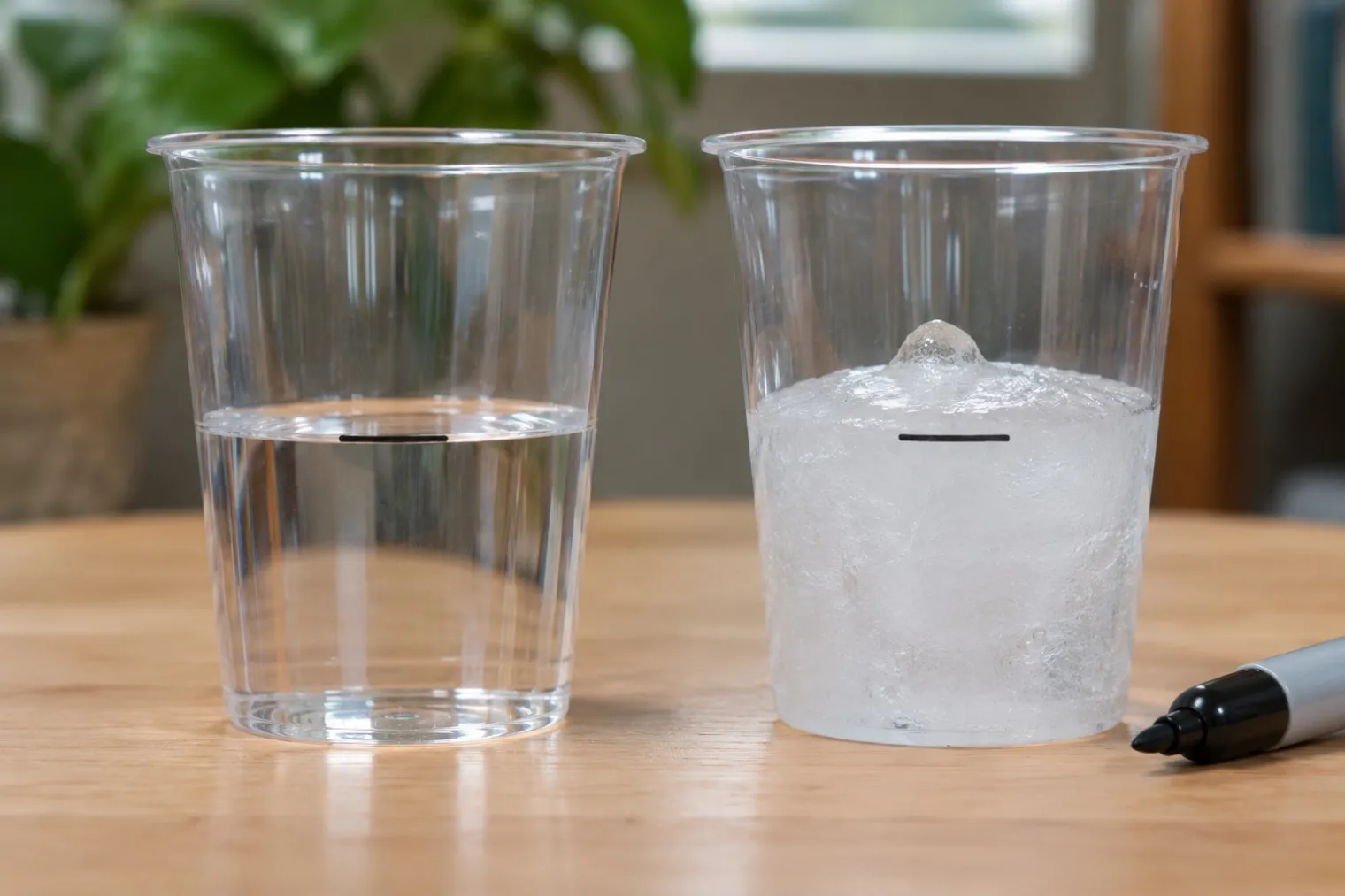
You need: a clear plastic cup, water, a permanent marker, a freezer, a glass of water and an ice cube.
- Fill the plastic cup about halfway with water. Draw a line on the outside right at the water level.
- Put it in the freezer overnight, standing level.
- The next day, check the ice. Is it above or below your line?
- Bonus: drop an ice cube in a glass of water and look from the side. How much of it is underwater?
What’s happening: the ice rises above your line, often with a little bump on top, because frozen water takes up more space. Your ice cube floats with most of it underwater, just like an iceberg.
Keep exploring: How Do Boats Float? · How Are Snowflakes Formed? · Why Does Salt Melt Ice?
Words to know
- Density
- How much stuff is packed into a certain amount of space.
- Molecule
- A tiny group of atoms stuck together. A water molecule is H₂O.
- Expand
- To get bigger and take up more space.
- Float
- To stay on top of a liquid because you’re less dense than it.
- Iceberg
- A huge chunk of ice floating in the ocean.
For grown-ups: the real science
Ordinary ice (ice Ih) has a hexagonal crystal lattice in which each water molecule forms four hydrogen bonds in a tetrahedral arrangement. This open structure gives ice a density of about 0.917 g/cm³, versus about 0.9998 g/cm³ for liquid water at 0°C, a volume increase of roughly 9%. By Archimedes’ principle, a floating body displaces its own weight, so about 92% of floating freshwater ice sits below the surface (about 89–90% for icebergs in denser seawater).
Liquid water reaches maximum density at about 4°C. In winter lakes, water cooled below 4°C stays near the surface and freezes there, while 4°C water settles at the bottom, creating a stable refuge for aquatic life. Freeze–thaw expansion drives frost wedging, a major form of physical weathering, and can generate pressures large enough to burst pipes.
Questions kids ask next
Does ice float in everything?
No. Ice floats in water and oil, but it sinks in rubbing alcohol, because alcohol is less dense than ice.
Why do frozen water bottles bulge?
The water expands as it freezes and pushes on the bottle. A completely full glass bottle can even crack, so leave space at the top before freezing.
Is all ice the same?
Not quite! Scientists have discovered about 20 kinds of ice that form under extreme pressure, and some of them are dense enough to sink.
Do fish freeze in winter?
Usually not. They slow down and rest in the liquid water under the ice, where the temperature stays just above freezing.