
Drop a steel nail in a bucket of water and it sinks straight to the bottom. Yet giant ships made of steel, some longer than three football fields and heavier than a mountain of cars, float across the ocean. How can the same material sink as a nail and float as a ship? It all comes down to shape.
Water pushes back
Have you ever tried to push a beach ball underwater? It fights back and pops up. That’s because water pushes up on anything placed in it. This upward push is called buoyancy (say it: BOY-un-see).
When something goes into water, it shoves some water out of the way. Scientists call that displacement. Here’s the key rule, discovered by the Greek scientist Archimedes more than 2,000 years ago: the water pushes up with a force equal to the weight of the water that got pushed aside.
- If an object is lighter than the water it pushes aside, the upward push wins and it floats.
- If it’s heavier than the most water it can push aside, gravity wins and it sinks.
Why shape matters
A nail is small and solid. It can only push aside a tiny bit of water, which weighs less than the nail, so it sinks. A ship spreads its steel into a huge, wide, hollow shape, mostly filled with air. It sinks down only a little way before it has pushed aside enough water to equal its own weight. Then buoyancy holds it up.
Explain it like I’m 5
Water likes to push things up. A boat is big and wide and full of air, so lots of water pushes up on it. A little rock is small and heavy, so the water can’t push hard enough, and plop, it sinks.
Why boats sit lower when they’re loaded
Add cargo to a boat and it sinks a little deeper, pushing aside more water until the upward push matches the new, heavier weight. Big ships have painted marks on their sides, called load lines, showing how deep they can safely sit. If a boat gets too heavy, or water pours inside and replaces the air, it can’t push aside enough water and it sinks.
Things float a little more easily in salty ocean water than in a freshwater lake, because salt water is heavier for its size, so it pushes up harder.
Try it: the foil boat penny challenge
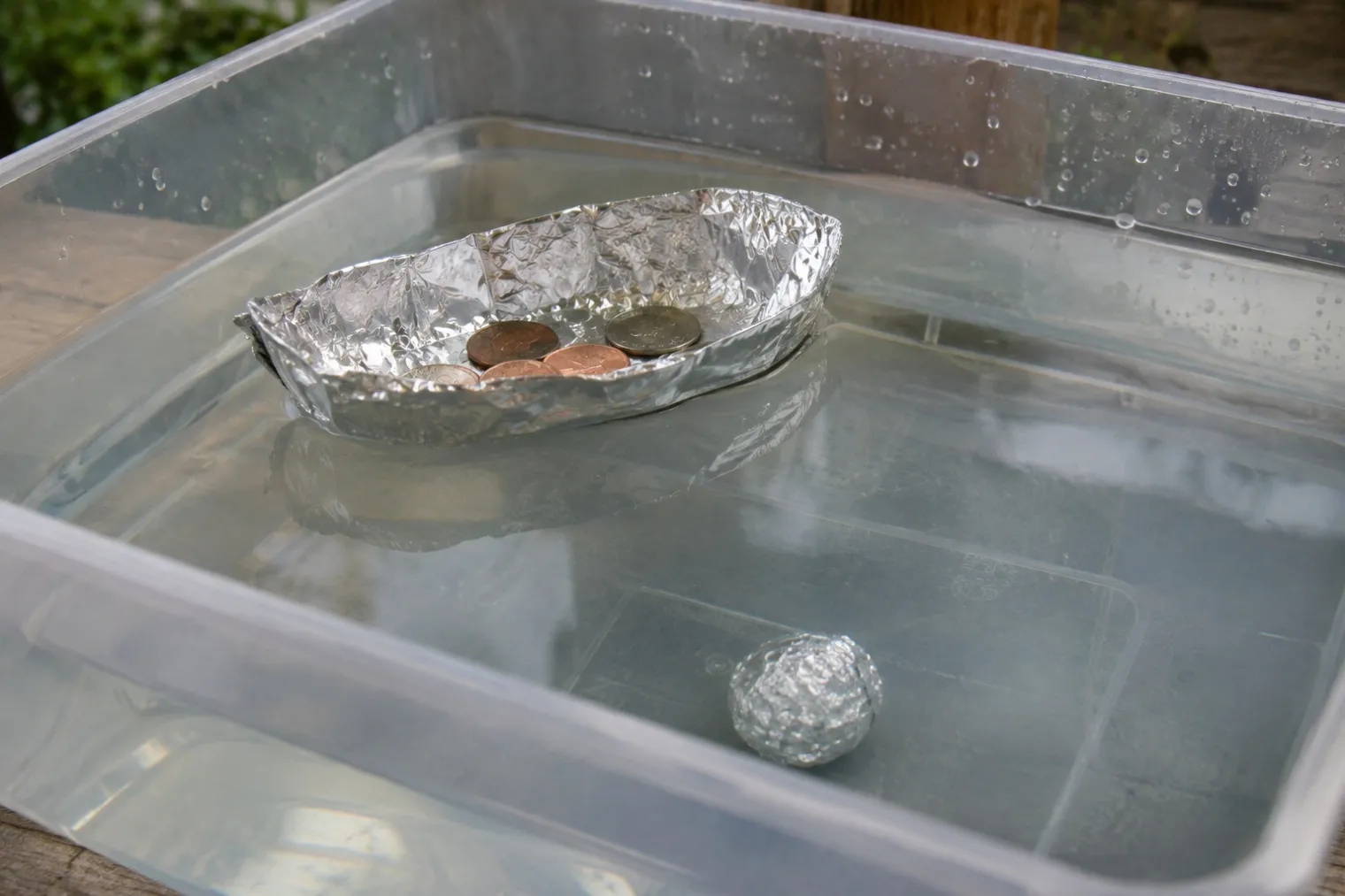
You need: aluminum foil, a sink or tub of water and a pile of pennies (or marbles).
- Tear off two squares of foil the same size, about 6 inches wide.
- Squeeze one square into a tight ball. Drop it in the water. What happens?
- Shape the other square into a boat with walls. Set it on the water.
- Add pennies one at a time, spreading them out, until it sinks. Count your score! Then redesign your boat to hold even more.
What’s happening: the tight ball pushes aside very little water and may sink, while the same foil shaped into a boat floats and even carries cargo. Wide, flat boats with tall walls usually win, because they can push aside the most water before it spills in.
Keep exploring: Why Does Ice Float? · Why Is the Ocean Salty? · Leonardo da Vinci’s Inventions
Words to know
- Buoyancy
- The upward push water gives to things in it.
- Displacement
- Pushing water out of the way when something goes into it.
- Density
- How much stuff is packed into a certain amount of space.
- Hull
- The main body of a boat that sits in the water.
- Cargo
- Things a boat carries, like boxes or people.
For grown-ups: the real science
Archimedes’ principle states that a body fully or partially immersed in a fluid experiences an upward buoyant force equal to the weight of the fluid displaced. A floating body sinks until it displaces fluid equal to its own weight; its average density (total mass divided by the total enclosed volume, including air) must be less than the fluid’s. Steel’s density is about 7.8 g/cm³, but a ship’s hull encloses so much air that its average density is far below that of seawater (about 1.025 g/cm³).
Stability depends on the relationship between the center of gravity and the metacenter; ballast keeps the center of gravity low. Plimsoll (load) lines mark safe draft for different water densities and seasons, since a ship sits deeper in fresh or warm water. In the foil challenge, spreading the load evenly prevents tipping, and higher walls increase the maximum displacement before swamping.
Questions kids ask next
Why do I float better in the ocean than in a pool?
Salt makes ocean water denser, so it pushes up harder. In the extra-salty Dead Sea, people float so easily they can lie back and read!
How do submarines sink and float?
They have tanks they can fill with water to get heavier and sink, or blow full of air to get lighter and rise.
Why do some heavy logs float?
Most wood is full of tiny air pockets, making it less dense than water. A few super-dense woods, like ironwood, actually sink.
Who was Archimedes?
A Greek scientist and inventor who lived over 2,200 years ago. Legend says he figured out buoyancy in the bathtub and shouted “Eureka!” meaning “I found it!”