The ground under your feet feels rock-solid. But every day, somewhere on Earth, the ground shakes, rattles and rolls. Most earthquakes are so small nobody feels them, while a few are strong enough to knock down buildings. They all start the same way: deep underground, with rocks that get stuck and then suddenly let go.
Earth’s moving puzzle pieces
Earth’s outer shell isn’t one solid piece. It’s cracked into giant slabs called tectonic plates that fit together like a puzzle. The plates ride on top of the mantle, a layer of hot rock that’s solid but flows very slowly, like super-thick putty, and they move about as fast as your fingernails grow, just an inch or two a year. Some plates slide past each other, some crash together and some pull apart.
Stuck, stuck, stuck… SLIP!
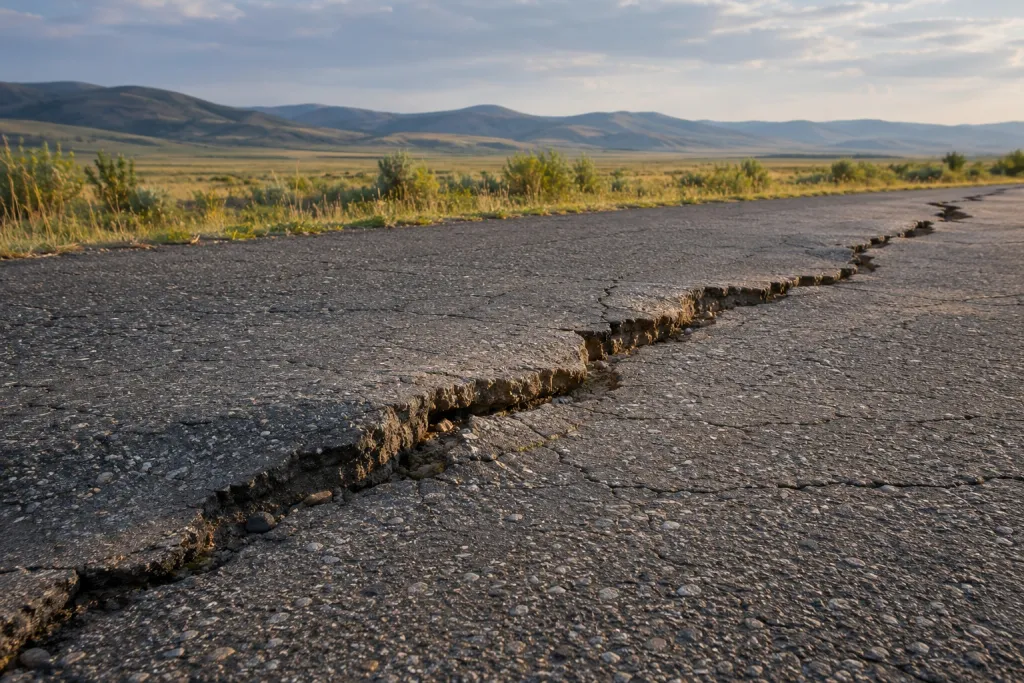
The edges of plates are rough and jagged, so they don’t slide smoothly. They get stuck on each other while the rest of the plate keeps moving. The rock bends and strains, storing up energy like a stretched rubber band. Eventually the pressure gets too strong, and the rocks suddenly break and slip along a crack called a fault. All that stored energy bursts out as seismic waves that ripple through the ground. That’s the shaking you feel.
Explain it like I’m 5
Push your two hands together hard and try to slide them past each other. They stick… stick… then suddenly slip! Big pieces of the ground do the same thing, and when they slip, the ground shakes.
Where do earthquakes happen?
Most earthquakes happen near the edges of tectonic plates. The busiest zone is the Ring of Fire around the Pacific Ocean, which includes places like Japan, Alaska, California, Chile and Indonesia. Scientists record around 20,000 earthquakes a year around the world, about 55 a day, but most are too small to notice.
How are earthquakes measured?
Scientists called seismologists use instruments called seismometers to record shaking. They rate the size of an earthquake with a number called its magnitude. Each step up on the scale releases about 32 times more energy, so a magnitude 6 earthquake is about 1,000 times more powerful than a magnitude 4! The strongest earthquake ever recorded was a magnitude 9.5 in Chile in 1960.
Earthquake safety: Drop, Cover, Hold On
If you ever feel an earthquake: Drop to your hands and knees, Cover your head and neck under a sturdy table or desk, and Hold On until the shaking stops. Stay away from windows and things that could fall. Practicing with your family helps everyone remember.
Try it: make a stick-slip earthquake
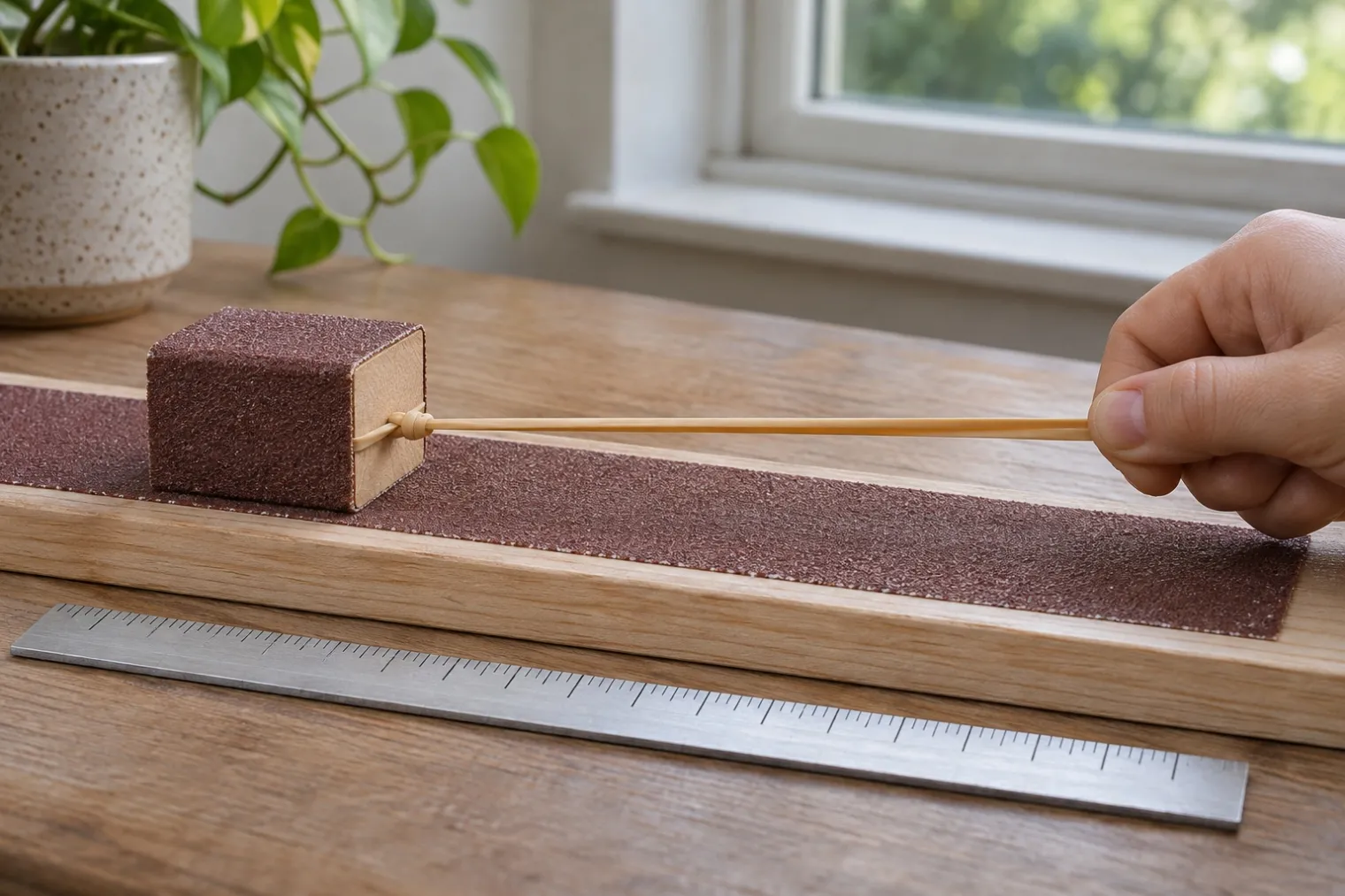
You need: a heavy hardcover book, a thick rubber band, a strip of sandpaper (or a rough towel) and a table.
- Lay the sandpaper on the table, rough side up, and set the book on top.
- Loop the rubber band around the book’s cover so you can pull it like a leash.
- Pull the rubber band very slowly and steadily. Watch it stretch while the book stays put.
- Keep pulling. Suddenly the book jumps forward! Keep going and watch it stick and jump again and again.
What’s happening: friction holds the book in place while the stretching rubber band stores up energy, just like rocks along a fault. When the pull beats the friction, the book lurches forward all at once. Scientists call this “stick-slip,” and it’s exactly how most earthquakes work.
Keep exploring: Build an earthquake shake table · Layers of the Earth · Why Do Volcanoes Erupt? · How Are Mountains Formed?
Words to know
- Tectonic plates
- Giant moving pieces of Earth’s outer shell.
- Fault
- A crack in Earth’s crust where rocks slip past each other.
- Seismic waves
- Waves of energy that travel through the ground during an earthquake.
- Epicenter
- The spot on the surface directly above where an earthquake starts.
- Magnitude
- A number that tells how big an earthquake is.
- Seismologist
- A scientist who studies earthquakes.
For grown-ups: the real science
Most earthquakes result from elastic rebound: strain accumulates in rocks locked along a fault as plates move, then is released in sudden rupture (Harry Fielding Reid’s model after the 1906 San Francisco earthquake). The rupture begins at the hypocenter (focus); the epicenter is the surface point above it. Energy radiates as body waves (faster P-waves and slower S-waves) and surface waves, which usually cause the most damage. Plate motions are typically 2–10 cm per year.
Seismologists now use the moment magnitude scale (Mw) rather than the original Richter scale; each whole-number increase corresponds to about 32 times more energy release and about 10 times greater wave amplitude. The USGS National Earthquake Information Center locates roughly 20,000 earthquakes worldwide each year. The 1960 Valdivia, Chile earthquake (Mw 9.4–9.6) is the largest recorded. “Drop, Cover and Hold On” is the protective action recommended by FEMA, the USGS and earthquake safety programs such as the Great ShakeOut.
Questions kids ask next
Can scientists predict earthquakes?
Not exactly. They know which areas are likely to have earthquakes, but nobody can say the exact day or time. Some places have warning systems that send alerts a few seconds before strong shaking arrives.
What is an aftershock?
A smaller earthquake that happens after a big one, as the rocks settle into their new positions. They can continue for days or even months.
What causes a tsunami?
When a big earthquake happens under the ocean, it can shove a huge amount of water up or down, sending giant waves racing across the sea.
Do earthquakes happen everywhere?
Small ones can happen almost anywhere, but big ones are much more common near plate edges, like the west coast of the United States.
What was the biggest earthquake in the United States?
The Great Alaska Earthquake of 1964, a magnitude 9.2. It shook the ground for about 4 and a half minutes and set off a tsunami. It’s the second-strongest earthquake ever recorded anywhere.