Mountains seem like they’ve been there forever. But every mountain on Earth had a beginning, and some are still growing today. Building a mountain takes enormous forces and millions of years.
It starts with moving plates
Earth’s outer shell is broken into huge pieces called tectonic plates. They move very slowly, only an inch or two a year, about as fast as your fingernails grow. When plates push together, pull apart or slide past each other, the crust gets squeezed, stretched and cracked. Over millions of years, that’s enough to build mountains.
The main kinds of mountains
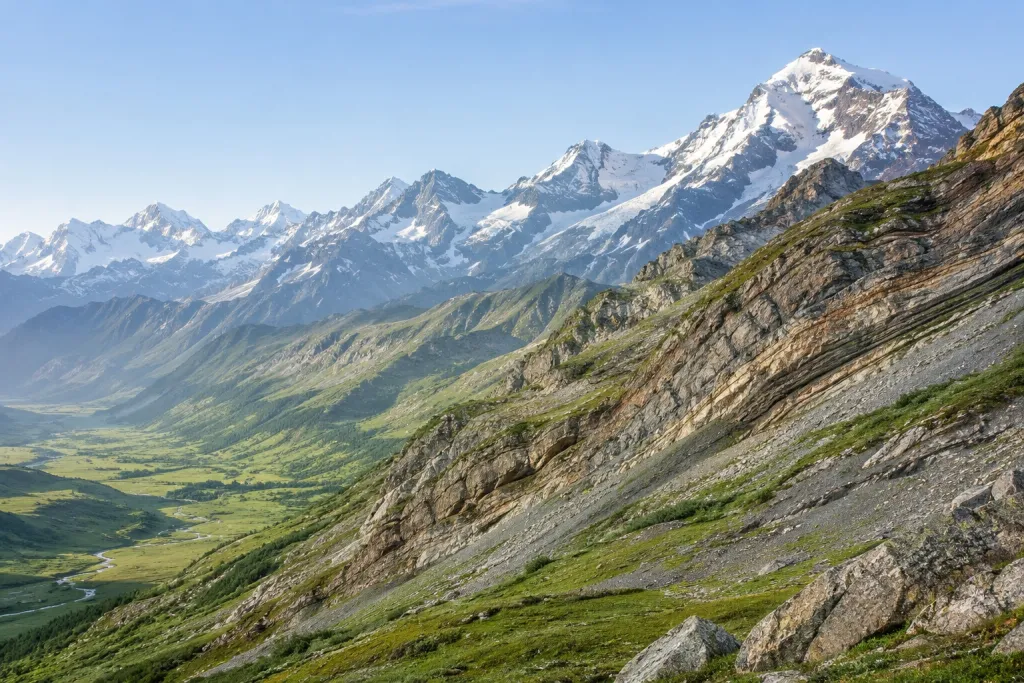
- Fold mountains: when two plates crash together, the rock between them crumples and folds upward, like a rug sliding into a wall. The Himalayas, home of Mount Everest, formed when the plate carrying India rammed into Asia, starting about 50 million years ago. They’re still being pushed up today. The Alps, Andes and Rocky Mountains also formed when plates collided.
- Volcanic mountains: when melted rock erupts again and again, lava and ash pile up into a mountain. Mount Fuji in Japan and the Hawaiian mountains formed this way.
- Fault-block mountains: when the crust stretches, it can crack into huge blocks. Some blocks get pushed up and tilt, while others drop down. The Sierra Nevada in California and the Teton Range in Wyoming are fault-block mountains.
- Dome mountains: magma rises underground and pushes the rock above it up into a dome without erupting.
Explain it like I’m 5
The ground is made of giant puzzle pieces that move super slowly. When two pieces push into each other, the ground scrunches up into big bumps, like a blanket when you push it together. Those bumps are mountains!
Mountains grow and shrink
While some forces push mountains up, others wear them down. Rain, wind, ice and rivers slowly break rock apart and carry it away. This is called erosion. Young mountains, like the Himalayas, are tall and jagged. Old mountains, like the Appalachians in the eastern United States, are lower and rounded because they’ve been worn down for hundreds of millions of years. They were once much taller!
Mount Everest is the highest point on Earth, about 29,032 feet above sea level, and it’s still growing by a tiny bit each year. But measured from its base on the ocean floor, Mauna Kea in Hawaii is even taller, about 33,500 feet from bottom to top!
Try it: fold your own mountain range

You need: play dough or modeling clay in 3 or 4 colors, a rolling pin, 2 heavy books and a plastic knife.
- Roll each color into a flat strip about the same size, like long pancakes.
- Stack the strips on top of each other. These are your rock layers.
- Set a book at each end of the stack. Slowly push the books toward each other. Watch the layers bend and rise!
- Have a grown-up slice your mountain in half with the plastic knife and look at the folded layers inside.
What’s happening: the books act like two colliding tectonic plates. The squeezed layers have nowhere to go but up, so they fold into mountains and valleys. Geologists see these same bent rock layers in road cuts and cliffs all over the world.
Keep exploring: What Causes Earthquakes? · Layers of the Earth · The 3 Types of Rocks
Words to know
- Tectonic plates
- Giant moving pieces of Earth’s outer shell.
- Fold mountain
- A mountain made when rock layers crumple and fold upward.
- Fault
- A crack in Earth’s crust where blocks of rock move.
- Erosion
- When wind, water and ice wear rock away and carry it off.
- Geologist
- A scientist who studies rocks and how Earth changes.
For grown-ups: the real science
Orogeny (mountain building) occurs mainly at convergent plate boundaries. Continent–continent collision, like India–Eurasia beginning about 50 million years ago, thickens the crust through folding and thrust faulting, producing ranges such as the Himalayas; ocean–continent subduction produces volcanic arcs and ranges like the Andes. Fault-block ranges form where extension creates normal faults, producing tilted horsts and grabens, as in the Basin and Range Province, the Sierra Nevada and the Tetons. Isostasy explains why thickened crust sits high and why ranges rebound as erosion removes material.
Everest’s official height is 8,848.86 m (29,031.7 ft), agreed by China and Nepal in 2020; GPS shows ongoing uplift of a few millimeters per year. Mauna Kea rises about 10,200 m (about 33,500 ft) from its base on the seafloor. The Appalachians formed during collisions that assembled the supercontinent Pangaea roughly 480–270 million years ago and have since been deeply eroded.
Questions kids ask next
Why are there seashells on top of mountains?
Some mountain rock formed at the bottom of ancient seas. When plates collided, that rock was pushed up thousands of feet, fossils and all. There are sea fossils near the top of Mount Everest!
Why is it cold on top of mountains?
Air gets thinner and spreads out as you go higher, and thinner air holds less heat. That’s why tall mountains can have snow even in summer.
Are there mountains underwater?
Yes! The longest mountain range on Earth, the mid-ocean ridge, runs about 40,000 miles along the ocean floor.
Are there mountains on other planets?
Yes. Olympus Mons on Mars is a giant volcano about 2½ times taller than Mount Everest.