If you could dig a tunnel straight down through your backyard, what would you find? Dirt and rock at first, but keep going and things get hotter, squishier and stranger. Earth is built in layers, a bit like a peach or a hard-boiled egg: a thin skin, a thick middle and a hard pit at the center.
1. The crust: where we live
The crust is Earth’s rocky outer shell. Compared with the whole planet, it’s super thin, like the skin on an apple. Under the oceans it’s only about 3 to 6 miles thick. Under the continents it’s thicker, usually around 20 to 30 miles, and even thicker under big mountains. The crust is cracked into giant pieces called tectonic plates that slowly move.
2. The mantle: hot, slow-moving rock
The mantle is the thickest layer, about 1,800 miles deep. It’s made of very hot rock. Even though it’s mostly solid, it flows super slowly over millions of years, like extremely thick silly putty. Those slow currents help push the plates around on the surface, causing earthquakes and building mountains and volcanoes.
3. The outer core: liquid metal
The outer core is a layer of melted metal, mostly iron and nickel, about 1,400 miles thick. As this liquid metal swirls around, it creates Earth’s magnetic field, the invisible force that makes compass needles point north and protects us from harmful particles from the Sun.
4. The inner core: a solid metal ball
At the very center is the inner core, a solid ball of iron and nickel about 1,500 miles across, a bit smaller than our Moon. It’s around 9,400°F (5,200°C), about as hot as the surface of the Sun! It’s so hot you’d expect it to melt, but the crushing weight of the whole planet above it squeezes it into a solid.
Explain it like I’m 5
Earth is like a peach. The skin is the crust, where we live. The juicy part is the mantle, made of hot rock. And the pit in the middle is the core, a super-hot ball of metal.
How do we know, if nobody’s been there?
The deepest hole people have ever drilled, in Russia, only reached about 7½ miles down, barely scratching the crust. So how do scientists know what’s at the center, almost 4,000 miles down? Earthquakes! Earthquakes send waves through the whole planet. Those waves speed up, slow down and bend as they pass through different materials, and some kinds of waves can’t travel through liquid at all. By recording earthquake waves all around the world, scientists mapped Earth’s insides like an X-ray.
Try it: build a play dough Earth
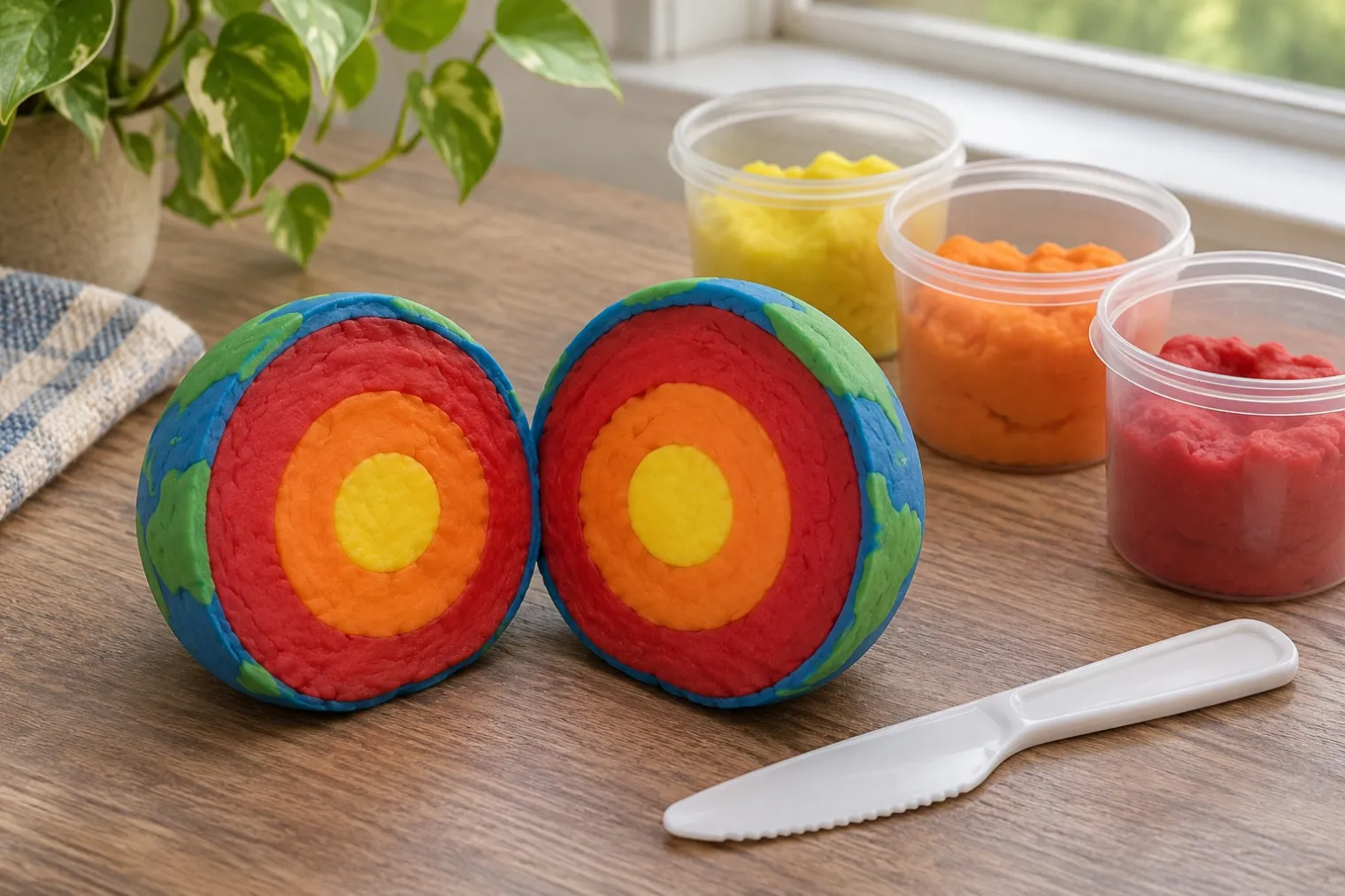
You need: play dough or modeling clay in 4 colors (yellow, orange, red and brown or green) and a piece of dental floss or a plastic knife.
- Roll a small yellow ball, about the size of a marble. That’s the inner core.
- Wrap it in a layer of orange for the outer core.
- Wrap that in a thick layer of red for the mantle. Make this the biggest layer!
- Cover it all with a very thin layer of brown or green for the crust (blue and green look like oceans and land). Then have a grown-up slice the ball in half with floss and look at your layers.
What’s happening: your cutaway looks just like the diagrams scientists draw. Notice how thin the crust is compared with everything else. On the real Earth, the whole crust is only about 1% of the way to the center.
Keep exploring: What Causes Earthquakes? · Why Do Volcanoes Erupt? · How Are Diamonds Made?
Words to know
- Crust
- Earth’s thin, rocky outer layer.
- Mantle
- The thick layer of hot, slowly flowing rock under the crust.
- Outer core
- A layer of liquid iron and nickel.
- Inner core
- The solid metal ball at Earth’s center.
- Tectonic plates
- Giant moving pieces of Earth’s crust.
- Seismologist
- A scientist who studies earthquakes and Earth’s insides.
For grown-ups: the real science
Earth’s mean radius is about 6,371 km. Oceanic crust is roughly 5–10 km thick and continental crust 30–50 km (up to about 70 km beneath major ranges). The crust plus the rigid uppermost mantle form the lithosphere, which rides on the ductile asthenosphere. The mantle extends to about 2,890 km depth; the liquid outer core to about 5,150 km; the solid inner core has a radius of about 1,220 km and a temperature estimated near 5,200°C, comparable to the Sun’s photosphere (about 5,500°C).
The structure was inferred seismologically: Richard Oldham identified the core in 1906, Beno Gutenberg located the core–mantle boundary in 1913 and Inge Lehmann discovered the inner core in 1936. S-waves don’t propagate through the liquid outer core, producing an S-wave shadow zone. Convection in the outer core drives the geodynamo responsible for Earth’s magnetic field. The Kola Superdeep Borehole reached about 12.2 km in 1989.
Questions kids ask next
Could we dig to the center of the Earth?
Not with any machine we have. The heat and pressure deep down would melt and crush drills long before they got close.
Why is the center of the Earth so hot?
Some heat is left over from when Earth formed 4.5 billion years ago, and some comes from natural radioactive elements slowly breaking down inside the planet.
Is lava from the mantle?
Yes. Magma forms when parts of the upper mantle or deep crust melt, then rises up through cracks and comes out of volcanoes as lava.
Which layer is the biggest?
The mantle. It makes up about 84% of Earth’s volume.