A sparkling diamond and the gray tip of your pencil seem like total opposites. One is clear, hard and precious. The other is soft and smudgy. But here’s a surprise: they’re made of exactly the same thing. The only difference is how they were made.
Diamonds are made of carbon
Carbon is one of the most important elements on Earth. It’s in your body, in trees, in the air and in pencil “lead,” which is really a mineral called graphite. A diamond is pure carbon too. What makes it special is the way its atoms are packed together.
Born deep underground
Most natural diamonds formed about 90 to 120 miles (150 to 200 kilometers) below the surface, in a layer of Earth called the mantle. Down there, temperatures reach about 2,000°F (1,100°C) and the pressure is enormous, like having several jumbo jets stacked on your fingertip. That extreme squeeze forces carbon atoms to lock tightly together into a diamond crystal.
And it took a long time. Most diamonds are 1 to 3½ billion years old, older than dinosaurs, older than almost any living thing.
A fast ride to the surface
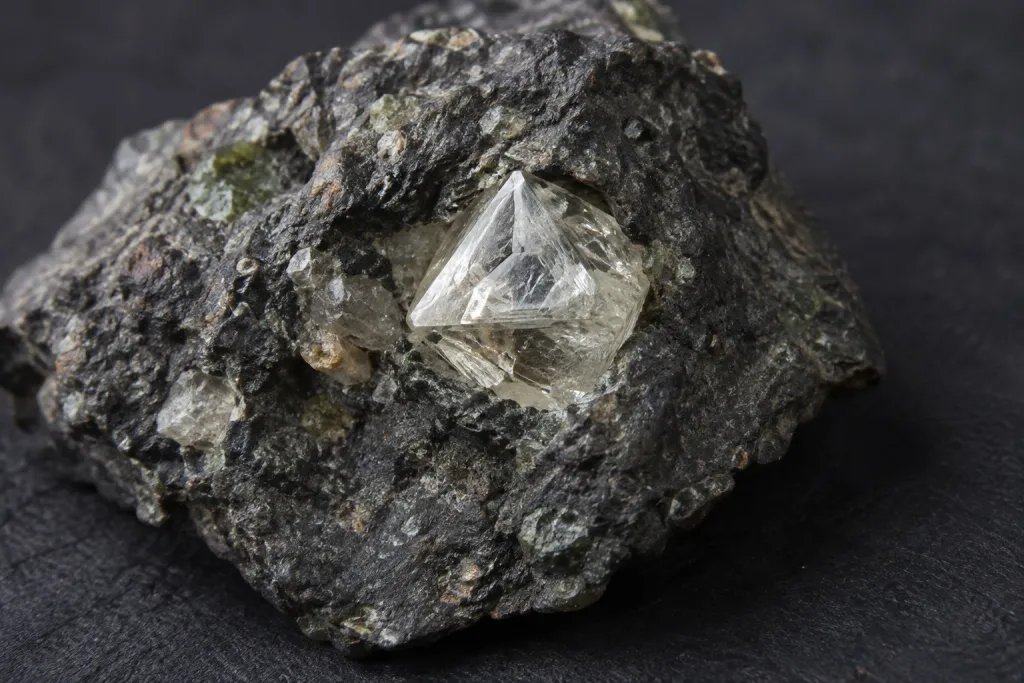
So how did diamonds get from deep in the mantle into rings? Rare, powerful volcanic eruptions shot magma up from incredibly deep, carrying diamonds with it. The eruptions were fast, so the diamonds didn’t have time to change. The magma cooled in carrot-shaped tubes of rock called kimberlite pipes, which is where most diamonds are mined today.
Explain it like I’m 5
Way, way down inside Earth, it’s super hot and things get squished really hard. When the stuff in pencils gets squished like that for a super long time, it turns into a sparkly diamond. Then a volcano gives it a ride up to the top.
Why diamonds are so hard
In a diamond, every carbon atom holds on tightly to four neighbors, in every direction, building a strong 3D frame like a jungle gym. That makes diamond the hardest natural material on Earth. It scores a 10, the top, on the Mohs hardness scale. Only another diamond can scratch it.
In graphite, the carbon atoms are arranged in flat sheets stacked like pages in a book. The sheets slide off easily, which is why a pencil leaves a gray line on paper.
Diamonds made in a lab
Scientists can now make real diamonds in a few weeks using machines that copy the heat and pressure deep in Earth, or by building diamonds one atom layer at a time from carbon gas. Lab-grown diamonds are chemically the same as mined ones. Lots of diamonds are also used in tools, like saw blades and drill tips that cut through stone.
Try it: build diamond and graphite with marshmallows
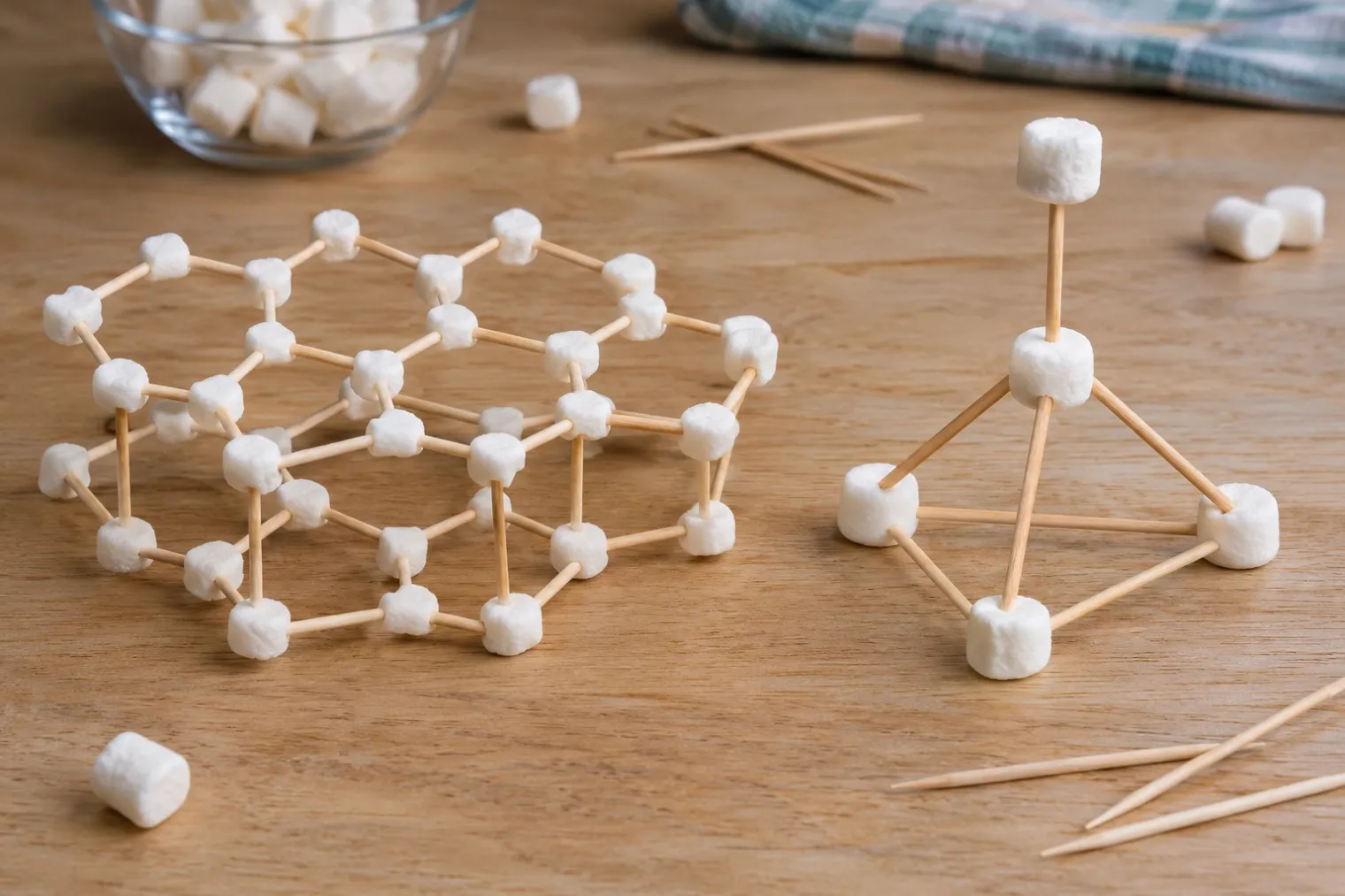
You need: mini marshmallows (or gumdrops) and toothpicks.
- Graphite: make a flat sheet of hexagons (six-sided shapes) with marshmallows at the corners, like a honeycomb. Make two sheets and lay one on top of the other.
- Push the top sheet sideways. See how easily it slides? That’s why pencils write.
- Diamond: take one marshmallow and stick 4 toothpicks in it, pointing in different directions like a little tripod with one stick pointing up. Add a marshmallow to the end of each toothpick, then keep adding pieces in the same pattern.
- Gently press on your diamond shape from different sides. Compare it to the sheets.
What’s happening: each marshmallow is a carbon atom. In your diamond model, each atom connects in four directions, making a sturdy 3D frame. In graphite, the atoms only connect within flat sheets, so the layers slide. Same atoms, different arrangement, totally different material.
Keep exploring: The 3 Types of Rocks · Why Do Volcanoes Erupt? · How Are Snowflakes Formed?
Words to know
- Carbon
- An element found in all living things, in diamonds and in pencil lead.
- Graphite
- A soft, gray form of carbon used in pencils.
- Mantle
- The thick, hot layer of Earth below the crust.
- Kimberlite pipe
- A carrot-shaped tube of volcanic rock where diamonds are often found.
- Crystal
- A solid whose atoms are arranged in a neat, repeating pattern.
For grown-ups: the real science
Diamond is the high-pressure polymorph of carbon. Each atom is sp3-bonded to four others in a tetrahedral cubic lattice; graphite is sp2-bonded in hexagonal sheets held together by weak van der Waals forces. Most gem diamonds crystallized in the lithospheric mantle beneath old, stable cratons at roughly 150–200 km depth and 900–1,300°C; a small fraction, “superdeep” diamonds, come from 300–700 km or more and carry mineral inclusions that sample the deep mantle.
Diamonds are metastable at the surface; they survive because kimberlite and lamproite magmas ascend rapidly (likely hours to days), preventing conversion to graphite. Synthetic diamonds are produced by high-pressure, high-temperature (HPHT) presses or chemical vapor deposition (CVD); they are physically and chemically identical to natural diamonds and are distinguished by growth features and trace defects.
Questions kids ask next
Are diamonds made from coal?
It’s a popular myth, but no. Coal forms near the surface from old plants, while most diamonds formed far deeper and are much older than the first land plants.
Can a diamond break?
Yes. Hard isn’t the same as unbreakable. Diamond resists scratching, but a sharp hit in the wrong direction can chip or split it.
Can diamonds burn?
Yes! Because they’re pure carbon, a diamond heated to very high temperatures in air will burn away into carbon dioxide gas.
Are there diamonds in space?
Yes. Tiny diamonds have been found in meteorites, and scientists think it may “rain” diamonds deep inside giant planets like Neptune and Uranus.