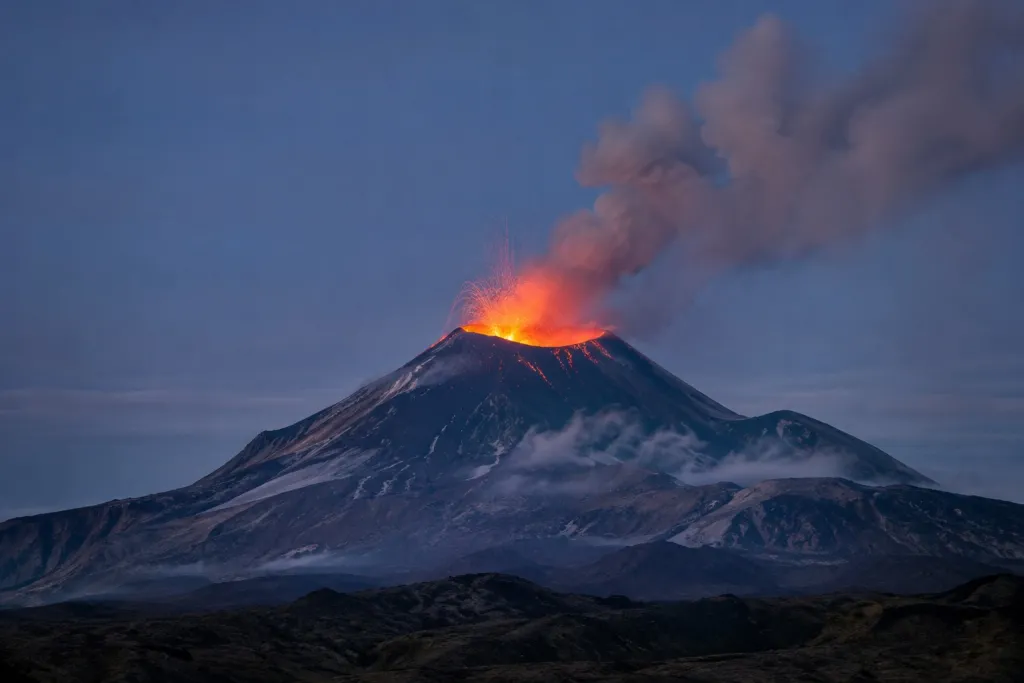
A volcano can sit quietly for hundreds of years, then suddenly rumble, smoke and blast out glowing lava. It’s one of the most powerful sights on Earth. To understand why it happens, we need to look deep underground, and think about a bottle of soda.
Step 1: Rock melts into magma
Earth gets hotter the deeper you go. Tens of miles down, in some places, rock gets hot enough to partly melt into a thick, glowing liquid called magma. This mostly happens where Earth’s giant puzzle-piece plates pull apart or where one plate slides underneath another, and over a few extra-hot spots in the mantle, like the one under Hawaii.
Step 2: Magma rises
Magma is lighter than the solid rock around it, so it slowly pushes upward, the way a beach ball held underwater pops back up. It collects in a big underground pool called a magma chamber.
Step 3: Gas builds pressure
Here’s the soda part. Magma holds dissolved gases, mostly water vapor and carbon dioxide, squeezed in by the enormous pressure underground. That’s just like the carbon dioxide hidden in a closed bottle of soda. As magma rises, the pressure on it drops, and the gas comes out as bubbles. The bubbles grow and push, and pressure builds up in the chamber.
Step 4: Eruption!
When the pressure is stronger than the rock holding it down, magma bursts up through cracks and out of the volcano. Once it reaches the surface, it’s called lava. Along with it come gases and sometimes clouds of ash, which is made of tiny bits of shattered rock and glass, not soft like ash from a fire.
Explain it like I’m 5
Way down under the ground, some rock is so hot it melts. The melted rock has bubbles in it, like soda. The bubbles push and push until the melted rock shoots out the top of the volcano!
Why some volcanoes explode and others ooze
It depends on how runny the magma is. Hawaii’s volcanoes have thin, runny magma, like warm syrup. Gas escapes easily, so lava pours out in glowing rivers. Other volcanoes, like Mount St. Helens, have thick, sticky magma, like peanut butter. Gas gets trapped until it blasts out all at once in a huge explosion of ash.
The Ring of Fire
About three-quarters of Earth’s active volcanoes sit around the edges of the Pacific Ocean, in a giant horseshoe called the Ring of Fire. That’s where ocean plates slide under other plates and melt. There are about 1,350 potentially active volcanoes on land around the world, plus many more hidden on the ocean floor.
Try it: see gas pressure in a bottle
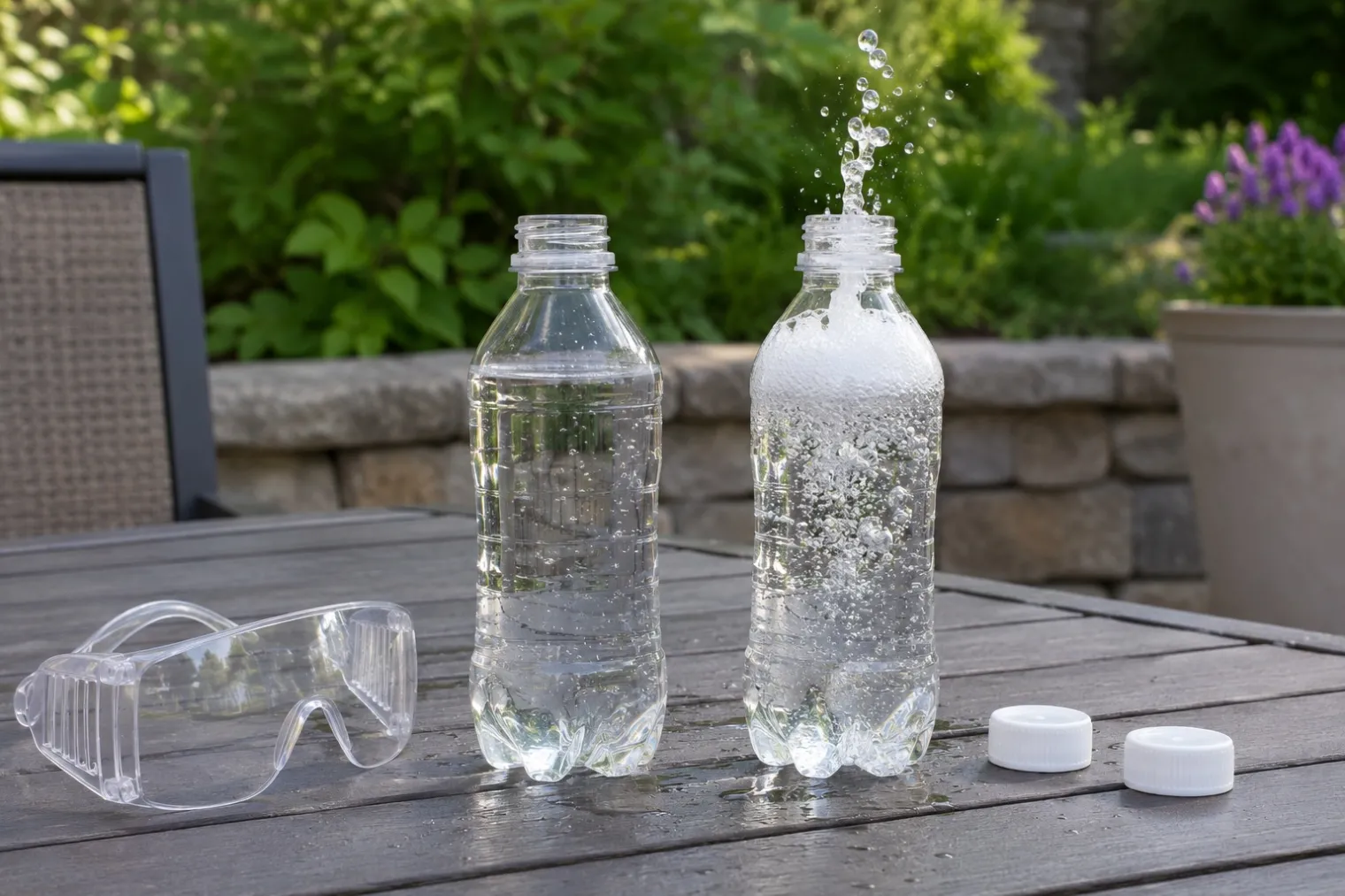
You need: 2 small plastic bottles of sparkling water (the same kind) and an outdoor spot. Safety glasses are a good idea.
- Look at both closed bottles. Do you see bubbles? (Hardly any. The gas is dissolved and squeezed in, like gas in deep magma.)
- Open the first bottle slowly, pointing it away from everyone. Watch the bubbles appear as the pressure drops.
- Gently shake the second bottle for 10 seconds. Squeeze the sides: does it feel harder?
- Point it away from everyone and open it fast. Compare the two “eruptions.”
What’s happening: releasing the pressure lets gas come out of the liquid as bubbles. Shaking makes lots of bubbles at once, and the trapped gas blasts out, like an explosive eruption. For a fizzy volcano you can build yourself, try our snow volcano experiment.
Keep exploring: The 3 Types of Rocks · How Are Diamonds Made? · How Do Hurricanes Form?
Words to know
- Magma
- Melted rock underground.
- Lava
- Melted rock that has come out onto Earth’s surface.
- Magma chamber
- A large underground pool of magma beneath a volcano.
- Ash
- Tiny sharp bits of rock and glass blasted out by a volcano.
- Tectonic plates
- The giant moving pieces that make up Earth’s outer shell.
- Volcanologist
- A scientist who studies volcanoes.
For grown-ups: the real science
Magma forms by decompression melting (at mid-ocean ridges and hotspots), flux melting (at subduction zones, where water released from the down-going slab lowers the melting point of the mantle wedge) and, less commonly, heat transfer into crustal rocks. Buoyant melt ascends and accumulates in crustal reservoirs, today understood often as crystal-rich “mush” zones rather than large liquid tanks. Volatile solubility (H₂O, CO₂, SO₂) decreases with falling pressure, so ascending magma vesiculates; bubble growth drives overpressure and fragmentation.
Eruptive style depends largely on viscosity, which rises with silica content and falling temperature. Low-silica basaltic magma (Kīlauea) degasses efficiently and erupts effusively; high-silica andesitic to rhyolitic magma traps gas and tends to erupt explosively (Mount St. Helens, 1980; Pinatubo, 1991). The Smithsonian Global Volcanism Program counts about 1,350 Holocene volcanoes on land, with roughly 40–50 erupting at any given time.
Questions kids ask next
How hot is lava?
Usually about 1,300 to 2,200°F (700 to 1,200°C). That’s hot enough to melt glass and much hotter than a pizza oven.
Can scientists predict eruptions?
Sometimes. They watch for warning signs like small earthquakes, the ground swelling and changes in gases. They can often warn people days or weeks ahead, but not always exactly when.
What’s the biggest volcano?
On Earth, Mauna Loa in Hawaii is the largest active volcano by volume. In the whole solar system, Olympus Mons on Mars is the tallest, about 2½ times as tall as Mount Everest.
Are volcanoes ever good?
Yes! Volcanic ash makes very rich soil for farming, volcanoes built islands like Hawaii and Iceland, and their heat can make clean electricity.