Why do you have your mom’s smile or your dad’s curly hair? Why does a puppy grow into a dog and not a cat? The answer is tucked inside almost every cell of your body, in a long, twisty molecule called DNA.
DNA is an instruction book
Your body is built from trillions of tiny cells. Inside most of them is a control center called the nucleus, and inside that is your DNA. DNA holds the instructions for building and running you: what color your eyes are, how your heart beats, how to heal a scraped knee. Every living thing has DNA, from oak trees to octopuses to the yeast in bread dough.
DNA stands for deoxyribonucleic acid (say it: dee-OX-ee-RYE-bo-new-CLAY-ick acid). That’s a mouthful, which is why everyone just says DNA.
A twisted ladder with a 4-letter code
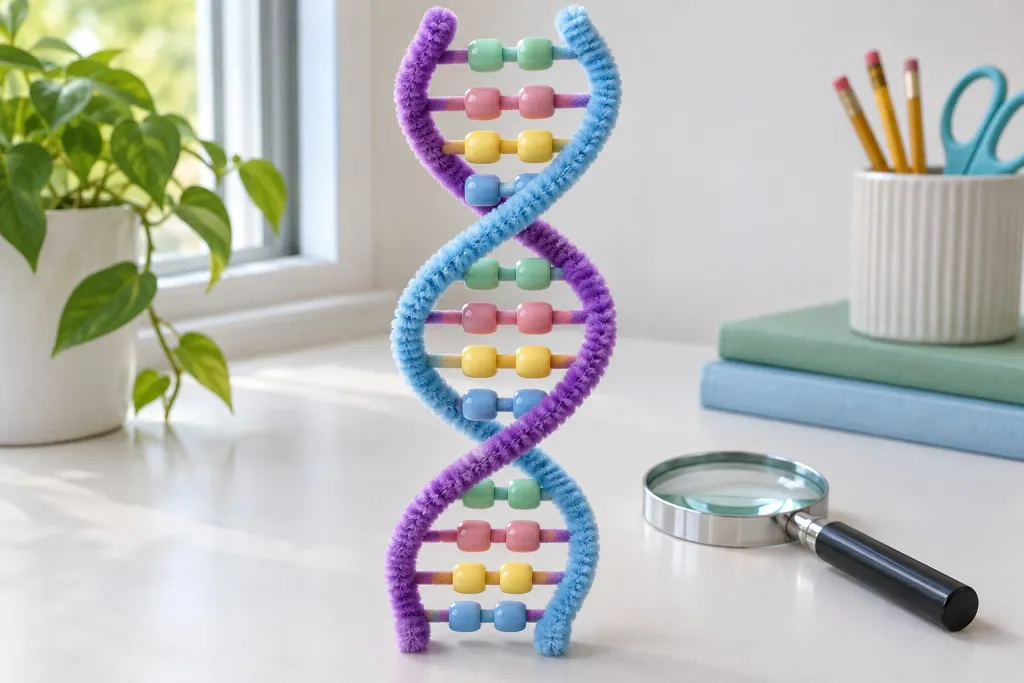
DNA is shaped like a ladder twisted into a spiral. Scientists call this shape a double helix. The rungs of the ladder are made of four chemicals, called bases, that scientists write as letters:
- A (adenine) always pairs with T (thymine)
- C (cytosine) always pairs with G (guanine)
The order of the letters is the code, just like the order of letters in a word gives it meaning. “CAT” and “ACT” use the same letters but say different things. Your DNA is about 3 billion letter pairs long. If you printed it out, it would fill a stack of books taller than a house.
Explain it like I’m 5
Inside you are teeny-tiny instruction books called DNA. They tell your body how to grow and what you’ll look like. You got half your instructions from your mom and half from your dad.
Genes: the chapters of the book
A gene is a section of DNA with the instructions for one job, like making a protein that colors your eyes. You have about 20,000 genes. You got half of your DNA from each parent, which is why you might have your dad’s dimples and your mom’s freckles, but also your own special mix that nobody else has (unless you have an identical twin).
Amazing DNA facts
- It’s super long. The DNA in just one of your cells, stretched out, would be about 6 feet long. It’s coiled up so tightly it fits in a space far too small to see.
- People are nearly identical. Any two humans share about 99.9% of the same DNA. The tiny 0.1% difference makes each of us unique.
- We’re related to bananas. Many of our genes have a match in bananas, because all living things share some of the same basic instructions.
- Discovering its shape took teamwork. In 1953, James Watson and Francis Crick figured out the double helix, using an X-ray photo of DNA taken by scientist Rosalind Franklin.
Try it: pull DNA out of a strawberry
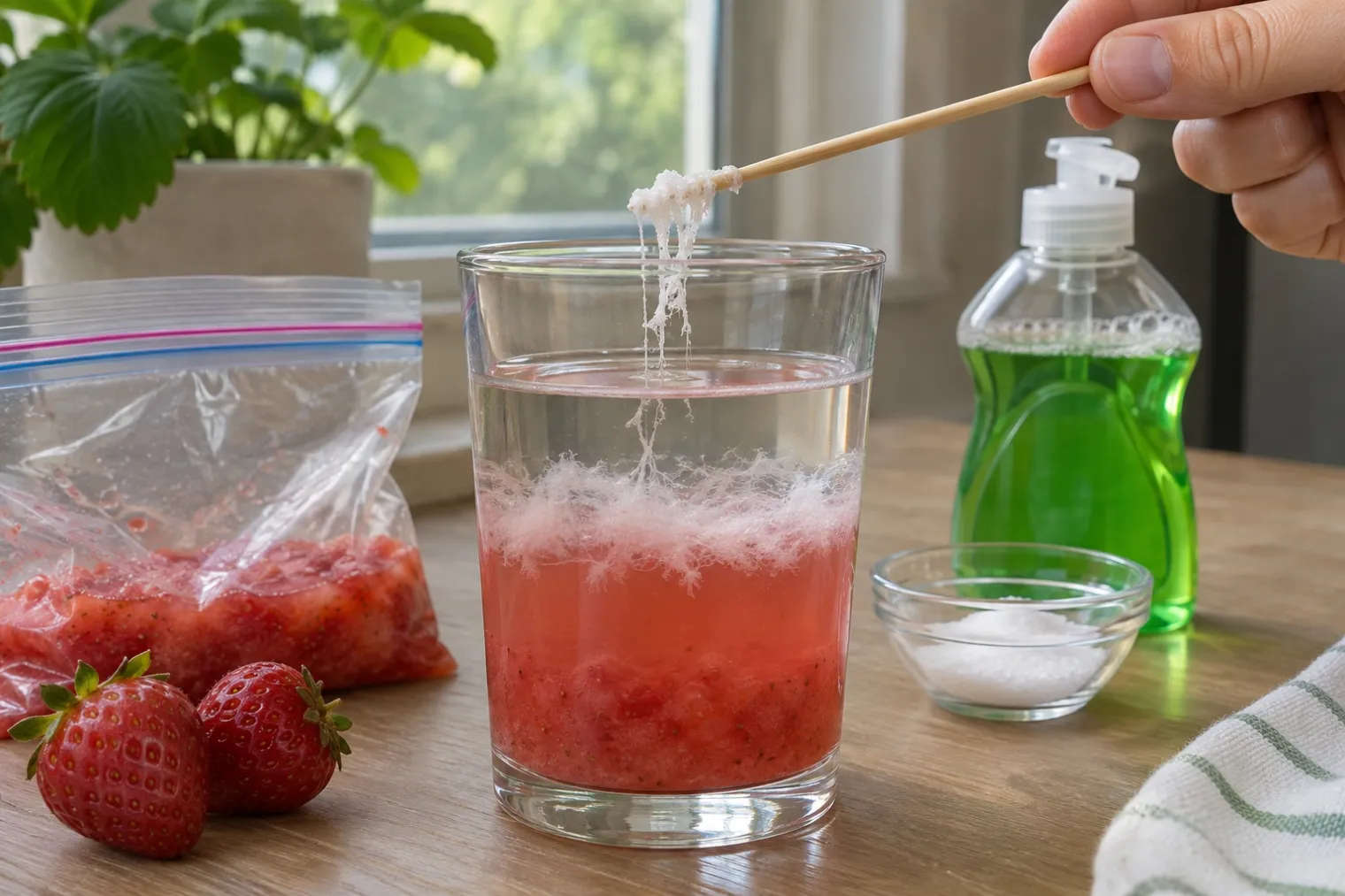
You need: 2 or 3 strawberries, a zip-top bag, 1/2 cup water, 2 teaspoons dish soap, 1/2 teaspoon salt, a coffee filter, a clear glass, a toothpick and ice-cold rubbing alcohol (chilled in the freezer; a grown-up handles it).
- Pull the green tops off the strawberries and seal them in the bag. Mash them with your fists for 2 minutes.
- Mix the water, soap and salt in a cup. Pour it into the bag and gently squish for 1 more minute.
- Set the coffee filter in the glass and pour the strawberry goop in. Let the liquid drip through for a few minutes, then remove the filter.
- A grown-up slowly pours ice-cold rubbing alcohol down the side of the glass so it forms a layer on top. Wait a minute and watch for white, cloudy strands rising into the alcohol. Twirl them up with the toothpick!
What’s happening: the soap breaks open the strawberry cells, the salt helps the DNA clump together, and DNA doesn’t dissolve in cold alcohol, so it comes out as stringy white goo. Those strands are millions of DNA molecules bundled together. Don’t eat the strawberries afterward, and keep the alcohol away from flames.
Keep exploring: Strawberry DNA Extraction · Parts of a Cell · What Is an Atom? · Why Does Hair Turn Gray?
Words to know
- DNA
- The molecule that holds the instructions for building and running a living thing.
- Cell
- The tiny building block that all living things are made of.
- Gene
- A section of DNA with instructions for one job.
- Double helix
- The twisted-ladder shape of DNA.
- Base
- One of the four chemical “letters” of DNA: A, T, C or G.
- Nucleus
- The control center of a cell, where most DNA is kept.
For grown-ups: the real science
DNA is a polymer of nucleotides (a deoxyribose sugar, a phosphate group and one of four nitrogenous bases). Two antiparallel strands form a right-handed double helix held together by hydrogen bonds between complementary bases (A–T, C–G). The human genome has about 3.1 billion base pairs and roughly 20,000 protein-coding genes; DNA in a diploid cell totals about 2 meters when extended, packaged by histones into chromatin and 46 chromosomes. Genes are transcribed into RNA and translated into proteins.
Watson and Crick’s 1953 model drew on Rosalind Franklin and Raymond Gosling’s X-ray diffraction “Photo 51” and Maurice Wilkins’s work; Franklin died in 1958 and was not included in the 1962 Nobel Prize. The often-quoted banana figure comes from NHGRI: about 60% of human genes have a recognizable counterpart in the banana genome. In the extraction demo, strawberries work well because they are octoploid (eight copies of each chromosome). Detergent dissolves membranes, NaCl neutralizes DNA’s negative charge so strands aggregate, and DNA precipitates in cold ethanol or isopropanol.
Questions kids ask next
Do identical twins have the same DNA?
Almost exactly, because they started as one cell that split in two. Tiny differences still build up as they grow, and their fingerprints are different.
Can DNA solve crimes?
Yes. Because everyone’s DNA is slightly different, scientists can match DNA from a hair or a drop of saliva to a person. It’s also used to find long-lost relatives.
Does DNA change?
Small changes, called mutations, happen sometimes. Most do nothing, a few cause problems, and over very long times, helpful changes help living things adapt.
Do plants have DNA?
Yes! Every living thing does, which is why you can pull it out of a strawberry.