Look at your hand. Now look at your desk, a glass of water, the air you breathe. They seem totally different, but they’re all made of the same kind of thing: unbelievably tiny pieces called atoms.
The building blocks of everything
Think of atoms like LEGO bricks. With a box of LEGO, you can build a car, a castle or a dragon, all from the same basic pieces. In the same way, atoms snap together to make everything in the universe. When atoms join up, they form molecules. Two hydrogen atoms plus one oxygen atom make a molecule of water: H₂O.
How small is an atom?
Ridiculously small. About half a million atoms lined up side by side would just stretch across one human hair. A single grain of sand contains more atoms than there are grains of sand on all the beaches on Earth. Atoms are too small to see even with a school microscope. Scientists use special machines to make pictures of them.
What’s inside an atom?
Atoms are made of even smaller pieces:
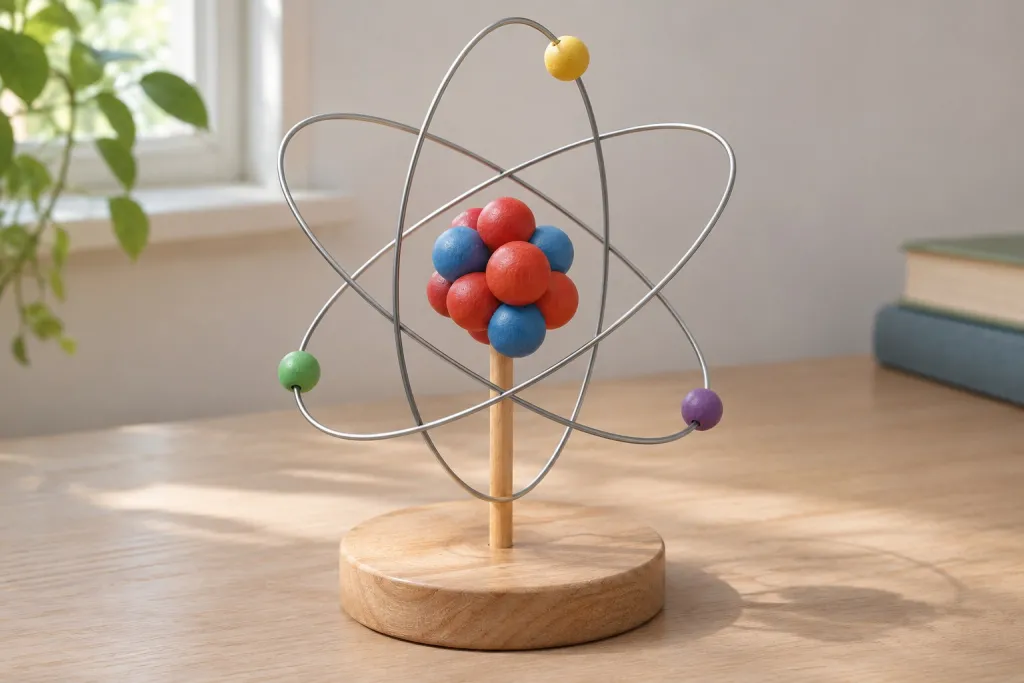
- Protons have a positive (+) charge and sit in the center, called the nucleus.
- Neutrons have no charge and sit in the nucleus with the protons.
- Electrons have a negative (−) charge and zip around the nucleus in a fuzzy cloud. They’re much, much lighter than protons.
Here’s a wild fact: atoms are mostly empty space. If the nucleus were the size of a marble in the middle of a football stadium, the electrons would be buzzing around up in the highest seats.
Explain it like I’m 5
Everything is made of teeny-tiny pieces called atoms. They’re so small you could never see them. Atoms stick together like building blocks to make you, your toys, the air and everything else!
Different atoms, different elements
What makes a gold atom different from an oxygen atom? The number of protons. Every atom with 1 proton is hydrogen. Every atom with 6 protons is carbon. Every atom with 79 protons is gold. Each kind of atom is called an element, and scientists have found 118 of them. They’re organized in a chart called the periodic table. Your body is made mostly of just a few: oxygen, carbon, hydrogen and nitrogen.
The idea of atoms is very old. About 2,400 years ago, a Greek thinker named Democritus guessed that if you kept cutting something in half, you’d eventually reach a piece that couldn’t be cut. He called it atomos, meaning “uncuttable.” Scientists later learned atoms can be split into even smaller parts, but the name stuck.
Try it: build a candy atom
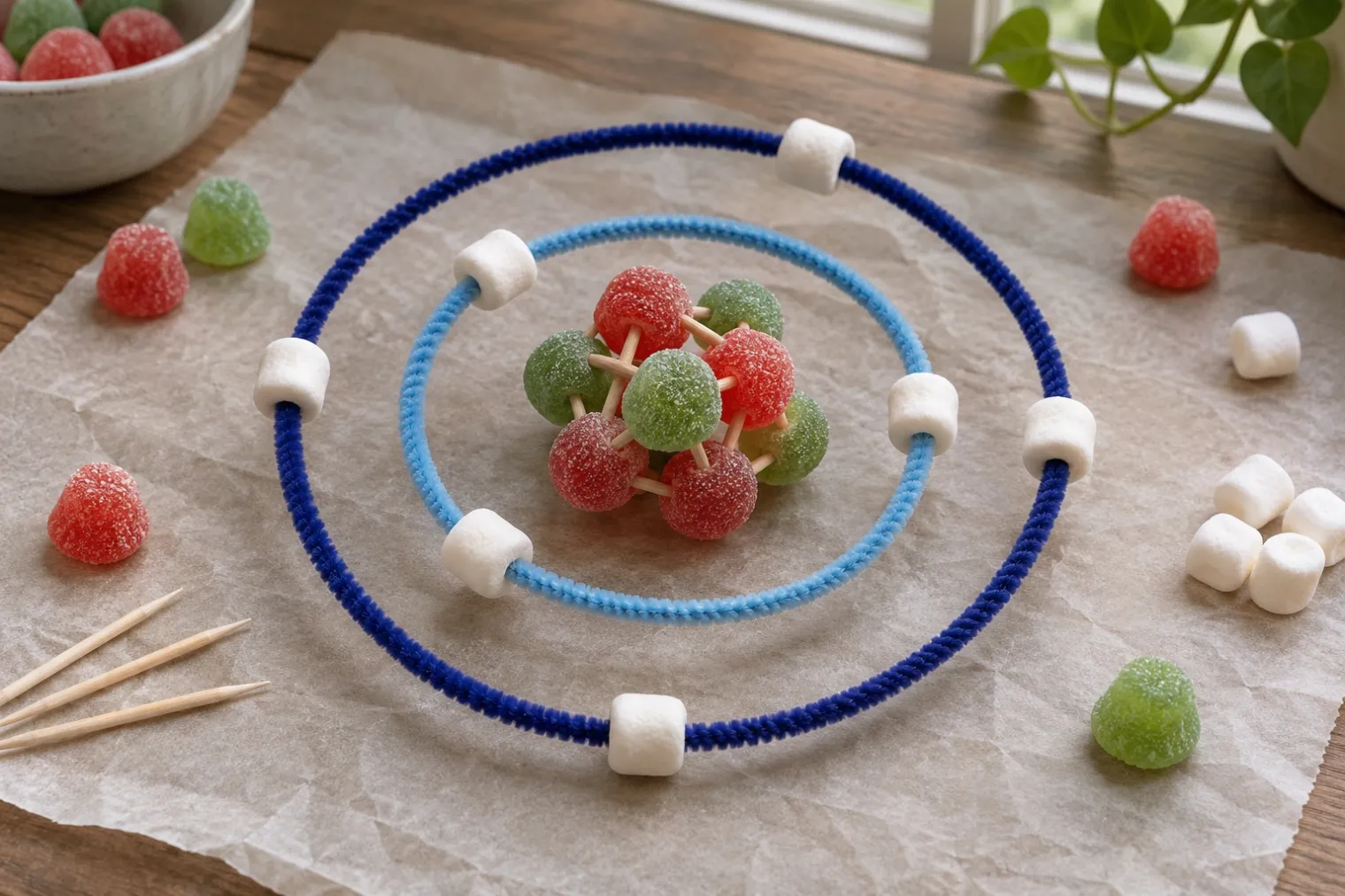
You need: a paper plate, a marker, mini marshmallows or pom-poms in 2 colors, and small candies or cereal pieces for electrons.
- Draw a small circle in the middle of the plate for the nucleus, and 2 bigger rings around it for electron paths.
- Build a helium atom: put 2 marshmallows of one color (protons) and 2 of the other color (neutrons) in the nucleus, and 2 candies (electrons) on the first ring.
- Now build carbon: 6 protons and 6 neutrons in the middle. Put 2 electrons on the first ring and 4 on the second ring.
- Challenge: look up how many protons oxygen has, and build it!
What’s happening: changing the number of protons changes which element you’ve made, which is exactly how real atoms work. A normal atom has the same number of electrons as protons, so its charges balance out. (Oxygen has 8.)
Keep exploring: What Is DNA? · What Is Heat? · How Are Diamonds Made?
Words to know
- Atom
- The tiny building block that all matter is made of.
- Nucleus
- The center of an atom, made of protons and neutrons.
- Proton
- A particle in the nucleus with a positive charge.
- Neutron
- A particle in the nucleus with no charge.
- Electron
- A tiny particle with a negative charge that moves around the nucleus.
- Element
- A kind of atom, like hydrogen, carbon or gold.
- Molecule
- Two or more atoms joined together.
For grown-ups: the real science
Atoms have radii of roughly 0.03–0.3 nanometers; a human hair (about 70–100 μm wide) spans on the order of several hundred thousand atoms. The nucleus is about 1/100,000 the diameter of the atom yet holds over 99.9% of its mass. Protons and neutrons are made of quarks; electrons are fundamental particles. Modern quantum mechanics describes electrons as probability clouds (orbitals) rather than planet-like orbits; the ring model in the activity is the simplified Bohr picture, useful for counting electron shells.
Atomic number (proton count) defines the element; atoms of the same element with different neutron counts are isotopes. 118 elements are confirmed, with oganesson (118) the heaviest; the last four were officially named in 2016. Democritus and Leucippus proposed atomism in the 5th century BCE; John Dalton’s atomic theory (1808), J.J. Thomson’s discovery of the electron (1897) and Ernest Rutherford’s gold-foil experiment revealing the nucleus (1911) built the modern picture. Individual atoms can be imaged with scanning tunneling and transmission electron microscopes.
Questions kids ask next
Can you see an atom?
Not with your eyes or a regular microscope. Special microscopes that use electrons instead of light can make images of individual atoms.
Are atoms alive?
No. Atoms aren’t alive, but living things are built from them. The atoms in your body were once in plants, animals, rocks and air, and some were made inside ancient stars.
What is the smallest atom?
Hydrogen is the lightest and simplest atom. It has just 1 proton and 1 electron, and it’s the most common element in the universe. By size, though, helium is a tiny bit smaller, because its 2 protons pull its electrons in closer.
Can atoms be split?
Yes, but it takes huge amounts of energy. Splitting certain big atoms is how nuclear power plants make electricity.
How many atoms are in the human body?
About 7 octillion in a grown-up. That’s a 7 followed by 27 zeros! Most of them are hydrogen, oxygen and carbon atoms.