You are made of about 30 trillion cells. So is a tree, in its own way, and so is your dog. Even a single drop of pond water is full of creatures made of just one cell. Cells are the smallest living building blocks, and inside each one is a busy little world.
A cell is like a tiny city
A city has a city hall, power plants, factories, roads and a border. A cell has parts that do those same jobs. Scientists call the parts organelles, which means “little organs.” Here are the main ones:
- Cell membrane (the city border): a thin, flexible skin around the cell that decides what comes in and what goes out.
- Nucleus (city hall): the control center. It holds the cell’s DNA, the instructions for everything the cell does.
- Cytoplasm (the city grounds): the jelly-like goo that fills the cell, where all the other parts float.
- Mitochondria (power plants): turn food into energy the cell can use. Busy cells, like muscle cells, have lots of them.
- Ribosomes (factories): tiny dots that build proteins, the materials the cell needs.
- Endoplasmic reticulum and Golgi body (roads and post office): folded tubes and stacks that move, package and ship proteins around the cell.
- Vacuoles (storage closets): bubbles that hold water, food or waste.
Plant cells have extra parts
- Cell wall: a stiff outer layer around the membrane that gives plants their shape, like a box around the cell.
- Chloroplasts: green organelles that use sunlight to make food (that’s photosynthesis).
- A big central vacuole: a giant water tank that pushes outward and keeps the plant firm. When a plant wilts, its vacuoles are low on water.
Explain it like I’m 5
Your body is built from teeny-tiny pieces called cells, like a house made of bricks. Each cell has a boss in the middle called the nucleus and little helpers that make energy and build things.
How we discovered cells
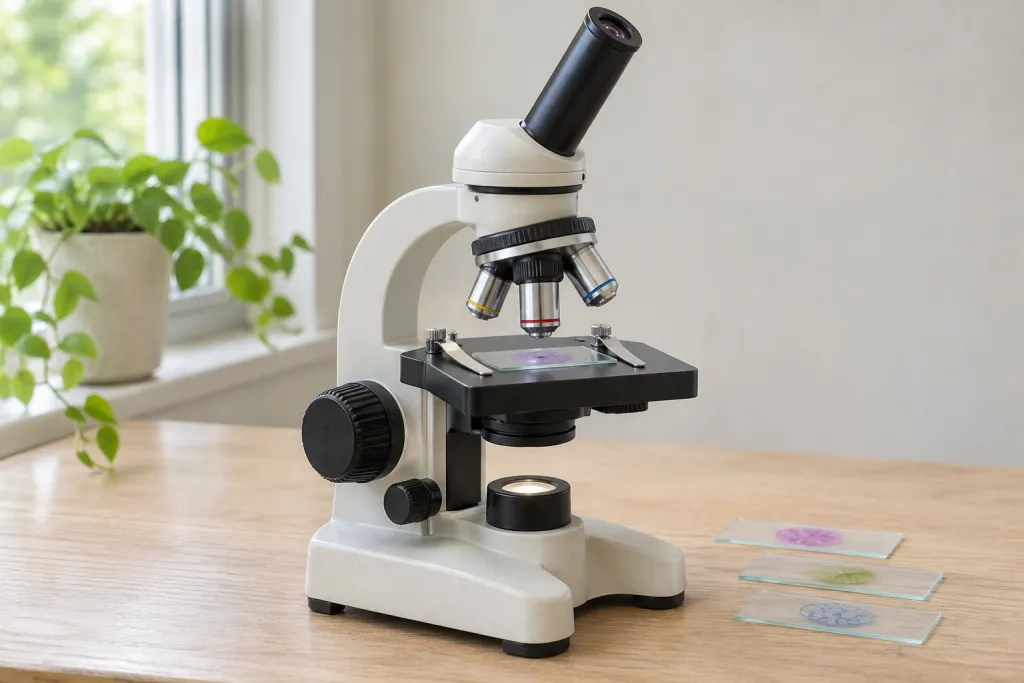
In 1665, scientist Robert Hooke looked at a thin slice of cork through an early microscope. He saw rows of tiny boxes and named them “cells,” because they reminded him of the small rooms monks lived in. A few years later, Antonie van Leeuwenhoek built even better microscopes and became the first person to see living single-celled creatures swimming in water.
Try it: make an edible cell model
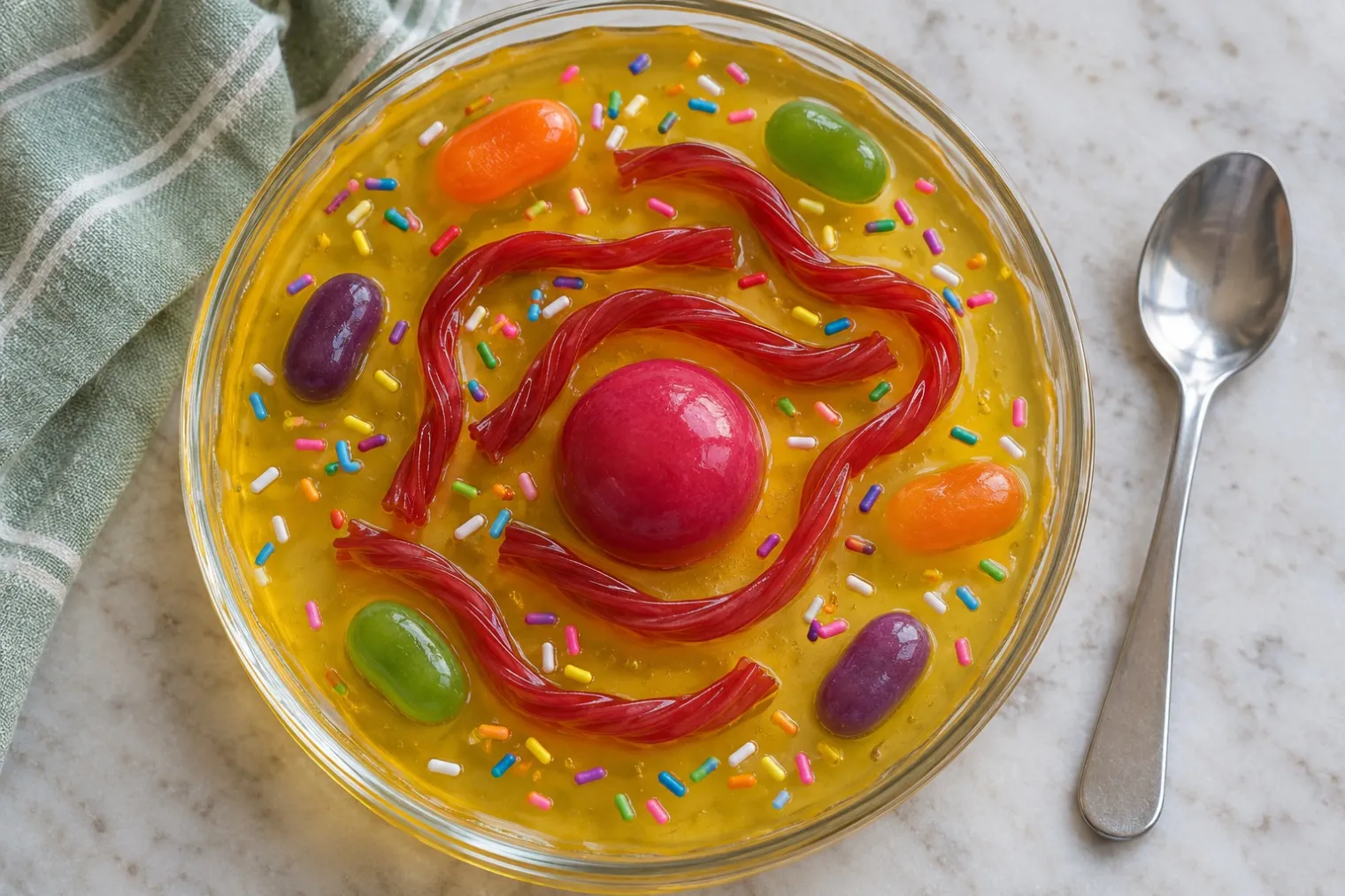
You need: a box of light-colored gelatin dessert mix (lemon works well), a zip-top bag (animal cell) or a small square container (plant cell), and candies: a gumball or plum for the nucleus, jelly beans, sprinkles, gummy worms and green candies. A grown-up helps with the hot water.
- A grown-up makes the gelatin following the package. Let it cool a bit, then pour it into the bag or container. Chill for about an hour until it’s starting to set.
- Push in your organelles: the gumball is the nucleus, jelly beans are mitochondria, sprinkles are ribosomes and gummy worms are the endoplasmic reticulum. For a plant cell, add green candies for chloroplasts.
- Chill until firm, about 2 more hours.
- Make a key on paper: which candy is which part? Then compare your squishy bag cell with a box-shaped plant cell. Then eat your science!
What’s happening: the gelatin acts like cytoplasm, holding the organelles in place. The bag is flexible like an animal cell’s membrane, while the box is stiff like a plant’s cell wall.
Keep exploring: What Is DNA? · Why Are Plants Green? · Why Is Blood Red?
Words to know
- Cell
- The smallest living building block of all living things.
- Organelle
- A part inside a cell with a special job.
- Nucleus
- The control center of a cell, which holds DNA.
- Mitochondria
- Organelles that turn food into energy.
- Chloroplast
- A green organelle in plant cells that makes food from sunlight.
- Cell wall
- A stiff layer around plant cells that gives them shape.
For grown-ups: the real science
Animal and plant cells are eukaryotic: they have a membrane-bound nucleus and organelles. The plasma membrane is a selectively permeable phospholipid bilayer. Mitochondria carry out cellular respiration, producing ATP, and contain their own DNA (evidence for their origin as ancient symbiotic bacteria). Ribosomes translate mRNA into protein, free in the cytosol or on rough endoplasmic reticulum; the Golgi apparatus modifies and sorts proteins; lysosomes (prominent in animal cells) digest waste.
Plant cells add a cellulose cell wall, chloroplasts for photosynthesis and a large central vacuole whose turgor pressure supports the plant. Bacteria are prokaryotic, with no nucleus. A 2013 estimate (Bianconi et al., Annals of Human Biology) put the adult human body at about 37 trillion cells; later estimates are around 30 trillion. Robert Hooke described cork “cells” in Micrographia (1665), and Schleiden and Schwann’s cell theory (1838–39) established cells as the basic unit of life.
Questions kids ask next
Can I see a cell?
Most cells are too small to see without a microscope. A few are bigger: a chicken egg yolk is one giant cell!
Are all my cells the same?
No. You have hundreds of kinds, like nerve cells, muscle cells, skin cells and blood cells, each shaped for its own job.
Do cells die?
Yes, all the time, and your body makes new ones to replace them. You shed thousands of skin cells every minute.
Is a bacterium a cell?
Yes! Bacteria are living things made of just one simple cell, with no nucleus.