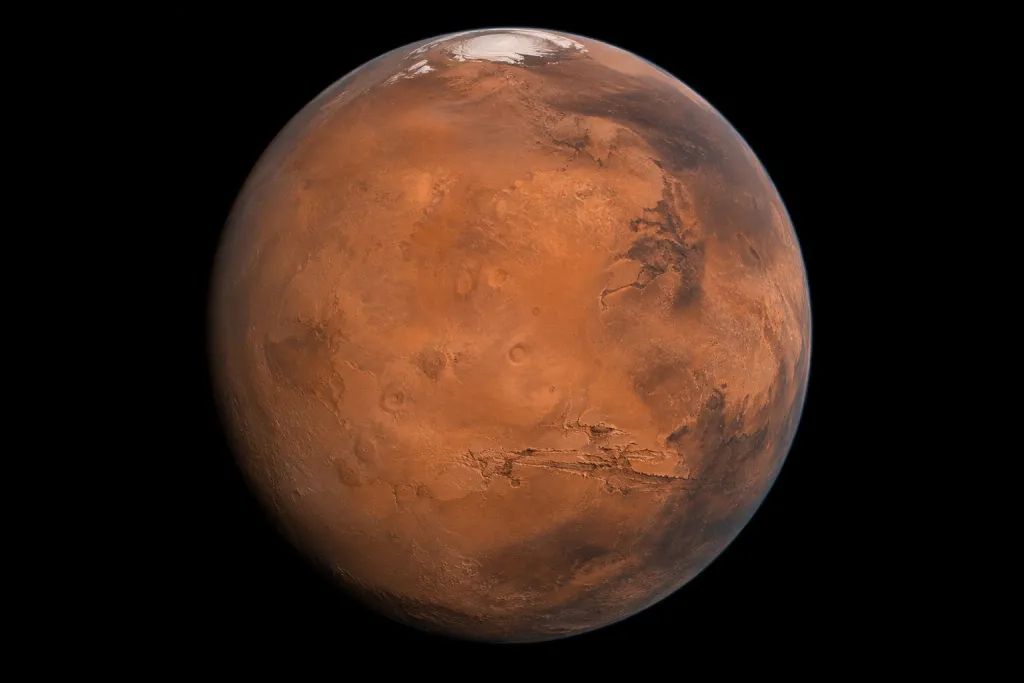
On a clear night, Mars shines in the sky like a little orange-red dot. People have noticed its color for thousands of years. The ancient Romans named it after their god of war, and it’s nicknamed the Red Planet. So what makes Mars red? It’s rusty!
A rusty planet
Mars’s rocks and soil contain lots of iron, the same metal used to make nails and frying pans. When iron meets oxygen, especially with some water around, it slowly changes into a new reddish-brown substance called iron oxide. You know it as rust. It’s the same thing that happens to an old bike left out in the rain.
Billions of years ago, Mars was warmer and had rivers, lakes and maybe even oceans. Over a very long time, water and oxygen helped the iron in Mars’s rocks rust. Then wind went to work. Mars has giant dust storms that can cover the entire planet, and they spread super-fine rusty dust everywhere, like red powdered sugar sprinkled over everything.
Explain it like I’m 5
You know how an old metal toy left outside gets orange rust on it? Mars has metal in its dirt, and it got rusty a long, long time ago. The wind blew the rusty dust everywhere, so the whole planet looks red.
Mars isn’t red all the way through
The red is mostly a thin coating of dust. When NASA’s rovers, like Curiosity and Perseverance, drill into rocks or scrape the surface, they often find gray and dark rock just underneath. Up close, Mars has lots of colors: butterscotch, tan, brown, gold and even greenish rocks.
A pink sky and blue sunsets
All that dust floating in Mars’s thin air turns its daytime sky a hazy butterscotch or pinkish-tan color. And here’s a twist: sunsets on Mars look blue. The fine dust lets blue light pass straight through toward your eyes when the Sun is low, so a blue glow surrounds the setting Sun. It’s the opposite of Earth, where we have blue skies and orange sunsets.
Try it: make Mars rust in a jar
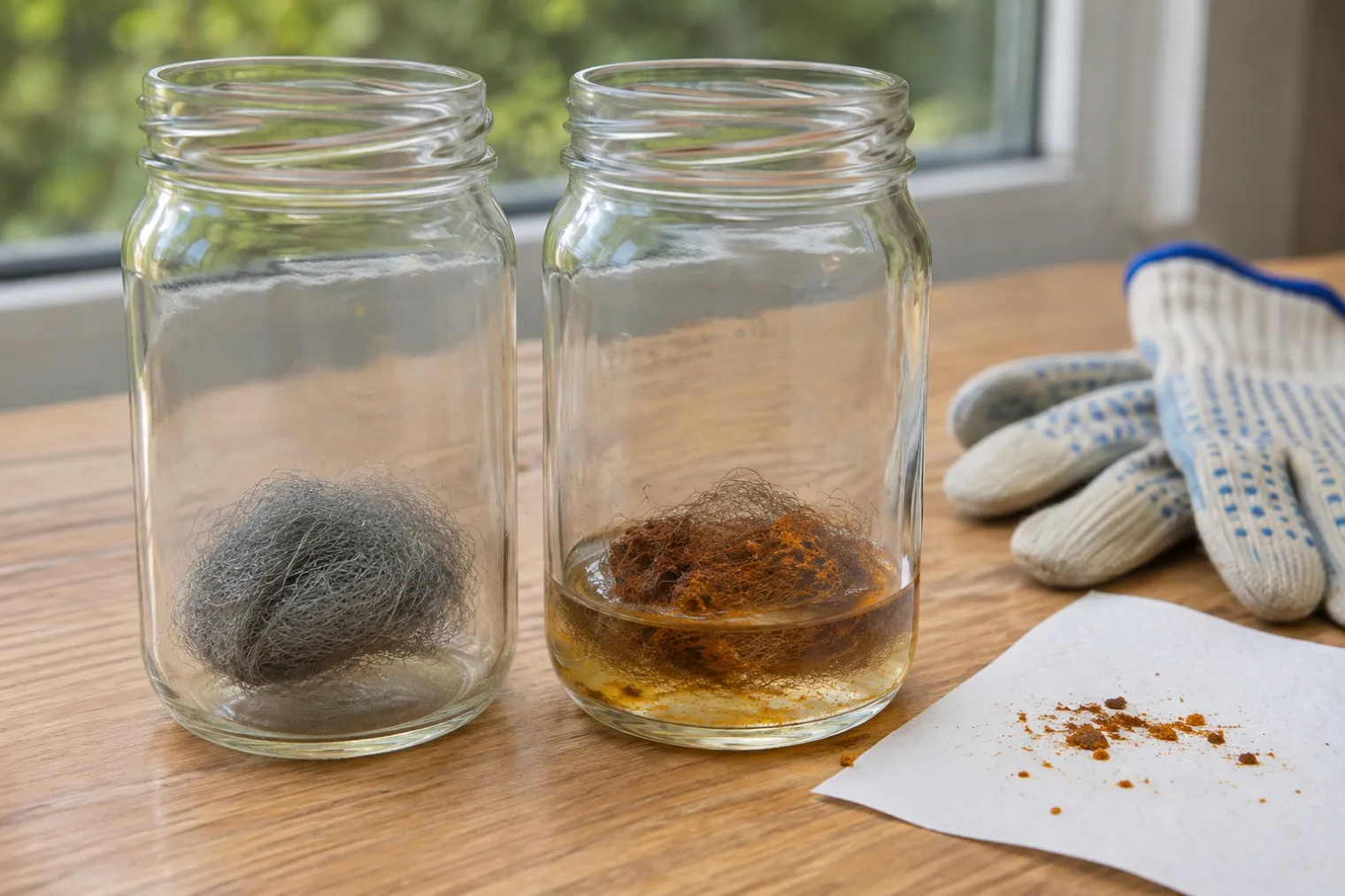
You need: a steel wool pad without soap (from a hardware store), 2 small jars or cups, vinegar, salt, water, gloves and a grown-up helper.
- With gloves on, pull off two small pieces of steel wool, each about the size of a walnut.
- Soak one piece in vinegar for 1 minute (this removes a protective coating), then squeeze it out and put it in a jar with a spoonful of salty water. Put the other piece in a jar dry.
- Check both jars after a few hours, then once a day.
- Which one turned orange-red? Rub it on white paper to make “Mars dust.”
What’s happening: the wet, salty steel wool rusts quickly because water helps iron and oxygen combine. The dry one barely changes. That’s why scientists think liquid water on ancient Mars helped make it so red. Throw the steel wool away when you’re done, and wash your hands.
Keep exploring: The 3 Types of Rocks · Why Is Blood Red? · What Is a Shooting Star?
Words to know
- Iron
- A common metal found in rocks, nails and even your blood.
- Oxygen
- A gas in air that we breathe and that helps things rust and burn.
- Rust
- A reddish-brown substance made when iron combines with oxygen.
- Iron oxide
- The science name for rust.
- Rover
- A robot vehicle that drives around and explores another planet.
For grown-ups: the real science
Mars’s color comes from fine-grained ferric (Fe³⁺) iron oxides in its globally mixed surface dust. The dust was long attributed to anhydrous hematite formed slowly under dry conditions, but a 2025 study (Valantinas et al., Nature Communications) found the spectra better match ferrihydrite, a water-rich iron oxide that forms quickly in the presence of cool liquid water, supporting the idea that Mars’s rust formed during an earlier wetter era. Global dust storms homogenize and redistribute this dust.
The underlying crust is largely basaltic and darker. Suspended dust particles (around 1–3 μm) absorb blue light and scatter red in the daytime sky; near sunset, forward scattering by these particles preferentially passes blue light along the line of sight, producing bluish halos around the Sun. In the demo, vinegar strips the oil coating from the steel wool, and salt water acts as an electrolyte that speeds oxidation.
Questions kids ask next
Is Mars hot because it’s red?
No, Mars is actually very cold, around −80°F (−60°C) on average. Red doesn’t mean hot. Mars is farther from the Sun than Earth and has very thin air to hold heat.
Could people breathe on Mars?
No. Mars’s air is very thin and made mostly of carbon dioxide. Astronauts would need spacesuits and oxygen tanks.
Is there still water on Mars?
Yes, but mostly frozen as ice in its polar caps and underground. Liquid water doesn’t last long on the surface today.
Is there rust in my body?
Not rust exactly, but your blood is full of iron. It helps carry oxygen and is part of what makes blood red.