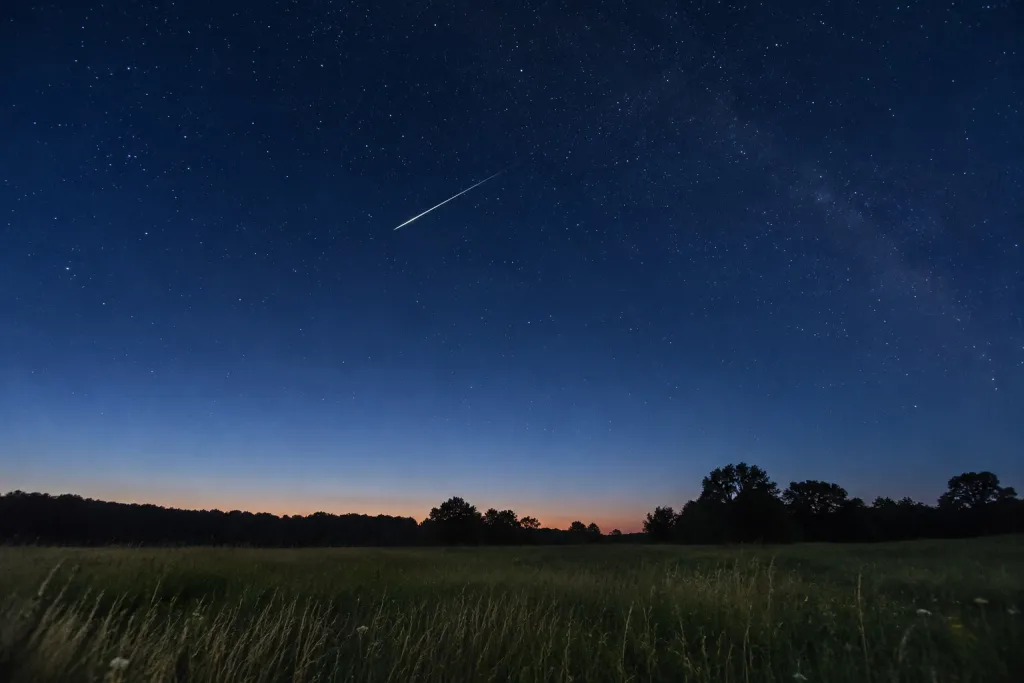
You’re looking up at the night sky and suddenly, zip! A bright streak flashes and disappears. People call it a shooting star and make a wish. But a shooting star isn’t a star at all. Stars are giant balls of burning gas, far away. A shooting star is something tiny, and it’s much closer than you’d think.
It’s a speck of space dust
Space is sprinkled with little bits of rock and dust left over from comets and asteroids. While they float in space, they’re called meteoroids. Most are smaller than a pebble, and many are as small as a grain of sand.
As Earth travels around the Sun, it runs into these bits. They hit our air going incredibly fast, from about 25,000 to 160,000 miles per hour. At that speed, the meteoroid squashes the air in front of it so hard that the air gets super hot and glows, and the meteoroid vaporizes. That glowing streak is a meteor, the thing we call a shooting star. It happens about 50 to 75 miles above the ground.
Explain it like I’m 5
A tiny space pebble zooms super fast into the air around Earth. It goes so fast that it glows and burns up, like a sparkler. That bright line is a shooting star.
Meteoroid, meteor, meteorite
- Meteoroid: the space rock while it’s still in space.
- Meteor: the streak of light when it burns through our air.
- Meteorite: a piece that survives the trip and lands on the ground. Only bigger rocks make it, and scientists treasure them because they’re samples from space.
Meteor showers: shooting stars on a schedule
On any dark night you might see a few meteors an hour. But on certain nights each year, you can see many more. That’s a meteor shower. It happens when Earth passes through a trail of dust left behind by a comet or asteroid. Because Earth crosses the same trails at the same time every year, we know exactly when showers will happen.
One of the best is the Geminids, which peaks around December 13–14 each year. Under a dark sky you can sometimes see over 100 meteors an hour. The Geminids come from an unusual rocky asteroid called 3200 Phaethon instead of a comet. Another favorite is the Perseids in mid-August, perfect for warm summer nights.
Try it: be a meteor counter
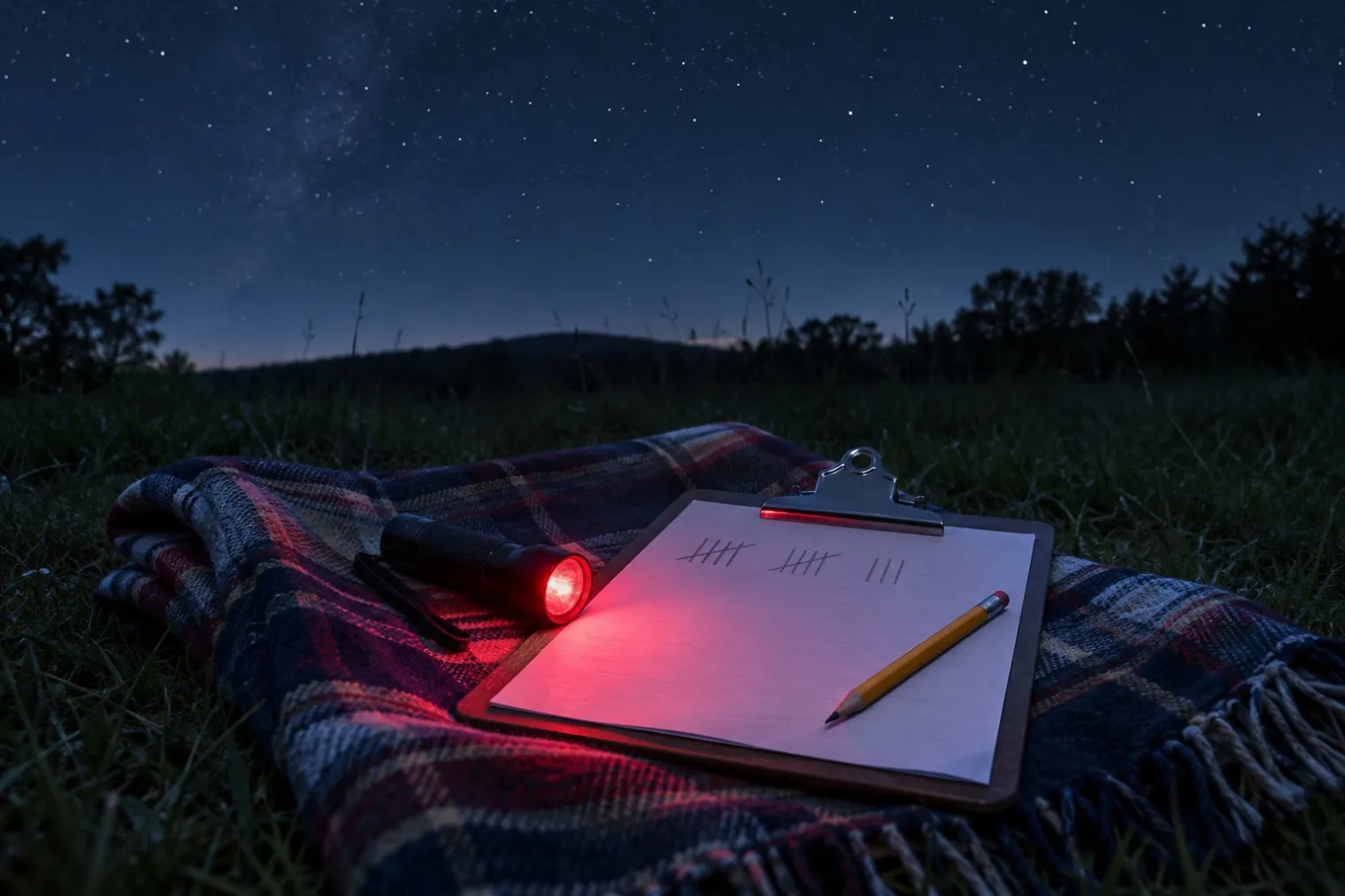
You need: a dark spot away from streetlights, a blanket or reclining chair, warm clothes, a clipboard, a pencil and a red flashlight (or a flashlight covered with red cellophane).
- Pick a meteor shower night, like the Geminids in mid-December. The best viewing is usually after 10 p.m.
- Lie back and look at a big patch of sky. Don’t use a telescope or binoculars; your eyes see more sky.
- Give your eyes 15 to 20 minutes to adjust to the dark. Use only red light to look at your paper.
- Make a tally mark for every meteor you see in 15 minutes. Then do another 15 minutes. Did the number change as it got later?
What’s happening: you’re collecting real data, just like volunteer scientists who count meteors for astronomy groups. Counts usually go up later at night, as your side of Earth turns to face the direction Earth is moving through the dust trail.
Keep exploring: What Is a Light-Year? · Why Do Stars Twinkle? · Why Is Mars Red?
Words to know
- Meteoroid
- A small rock or bit of dust traveling through space.
- Meteor
- The streak of light made when a meteoroid burns up in Earth’s air.
- Meteorite
- A space rock that lands on Earth’s surface.
- Meteor shower
- A night when lots of meteors appear because Earth passes through a dust trail.
- Comet
- A ball of ice and dust that leaves a trail as it orbits the Sun.
For grown-ups: the real science
Meteoroids enter the atmosphere at roughly 11 to 72 km/s. The light is produced mainly by ram-pressure heating: the meteoroid compresses air ahead of it, heating it and ablating the meteoroid, and the excited atoms (from both the meteoroid and the air) emit light as they de-excite. Most visible meteors are millimeter-scale and fully ablate at about 80–120 km altitude. Earth collects an estimated tens of tonnes of meteoritic material every day, mostly as dust.
Shower meteors appear to radiate from a single point (the radiant) because of perspective: the parallel particles in a debris stream look like they converge, like railroad tracks. The Geminids, with a zenithal hourly rate around 120–150, originate from asteroid 3200 Phaethon. Rates rise after local midnight because the observer is then on Earth’s leading hemisphere. Moonlight strongly affects how many you’ll see, so check the Moon phase for the peak night.
Questions kids ask next
Can a shooting star hit me?
It’s incredibly unlikely. Almost all meteors burn up high in the sky, and the rare meteorites that land usually fall in oceans or empty land.
Why are some shooting stars colorful?
Different materials glow different colors when they burn, just like fireworks. Sodium glows orange-yellow, magnesium glows blue-green and nitrogen and oxygen in the air glow red.
What is a fireball?
An extra-bright meteor, brighter than any planet. It’s usually made by a bigger piece, maybe the size of a marble or a golf ball.
Can I see shooting stars from the city?
Only the brightest ones. City lights wash out fainter meteors, so a dark spot in the country lets you see many more.