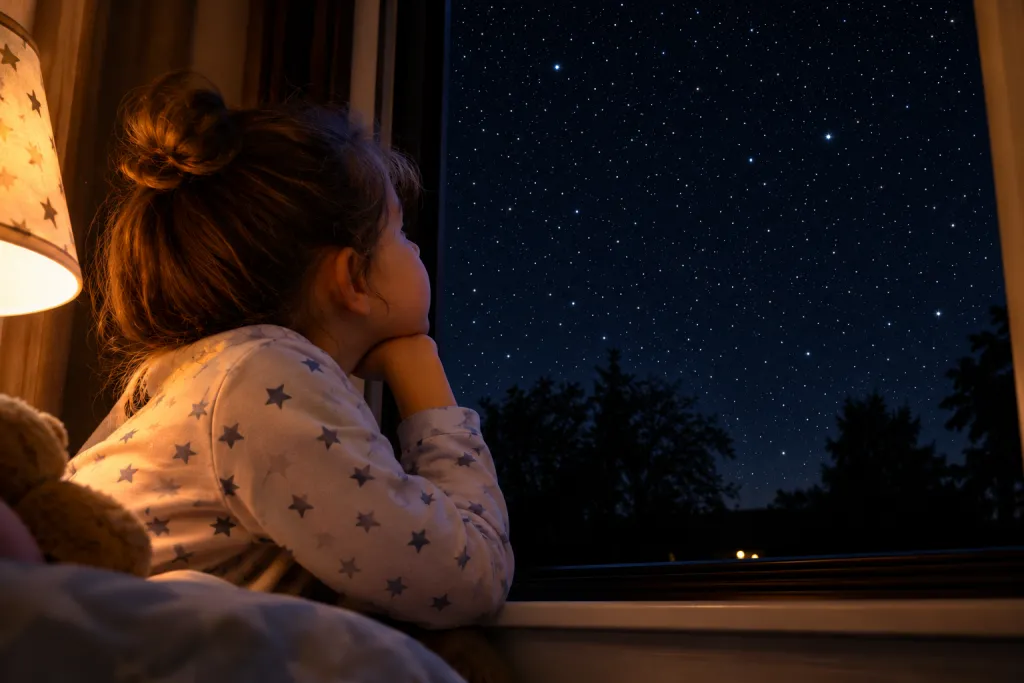
“Twinkle, twinkle, little star” might be the first science question many kids ever sing. Here’s the secret: the star isn’t twinkling at all. Our air is doing it.
Starlight takes a very long trip
Every star you see at night is a sun, a giant ball of glowing gas. Most are so far away that their light has been traveling for years to reach you. Because they’re so far, even huge stars look like tiny dots of light.
Out in space, that light travels in a perfectly straight, steady line. Nothing gets in its way until the very end of the trip.
The last few miles are the bumpiest
Earth is wrapped in a blanket of air called the atmosphere. That air is always moving, with pockets of warm air and cool air sliding past each other. When light passes from one pocket into another, it bends a tiny bit. Scientists call this bending refraction.
Starlight gets bent again and again, in a different direction each moment. So the star seems to wiggle, and its light gets brighter and dimmer many times a second. That flicker is the twinkle.
Explain it like I’m 5
Have you ever looked at a penny at the bottom of a swimming pool while the water was wiggly? The penny seems to dance around. Our air is like that wiggly water, and the star is the penny.
Why planets don’t twinkle much
Planets like Venus, Jupiter and Mars are much closer to us than stars. Instead of a single dot, they look like tiny circles. Light from one side of the circle bends one way while light from the other side bends another way, and it all evens out. So planets shine with a calm, steady glow.
Stargazing tip: if a bright “star” isn’t twinkling, you’re probably looking at a planet.
Why stars low in the sky twinkle the most
When a star is straight overhead, its light passes through the least amount of air. Near the horizon, the light has to slice sideways through much more air, so it gets bent many more times. Low stars can even flash red, green and blue, because each color bends a slightly different amount.
Try it: make a star twinkle in a bowl
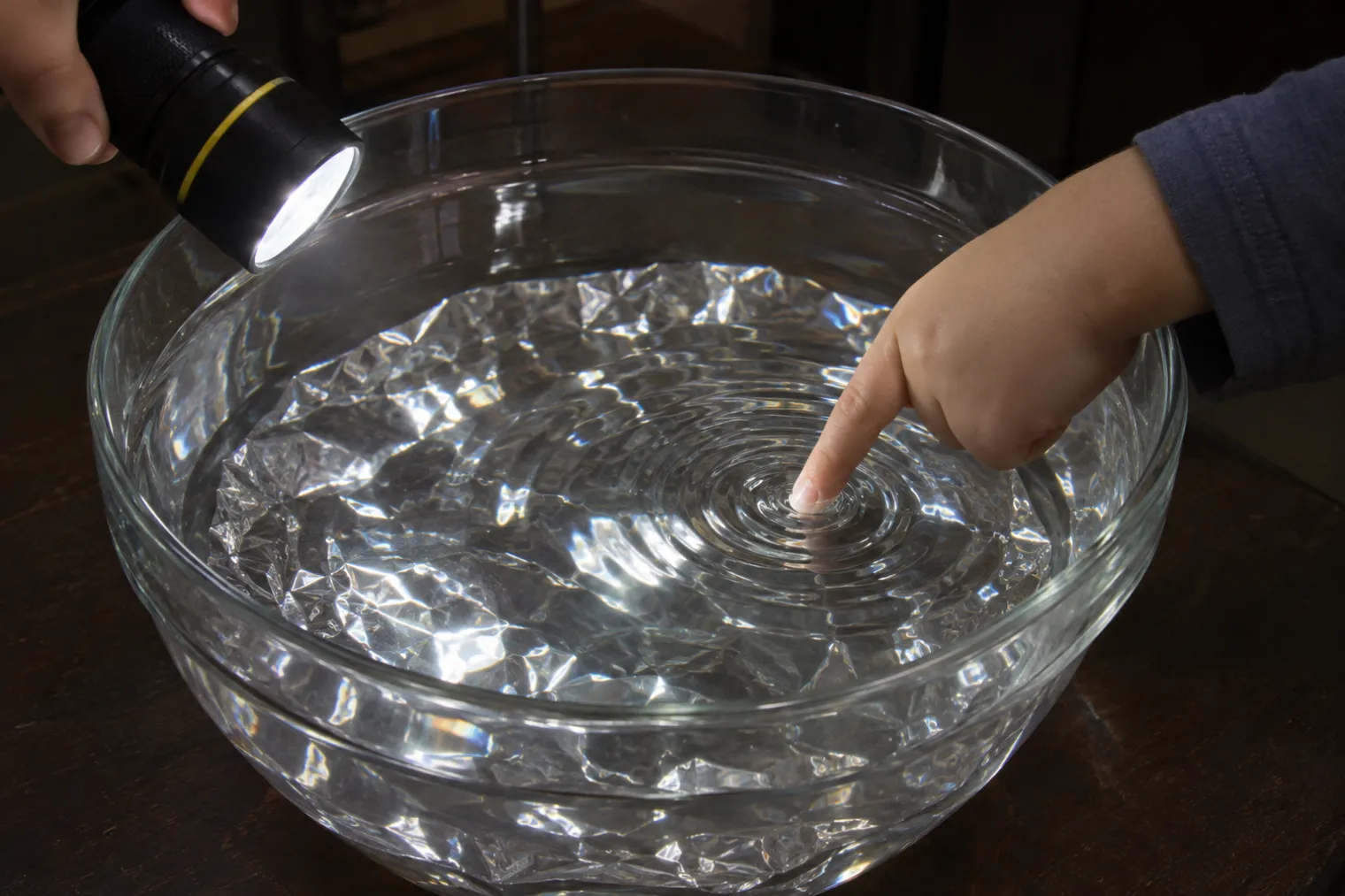
You need: a clear glass bowl or baking dish, water, a small square of aluminum foil and a flashlight.
- Crumple the foil, then flatten it back out so it’s full of tiny shiny bumps. Lay it in the bottom of the empty bowl.
- Turn off the lights and shine the flashlight down onto the foil. Look at the little sparkles. They hold still.
- Pour in a few inches of water and let it settle. The sparkles still look steady, like stars on a calm night.
- Now gently tap the side of the bowl or swirl the water with a finger. Watch the sparkles flicker and dance. They’re twinkling!
What’s happening: the moving water bends the light a little differently every moment, just like moving air bends starlight. Calm water, steady sparkles. Wiggly water, twinkling sparkles.
Keep exploring: What Is a Light-Year? · What Is a Shooting Star? · Why Is Pluto Not a Planet?
Words to know
- Atmosphere
- The blanket of air wrapped around Earth.
- Refraction
- When light bends as it passes from one material into another, like air to water.
- Twinkling
- The quick flicker of a star’s light. Scientists call it scintillation.
- Planet
- A big world that circles a star. Planets don’t make their own light; they reflect the Sun’s.
- Telescope
- A tool that gathers light so we can see faraway things.
For grown-ups: the real science
Twinkling is called astronomical scintillation. Turbulence mixes air of different temperatures and densities, and each small cell has a slightly different refractive index. As these cells drift across the line of sight, they shift the star’s apparent position and focus or spread its light, so brightness and position change many times per second.
Stars are effectively point sources, so they show the full effect. Planets have a measurable disk, and the variations from different parts of the disk average out. Astronomers fight the problem by building observatories on high, dry mountains, using adaptive optics with fast-flexing mirrors, or putting telescopes like Hubble and James Webb above the atmosphere entirely.
Questions kids ask next
Do stars twinkle in space?
No. Astronauts see stars as steady points of light, because there’s no air in space to bend the light around.
Why do some stars flash different colors?
Stars close to the horizon shine through lots of air. Each color of light bends a slightly different amount, so you may see quick flashes of red, green or blue. Bright Sirius is famous for this on winter nights.
Are stars really shaped like stars?
No, stars are round balls of glowing gas. The pointy look comes from the way light spreads out inside our eyes and cameras.
Is twinkling a problem for scientists?
Yes. It makes stars look blurry in telescopes. That’s why big observatories sit on tall mountains above much of the air, and why some telescopes are launched into space.