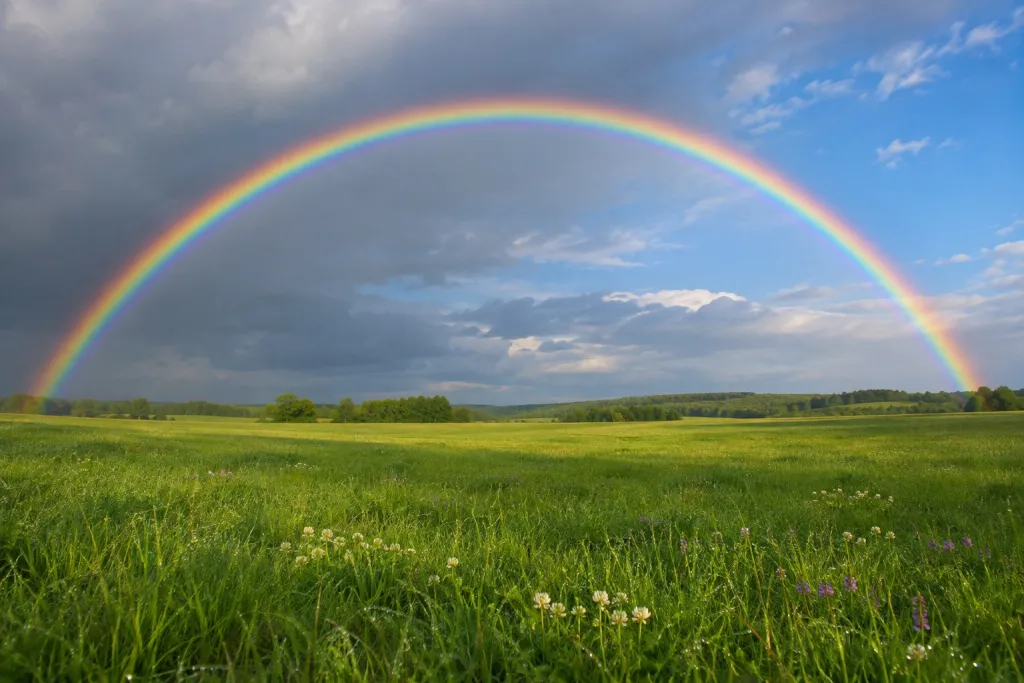
The rain is stopping, the Sun peeks out, and there it is: a giant, glowing arc of color across the sky. Rainbows can seem magical, but they’re made from just two everyday ingredients: sunlight and raindrops.
Sunlight is hiding a rainbow
Sunlight looks white or yellowish, but it’s really a mix of every color: red, orange, yellow, green, blue, indigo and violet. A handy way to remember the order is the name ROY G. BIV. Mixed together, the colors look white. To see them separately, something has to spread them apart.
Raindrops split the light
When sunlight enters a raindrop, it slows down and bends. That bending is called refraction. Here’s the key: each color bends by a slightly different amount. Violet bends the most and red bends the least. So the colors start to fan apart.
The light then bounces off the back of the raindrop, like a mirror (that’s reflection), and bends again as it leaves the drop, spreading the colors even more. Millions of raindrops do this at once. Each drop sends one color to your eye, depending on its position in the sky, and together they paint the whole rainbow.
Explain it like I’m 5
Sunlight has all the colors hiding inside it. When sunshine goes through raindrops, the drops split the light apart so we can see each color. That’s a rainbow!
How to find a rainbow
- Put the Sun behind you. Rainbows always appear on the opposite side of the sky from the Sun.
- Look toward the rain. You need raindrops in the air in front of you while the Sun shines from behind.
- Try early morning or late afternoon. A low Sun makes bigger, higher rainbows. When the Sun is high at midday, the rainbow is too low to see.
Why are rainbows curved?
Light leaves the raindrops at a special angle, about 42 degrees from the point directly opposite the Sun. All the drops that send light to your eyes at that angle sit on a big circle around that point. The ground usually blocks the bottom half, so we see an arch. From an airplane or a mountaintop, you can sometimes see a rainbow as a full circle!
Double rainbows
Sometimes you’ll spot a fainter second rainbow outside the first one. It forms when light bounces twice inside the raindrops. Because of the extra bounce, its colors are in reverse order, with red on the inside. The sky between the two rainbows is often darker, which has a fancy name: Alexander’s band.
Try it: make a rainbow indoors
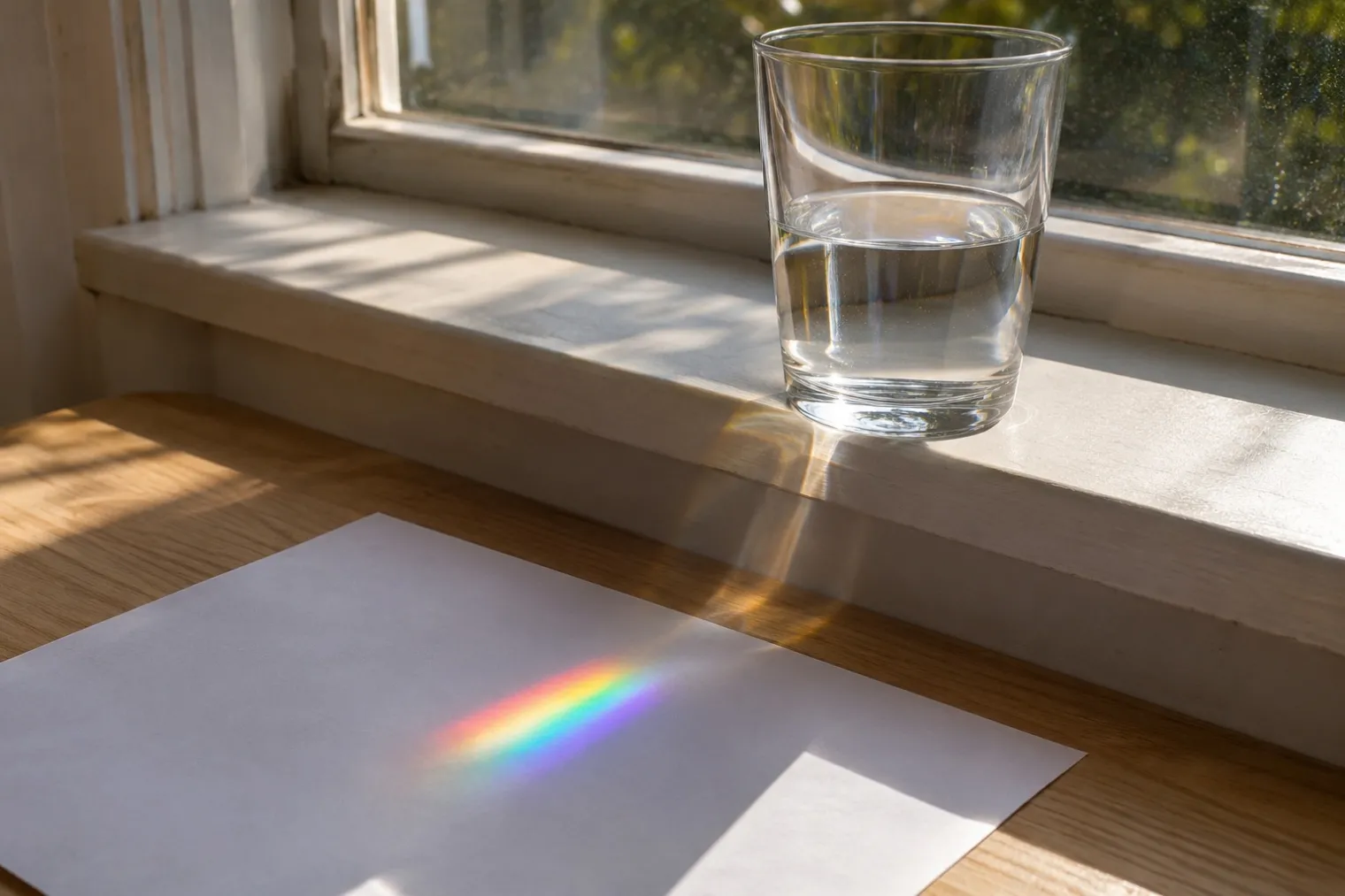
You need: a clear glass of water, a sunny window (or a bright flashlight) and a sheet of white paper.
- Fill the glass almost to the top with water.
- Set it on the edge of a sunny windowsill or table so sunlight shines through the water.
- Hold the white paper on the floor or a chair on the other side of the glass and move it around until you see a little rainbow. Tilt the glass or move the paper to make it brighter.
- Bonus: on a sunny day outside, stand with your back to the Sun and spray a fine mist from a garden hose. Look for a rainbow in the spray!
What’s happening: the curved glass of water bends the sunlight just like a raindrop does, splitting it into its colors on the paper. The hose mist creates millions of tiny raindrops, so you get a real rainbow, made the same way as one in the sky.
Keep exploring: Why Is the Sky Blue? · How Do Clouds Form? · Why Is the Ocean Blue?
Words to know
- Refraction
- The bending of light as it passes from one material into another.
- Reflection
- Light bouncing off a surface.
- Spectrum
- The band of colors that makes up white light.
- Prism
- A clear, angled object that splits light into colors.
- ROY G. BIV
- A name that helps you remember rainbow colors: red, orange, yellow, green, blue, indigo, violet.
For grown-ups: the real science
Rainbows result from refraction, internal reflection and dispersion in roughly spherical water droplets. Water’s refractive index varies with wavelength (about 1.331 for red, 1.343 for violet), so colors exit at slightly different angles. For a primary bow, light refracts on entry, reflects once internally and refracts on exit, concentrating near a minimum-deviation angle of about 42° from the antisolar point for red and about 40° for violet. The secondary bow (two internal reflections) appears at about 51° with reversed colors, and the darker region between them is Alexander’s band.
Because the bow is centered on the antisolar point, it is invisible when the Sun is higher than about 42°. Newton’s prism experiments (1660s) established that white light is a mixture of colors; Descartes worked out the rainbow’s geometry in 1637. Rainbow light is also polarized. Faint supernumerary bands inside the primary bow arise from wave interference and can’t be explained by simple ray optics.
Questions kids ask next
Can you reach the end of a rainbow?
No. A rainbow isn’t an object in one place; it depends on where you’re standing. When you move, it moves with you. No pot of gold, sorry!
Do two people see the same rainbow?
Not exactly. Each person sees light from a slightly different set of raindrops, so everyone sees their very own rainbow.
Can rainbows happen at night?
Yes! Bright moonlight can make a faint “moonbow.” It usually looks white to our eyes because colors are hard to see in dim light.
How many colors are in a rainbow?
A rainbow is really a smooth blend of millions of shades. We name seven main colors, but there are no sharp lines between them.