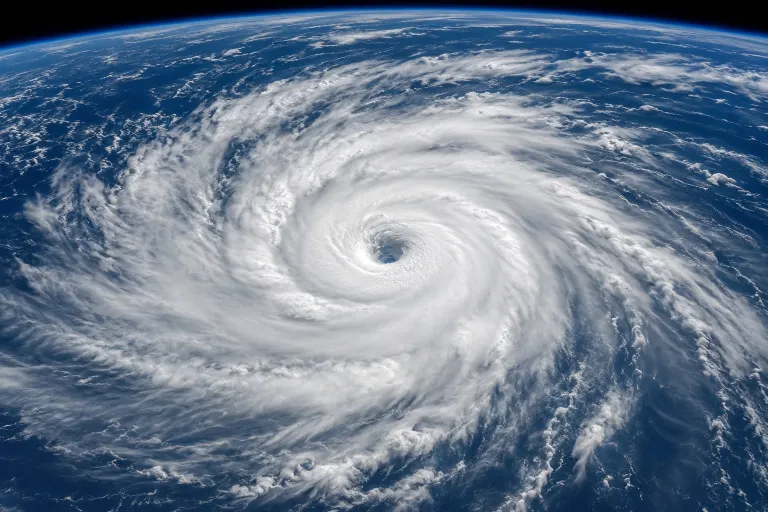
Clouds look soft and fluffy, like you could bounce on them. But if you flew through one in an airplane, you’d find it’s just foggy and damp. That’s because clouds are made of water, billions and billions of droplets so tiny that they float. Here’s how they get up there.
Step 1: Invisible water in the air
When the Sun warms oceans, lakes, puddles and even wet grass, some water evaporates. It turns into an invisible gas called water vapor and mixes into the air. There’s water vapor around you right now, even though you can’t see it.
Step 2: Warm air rises and cools
Warm air is lighter than cool air, so it rises, carrying the water vapor with it. Air can also be pushed up over mountains or lifted when a mass of cold air slides underneath it. The higher air goes, the more it spreads out and cools.
Step 3: Vapor turns into droplets
Cool air can’t hold as much water vapor as warm air. So as the air cools, the vapor condenses: it turns back into tiny drops of liquid water. But the drops need something to form on. Luckily, the air is full of microscopic specks of dust, salt from ocean spray, smoke and pollen. Each speck becomes the center of a droplet. When billions of droplets gather together, we can see them: a cloud!
Explain it like I’m 5
The Sun warms up water and turns it into an invisible gas that floats up into the sky. Up high it’s cold, so the gas turns back into teeny-tiny water drops. Lots and lots of drops together make a cloud!
Main types of clouds
- Cumulus: puffy, cotton-ball clouds with flat bottoms. Usually a sign of nice weather.
- Stratus: flat, gray sheets that cover the sky like a blanket. They can bring drizzle. Fog is really a stratus cloud on the ground!
- Cirrus: thin, wispy streaks very high in the sky, made of ice crystals. They can mean the weather will change soon.
- Cumulonimbus: giant, towering storm clouds that bring thunder, lightning and heavy rain.
If clouds are water, why don’t they fall?
Cloud droplets are incredibly small, so tiny that rising air easily holds them up, like dust floating in a sunbeam. But all together they’re heavy: an average puffy cumulus cloud holds about 1 million pounds of water, as much as 100 elephants! When droplets bump together and grow big and heavy enough, they fall as rain or snow.
Try it: make a cloud in a jar
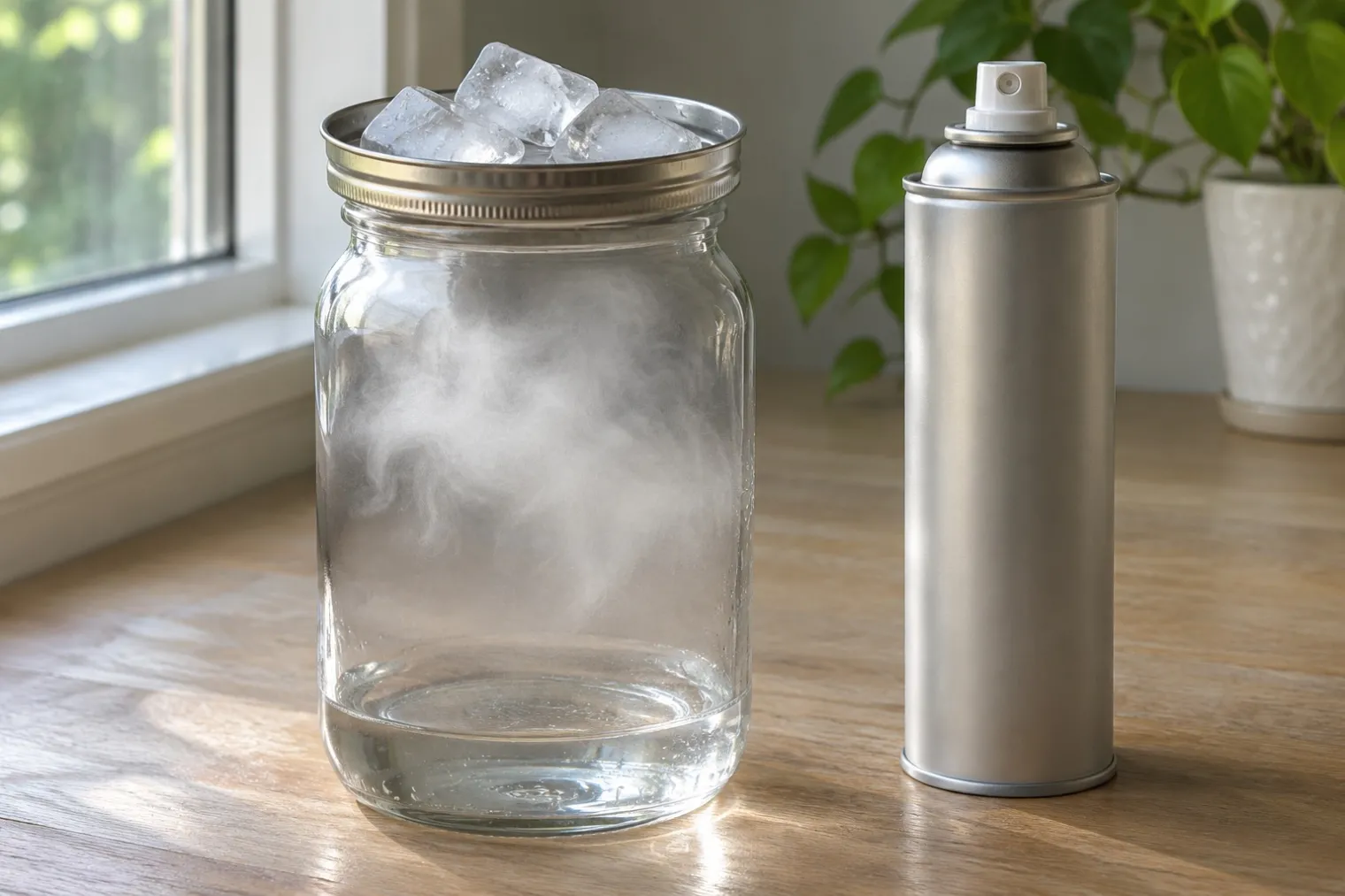
You need: a clear glass jar with a lid, very hot tap water (a grown-up pours), ice cubes and a can of aerosol hairspray.
- A grown-up pours about 1 inch of hot water into the jar and swirls it to warm the sides.
- Flip the lid upside down, set it on top of the jar like a little tray, and pile ice cubes on it. Wait 20 seconds.
- Lift the lid quickly, give one short spray of hairspray into the jar and put the ice lid right back on.
- Watch a swirling cloud form! After a minute, lift the lid and let your cloud escape.
What’s happening: the hot water fills the jar with warm, wet air. The ice cools it from the top, just like air cooling as it rises into the sky. The hairspray adds tiny particles for the water to condense on, just like dust in real clouds. Put them together and you get a cloud.
Keep exploring: What Causes Thunder? · How Are Rainbows Formed? · How Are Snowflakes Formed?
Words to know
- Water vapor
- Water in the form of an invisible gas.
- Evaporate
- To change from a liquid into a gas.
- Condense
- To change from a gas back into a liquid.
- Water cycle
- The journey water takes from the ground to the sky and back again.
- Meteorologist
- A scientist who studies weather.
For grown-ups: the real science
Clouds form when air is cooled to its dew point, usually through adiabatic expansion as it rises (by convection, orographic lift over terrain or frontal lifting). Condensation requires cloud condensation nuclei (aerosols such as sea salt, dust and sulfates, typically 0.1–1 μm); homogeneous nucleation without them would require extreme supersaturation. Typical cloud droplets are about 10–20 μm in diameter, with terminal velocities of around 1 cm/s, easily supported by updrafts. Raindrops grow via collision-coalescence in warm clouds or the Bergeron ice-crystal process in mixed-phase clouds.
Luke Howard’s 1803 classification (cumulus, stratus, cirrus and nimbus) underlies the WMO’s ten cloud genera. The USGS estimates a cubic kilometer of cumulus cloud with typical liquid water content (about 0.5 g/m³) holds roughly 500,000 kg of water, about 1.1 million pounds. In the jar demo, aerosol particles act as condensation nuclei while the ice chills the air above the warm water.
Questions kids ask next
Why are clouds white?
Cloud droplets scatter all colors of sunlight equally, and all the colors mixed together look white.
Why do some clouds turn gray?
Thick clouds with lots of big droplets block more sunlight, so less light reaches the bottom. A dark gray cloud often means rain is on the way.
Is fog a cloud?
Yes! Fog is a cloud that forms right at ground level, so when you walk through fog, you’re walking through a cloud.
Are there clouds on other planets?
Yes. Jupiter has clouds of ammonia, Venus is covered in clouds of sulfuric acid, and Mars has thin clouds of water ice.