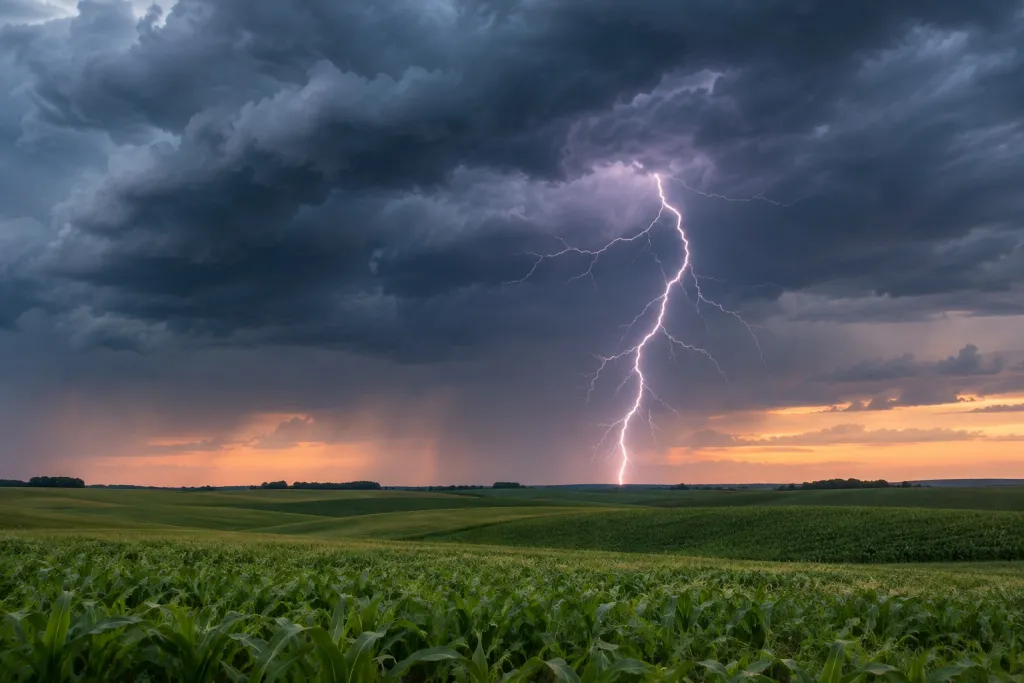
A flash lights up the sky, and a few seconds later, BOOM! The windows rattle and the dog hides under the bed. Thunder can be scary, but the science behind it is amazing, and once you understand it, you can even use it to tell how far away a storm is.
Thunder is the sound of lightning
No lightning, no thunder. Every lightning bolt makes thunder. A bolt of lightning is a giant electric spark, and it heats the air it passes through to about 50,000°F (28,000°C). That’s about five times hotter than the surface of the Sun, and it happens in a tiny fraction of a second.
When air gets hot, it expands. When it gets that hot that fast, it expands explosively, slamming into the cooler air around it. That sudden push creates a powerful wave of sound that spreads out in every direction. That sound wave is thunder.
Explain it like I’m 5
Lightning is super, super hot. It makes the air around it jump out of the way so fast that it goes BOOM, like a giant balloon popping. That boom is thunder.
Why do you see lightning before you hear thunder?
They happen at the same time, but light is way faster than sound. Light zips to your eyes almost instantly. Sound is much slower: it takes about 5 seconds to travel 1 mile (about 3 seconds per kilometer). The farther away the lightning, the longer the wait for the boom.
Why does thunder rumble?
A close lightning strike sounds like a sharp CRACK. Farther away, thunder becomes a long, low rumble. That’s because a lightning bolt can be miles long. Sound from the closest part of the bolt reaches you first, and sound from the farther parts arrives a little later, so it stretches into a rumble. Sound also bounces off clouds, hills and buildings, adding echoes.
Lightning safety
Remember: “When thunder roars, go indoors!” If you can hear thunder, lightning is close enough to strike you. Get inside a building or a hard-topped car, stay away from water and tall objects, and wait 30 minutes after the last thunder before going back outside.
Try it: make thunder and time a storm

You need: a paper lunch bag and, on a stormy day, a window and a clock or timer.
- Make thunder: blow up the paper bag, twist the top closed and hold it tight.
- Smack the bag hard with your other hand. BANG!
- Time a storm (safely indoors): when you see lightning, start counting seconds: “one-Mississippi, two-Mississippi…”
- Stop when you hear the thunder. Divide by 5 to get the distance in miles (or by 3 for kilometers). Is the storm coming closer or moving away?
What’s happening: when the bag bursts, the air inside rushes out all at once and smacks into the air around it, sending out a sound wave, just like the bursting air around a lightning bolt (but much, much smaller). Counting the seconds uses the difference between the speed of light and the speed of sound.
Keep exploring: How Do Clouds Form? · How Do Hurricanes Form? · What Is Heat?
Words to know
- Lightning
- A giant spark of electricity in the sky.
- Thunder
- The loud sound made when lightning heats the air.
- Sound wave
- A vibration that travels through the air to your ears.
- Expand
- To get bigger and take up more space.
- Thunderstorm
- A storm with lightning and thunder.
For grown-ups: the real science
A lightning return stroke heats a channel a few centimeters wide to roughly 30,000 K (about 50,000°F) in microseconds, raising the channel pressure to many times atmospheric. The channel expands supersonically, producing a shock wave that decays within meters into an acoustic wave: thunder. Thunder’s rumble arises from the different distances to points along a channel that may be kilometers long and tortuous, plus reflection and refraction. Thunder is rarely audible beyond about 10–15 miles.
Sound travels about 343 m/s in air at 20°C, roughly 1 mile per 4.7 seconds or 1 km per 2.9 seconds; light’s travel time is negligible. The U.S. National Weather Service recommends “When Thunder Roars, Go Indoors” and waiting 30 minutes after the last thunder; lightning can strike 10 miles or more from the parent storm.
Questions kids ask next
Can thunder hurt you?
Thunder itself is just sound, so it can’t hurt you (though very close thunder is loud!). Lightning is what’s dangerous, and thunder tells you it’s nearby.
Can there be lightning without thunder?
Every lightning bolt makes thunder, but if the storm is very far away, the sound fades out before it reaches you. People sometimes call that “heat lightning.”
Is there thunder in snowstorms?
Yes, rarely! It’s called thundersnow, and the snow muffles the sound so it’s often quieter.
Why are dogs scared of thunder?
Dogs hear better than we do, and they may also feel the pressure change and static electricity before a storm. A cozy, quiet spot helps them feel safe.