

It’s one of the most-asked questions in the world, usually from the back seat on a sunny day. The good news: the answer is simple enough for a five-year-old, and you can prove it at home with a glass of water and a splash of milk.
Sunlight is secretly a rainbow
Sunlight looks white, but it’s really every color mixed together: red, orange, yellow, green, blue and violet. You can see them split apart in a rainbow or when light shines through a prism.
Light travels in waves, and each color has a different wave size. Red light has long, lazy waves. Blue and violet light have short, choppy waves. That difference is the whole secret.
Air bounces blue light all over the sky
Our air is made of trillions of tiny molecules, mostly nitrogen and oxygen. They’re much smaller than a wave of light. When sunlight hits them, some of the light gets bounced off in a new direction. Scientists call this scattering.
Tiny molecules are much better at scattering short, choppy waves than long ones. Blue light gets scattered about five times more than red light. So while most of the red and yellow light zooms straight through the air, the blue light ping-pongs around the whole sky. Wherever you look up, blue light is coming toward your eyes from that direction, so the whole sky looks blue.
Explain it like I’m 5
Sunlight is a bunch of colors holding hands. When they run through the air, the blue color keeps bumping into tiny bits of air and bouncing everywhere, like a bouncy ball in a small room. So when you look up, you see blue bouncing all around you!
Why sunsets turn orange and red
At noon, sunlight comes almost straight down and only passes through a thin layer of air. At sunset, the sun is low, so its light has to travel sideways through much more air to reach you.
On that long trip, nearly all the blue light gets scattered away before it gets to your eyes. What’s left is the long-wave light: yellow, orange and red. Dust, smoke or tiny droplets in the air can make sunsets even more colorful.
Then why isn’t the sky purple?
Great question, because violet light has even shorter waves than blue and scatters even more. Three things keep the sky blue instead:
- Sunlight has less violet in it than blue to begin with.
- Some violet light gets soaked up high in the atmosphere before it reaches the ground.
- Our eyes are much more sensitive to blue than to violet, so our brain reads the mix as sky blue.
Try it: make a sunset in a glass
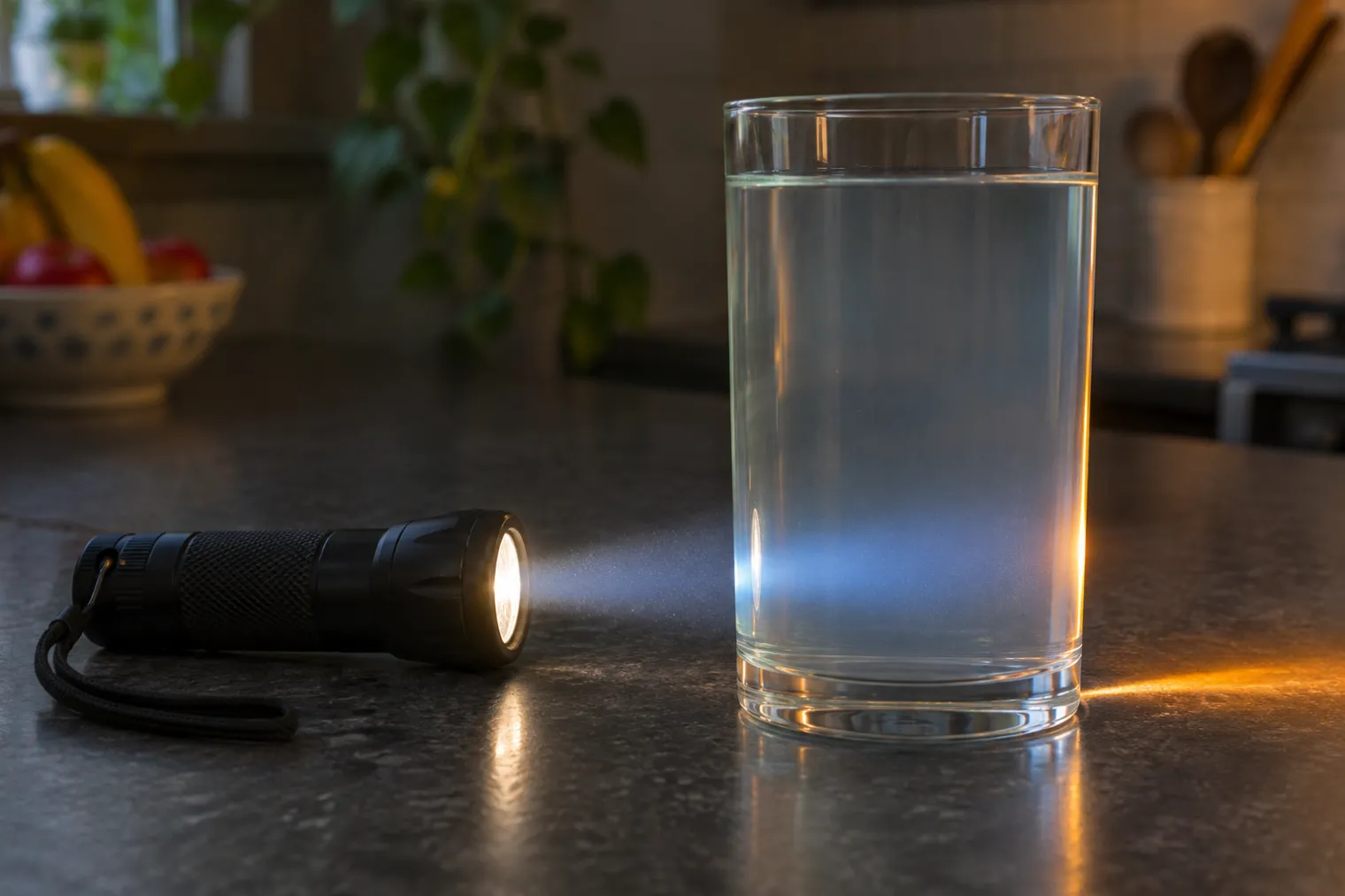
You need: a tall clear glass or jar, water, milk, a spoon and a flashlight (a phone light works).
- Fill the glass with water and stir in about 1/2 teaspoon of milk. The water should look a little cloudy, not white.
- Turn off the lights. Shine the flashlight through the side of the glass and look at the water from the front. It should have a faint bluish glow. That’s your “sky.”
- Now hold the flashlight on the far side and look straight through the glass at the light. It should look yellow-orange. That’s your “sunset.”
- Stir in a few more drops of milk and look again. The more milk the light has to pass through, the more orange and red it gets, just like a sun sitting low on the horizon.
What’s happening: tiny bits of fat and protein in the milk act like air molecules. They scatter blue light out the sides of the glass, and the light that makes it all the way through has lost much of its blue.
Words to know
- Scattering
- When light bounces off tiny particles and heads off in new directions.
- Wavelength
- The size of a light wave. Blue has short waves, red has long ones.
- Atmosphere
- The blanket of air wrapped around Earth.
- Molecule
- A super-tiny bit of something, like a single piece of oxygen or nitrogen.
- Spectrum
- All the colors in light, lined up like a rainbow.
For grown-ups: the real science
This is called Rayleigh scattering, after the British physicist Lord Rayleigh, who worked out the math in the 1870s. For particles much smaller than the wavelength of light, the amount of scattering goes up with the inverse fourth power of the wavelength. Blue light around 450 nm is scattered roughly 5 to 6 times more than red light around 700 nm.
Clouds look white because their water droplets are much larger than light waves. Larger particles scatter all colors about equally (Mie scattering), so the mix stays white. The milk demo is closer to the related Tyndall effect, which is why it’s a good model but not a perfect copy of the sky.
Questions kids ask next
Why are clouds white if the sky is blue?
Cloud droplets are much bigger than air molecules, so they bounce all the colors of sunlight about the same amount. All the colors mixed together look white. Thick storm clouds look gray because less light makes it through them.
What color is the sky on Mars?
Nearly the opposite of ours. Mars has very thin air full of fine, rusty dust, so its daytime sky looks butterscotch or tan. At sunset, NASA rovers have photographed a blue glow around the sun, because the dust lets blue light through toward the viewer.
Is the sky blue in space?
No. Space is black, even in sunlight, because there’s no air to scatter the light toward your eyes. Astronauts see a thin blue line of atmosphere hugging Earth’s edge.
Is the ocean blue because it reflects the sky?
Partly, but mostly it’s the water itself. Water soaks up a little red light, and in a deep ocean that adds up, so the light that bounces back out looks blue. Reflections of the sky add to it on sunny days.