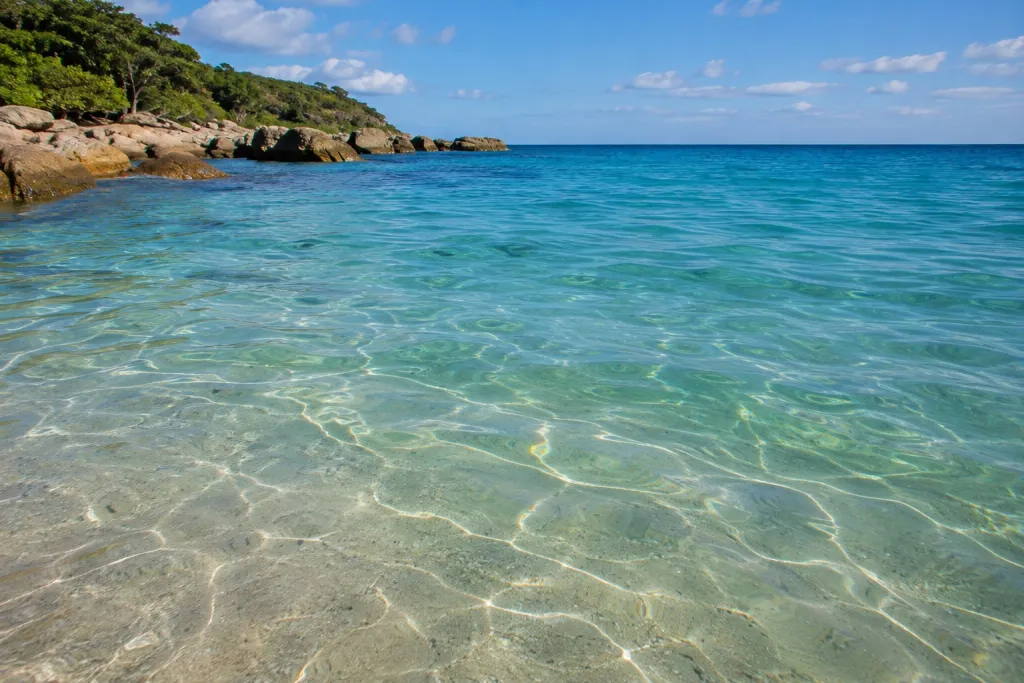
Scoop up some ocean water in a cup and it looks clear. So why does the whole ocean look so blue? Most people guess it’s reflecting the sky. That’s part of the answer, but the bigger secret is that water itself is very slightly blue.
Sunlight is a rainbow in disguise
Sunlight looks white, but it’s really all the colors of the rainbow mixed together: red, orange, yellow, green, blue and violet. You can see them separately when sunlight passes through a prism or raindrops.
Water eats the red
When sunlight goes into water, the water absorbs (soaks up) some colors more than others. Red goes first, then orange and yellow. Blue light travels the farthest. Some of that blue light bumps off tiny particles and water molecules and bounces back up to your eyes. So deep water looks blue.
It’s a tiny effect, so you need a lot of water to see it. A glass is way too thin. A swimming pool shows a hint of blue. An ocean, hundreds or thousands of feet deep, is deeply blue.
Explain it like I’m 5
Sunlight is made of every color. Ocean water gobbles up the red and orange light but doesn’t like to eat blue. The blue is left over, so the ocean looks blue.
What about the sky?
The sky does help. The water’s surface works a bit like a mirror, especially when you look across it toward the horizon. On a gray, cloudy day the ocean looks grayer, and at sunset it can glow orange and pink. But even under a gray sky, deep, clear water still looks blue from above, because of the water’s own color.
Why some water looks green or brown
- Green: water full of tiny ocean plants called phytoplankton looks green, because they contain green chlorophyll.
- Turquoise: shallow water over white sand reflects lots of light back up, giving that bright tropical blue-green.
- Brown: near river mouths, mud and sand stirred up in the water make it look brown.
Scientists use satellites to measure the ocean’s exact color, which tells them where phytoplankton are growing.
Try it: find the blue in your bathtub

You need: a clear glass, a white bathtub (or a big white bucket) and water.
- Fill a glass with water and set it on white paper. What color is it?
- Fill a white bathtub as deep as you can with clear water (no bubbles!).
- Turn on a bright light and look down at the deepest part of the tub. Compare it to the glass.
What’s happening: the glass looks clear, but the deep tub has a faint blue-green tint, even though there’s no sky indoors. The light travels down through the water and back up again, so there’s enough water to soak up a little red. Imagine how blue it gets in water thousands of feet deep!
Keep exploring: Why Is the Sky Blue? · Why Is the Ocean Salty? · Why Are Plants Green?
Words to know
- Absorb
- To soak something up, like water soaking up red light.
- Reflect
- To bounce light back, like a mirror.
- Spectrum
- All the colors that make up white light.
- Phytoplankton
- Tiny plant-like living things that float in the ocean and can turn water green.
For grown-ups: the real science
Water’s intrinsic color comes from vibrational overtone absorption by O–H bonds, which absorbs weakly at the red end of the visible spectrum (around 600–750 nm). It’s one of the few cases in nature where color arises from molecular vibrations rather than electronic transitions (Braun and Smirnov, Journal of Chemical Education, 1993). Light penetrating clear water is progressively filtered: red is largely gone within about 10 m, and blue (around 450–490 nm) penetrates deepest, beyond 100 m in very clear oligotrophic water.
Backscattering by water molecules and particles returns the surviving blue light upward. Surface reflection of skylight contributes more at low viewing angles. Ocean color varies with chlorophyll, colored dissolved organic matter and suspended sediment; NASA’s ocean color satellites (such as PACE, launched 2024) use these signals to map phytoplankton.
Questions kids ask next
Is the ocean blue because it reflects the sky?
Only partly. The main reason is that water soaks up red light and leaves blue. Reflection of the sky adds to it, especially when you look toward the horizon.
Why is the sky blue?
For a different reason! Air scatters blue sunlight all across the sky much more than red light. The ocean’s blue comes mostly from water absorbing red.
Is it dark at the bottom of the ocean?
Yes. Below about 3,300 feet (1,000 meters), no sunlight reaches at all. The only light down there comes from glowing animals.
Why do things look blue underwater?
Because the red light gets soaked up first. A red fish deep underwater can look dark gray or black, which helps it hide.