Between Mars and Jupiter, a giant swarm of space rocks circles the Sun. They’re called asteroids, and they’re like the leftover building blocks from when our planets were made, billions of years ago.
Leftovers from the solar system’s birth
About 4.6 billion years ago, our solar system was a spinning cloud of gas and dust. Over time, bits of dust clumped into rocks, rocks crashed into bigger rocks, and some grew into the planets. But not everything became part of a planet. The rocky pieces left over are asteroids. Studying them is like reading pages from the solar system’s baby book.
Where asteroids live
Most asteroids orbit the Sun in the asteroid belt, a wide ring between Mars and Jupiter. Jupiter’s strong gravity kept these rocks stirred up so they could never come together into a planet. Movies often show the belt as a crowded field of tumbling rocks, but it’s mostly empty space. Spacecraft fly through it safely, because the asteroids are usually hundreds of thousands of miles apart.
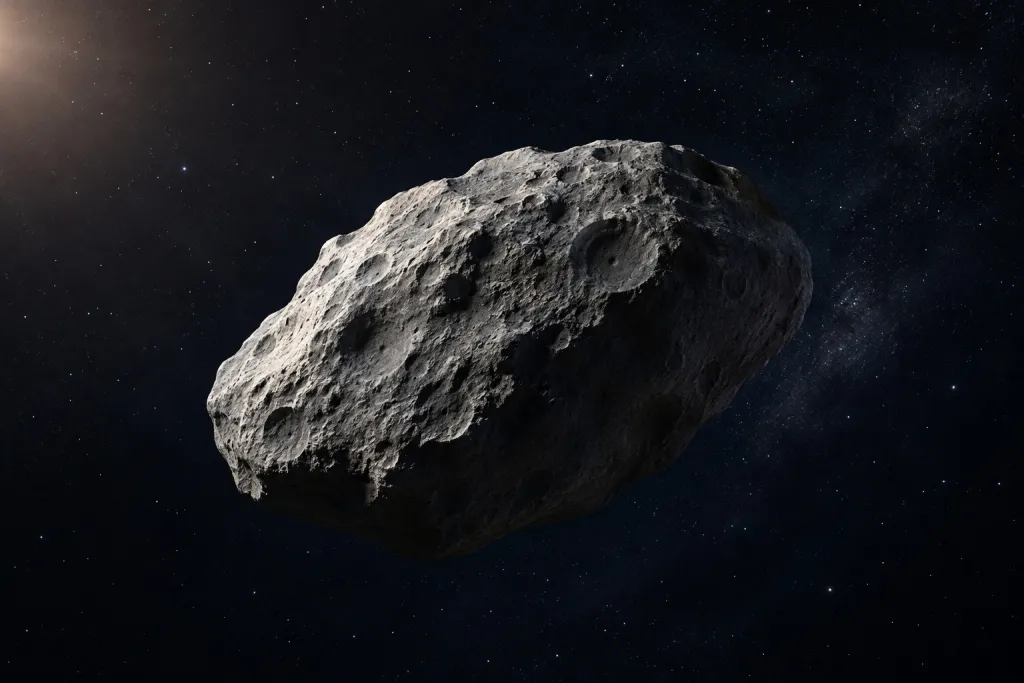
Scientists have found more than a million asteroids. Some are tiny, just a few feet across. The biggest, Ceres, is about 590 miles wide, big enough to be round, so it’s also called a dwarf planet. Many asteroids are lumpy, shaped like potatoes or peanuts, and some even have their own tiny moons.
Explain it like I’m 5
When the planets were made, there were rocks left over, like crumbs after baking cookies. Those space rocks are asteroids. Lots of them float around the Sun in a big ring.
Asteroid, comet or meteor?
- Asteroid: a rocky or metal space rock orbiting the Sun, mostly in the asteroid belt.
- Comet: a ball of ice, dust and rock from the far, cold edges of the solar system. When it gets close to the Sun, the ice heats up and makes a glowing tail.
- Meteor: the streak of light when a small bit of space rock burns up in Earth’s air, also called a shooting star.
Asteroids and Earth
About 66 million years ago, an asteroid around 6 miles wide crashed into what is now Mexico. The huge impact changed Earth’s climate and helped wipe out the dinosaurs (except for the ones that became birds). Today, scientists keep track of asteroids that come near Earth, and none of the big ones they know about is on course to hit us. In 2022, NASA’s DART spacecraft even crashed into a small asteroid on purpose and nudged its path, proving we could someday steer one away if we needed to.
Try it: make asteroid craters
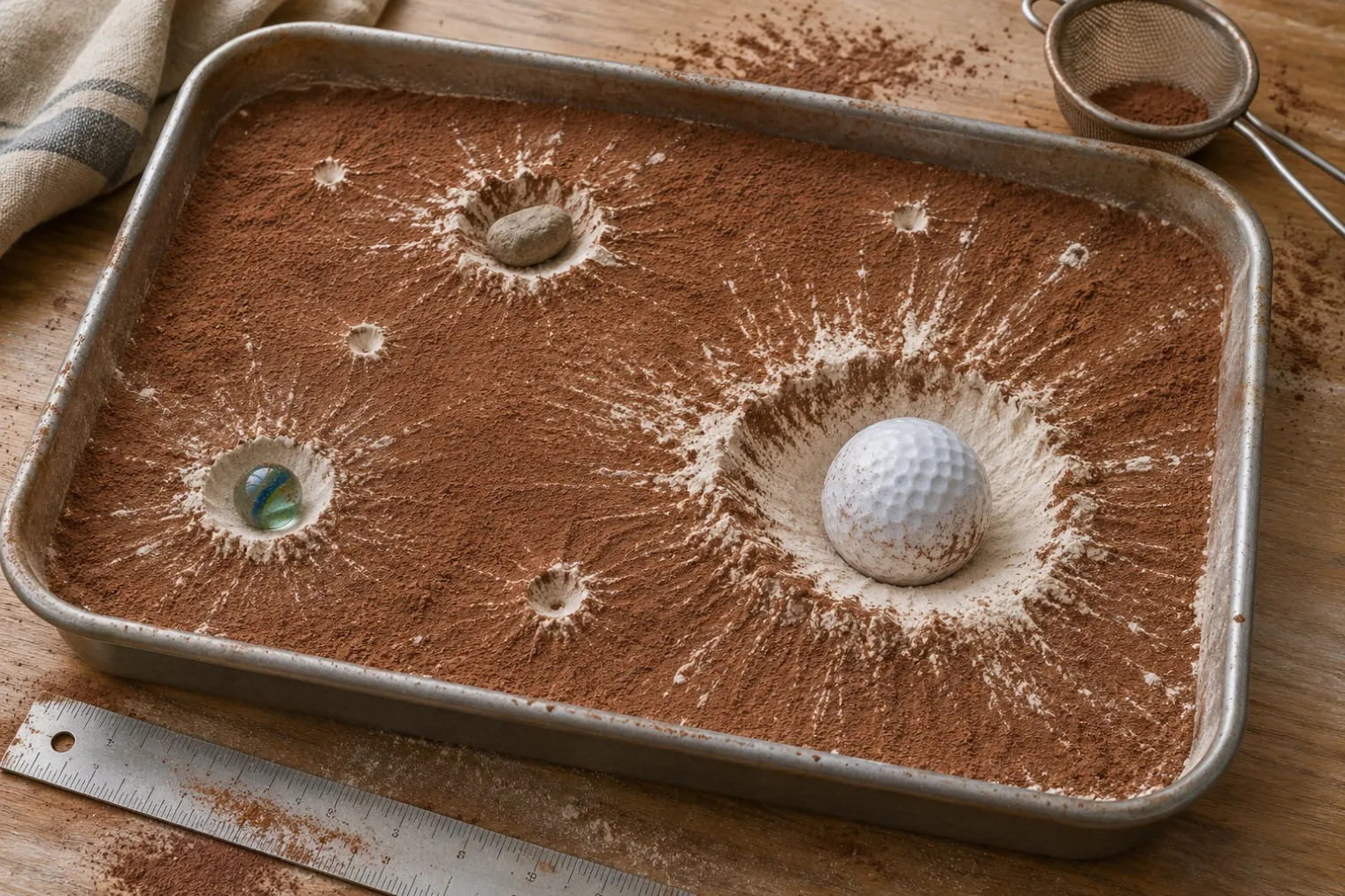
You need: a baking pan, 2 or 3 cups of flour, a few spoonfuls of cocoa powder, a sifter or strainer, a ruler and “asteroids” of different sizes, like a marble, a golf ball and a small rock.
- Spread the flour in the pan about 1 inch deep and smooth it flat. Sift a thin layer of cocoa on top, so it looks like a planet’s surface.
- Drop the marble from about 1 foot high. Look at the crater it makes.
- Drop the same marble from 3 feet. Then try the bigger objects. Measure each crater’s width with the ruler.
- Look for “rays,” the streaks of white flour splashed out across the cocoa.
What’s happening: bigger and faster “asteroids” make bigger craters and splash more material outward, just like real impacts. Look at the Moon with binoculars and you’ll see the same round craters and bright rays left by asteroids long ago.
Keep exploring: What Is a Shooting Star? · Why Is Pluto Not a Planet? · What Is a Black Hole?
Words to know
- Asteroid
- A rocky or metal object that orbits the Sun.
- Asteroid belt
- The region between Mars and Jupiter where most asteroids are found.
- Comet
- An icy object that grows a glowing tail near the Sun.
- Crater
- A bowl-shaped hole made when something smashes into a surface.
- Dwarf planet
- A round object that orbits the Sun but isn’t a full planet, like Ceres or Pluto.
For grown-ups: the real science
Asteroids are planetesimal remnants from the solar system’s formation about 4.6 billion years ago. The main belt lies roughly 2.1–3.3 AU from the Sun, where Jupiter’s gravitational perturbations prevented accretion into a planet; its total mass is only about 3% of the Moon’s, with Ceres (about 940 km across) holding roughly a third of it. More than 1.3 million asteroids have been catalogued. Compositional classes include carbonaceous (C-type), silicaceous (S-type) and metallic (M-type).
The Chicxulub impactor (about 10 km) struck the Yucatán Peninsula about 66 million years ago, contributing to the Cretaceous–Paleogene extinction. NASA’s Planetary Defense Coordination Office tracks near-Earth objects; no known asteroid larger than 140 m poses a significant impact risk in the next century. DART (2022) shortened the orbit of the moonlet Dimorphos by about 32 minutes, and OSIRIS-REx returned samples from asteroid Bennu in 2023. In the crater demo, crater size scales with impactor size and speed, and ejecta rays mimic lunar features like those around Tycho.
Questions kids ask next
Will an asteroid hit Earth?
Tiny space rocks hit Earth every day and burn up as shooting stars. Big, dangerous impacts are extremely rare, and scientists watch the sky carefully for any that might come close.
Have we ever landed on an asteroid?
Yes! Spacecraft have landed on or touched several asteroids, and missions from Japan and NASA have even brought asteroid dust back to Earth.
Are asteroids made of gold?
Some metal-rich asteroids contain iron, nickel and small amounts of precious metals. NASA’s Psyche spacecraft is on its way to study a metal-rich asteroid called Psyche.
How many asteroids are there?
Scientists have found more than a million, and there are probably millions more too small or faint to have been spotted yet.