Imagine a place in space so powerful that if you shined a flashlight near it, the light itself would get sucked in and never come back. That’s a black hole. It sounds like science fiction, but black holes are real, and scientists have even taken pictures of them.
It’s all about gravity
Everything with mass has gravity, a pull that draws other things toward it. Earth’s gravity keeps your feet on the ground. The more stuff that’s packed into a small space, the stronger the pull close to it.
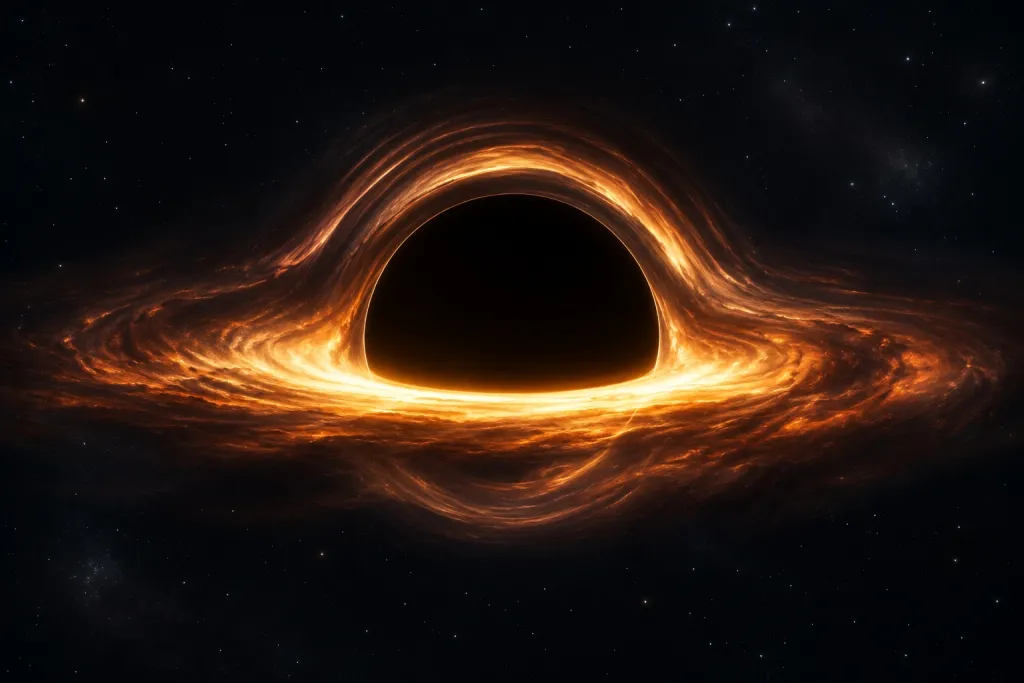
A black hole is what happens when an enormous amount of stuff gets squeezed into a tiny space. To turn Earth into a black hole, you’d have to crush the whole planet down to the size of a marble! Near something that dense, gravity is so strong that nothing can escape once it gets too close, not even light, the fastest thing in the universe. With no light coming out, it looks perfectly black.
The point of no return
Around every black hole is an invisible boundary called the event horizon. Outside it, things can still orbit or escape, the way planets orbit the Sun. Once something crosses the event horizon, there’s no coming back. It’s like the edge of a giant waterfall: far away, a boat can paddle against the current, but past the edge, it’s going over.
Explain it like I’m 5
A black hole is like the strongest vacuum cleaner in the universe. If anything gets too close, even light, it gets pulled in and can’t get back out. That’s why it looks black.
How do black holes form?
Most black holes are born when a giant star, many times bigger than our Sun, runs out of fuel. Without fuel pushing outward, the star’s own gravity makes it collapse. The outer layers blast away in a gigantic explosion called a supernova, and the core crushes down into a black hole.
Our Sun is too small to ever become a black hole. Billions of years from now it will gently puff up and then shrink into a small, dim star called a white dwarf.
Giant black holes and the first photos
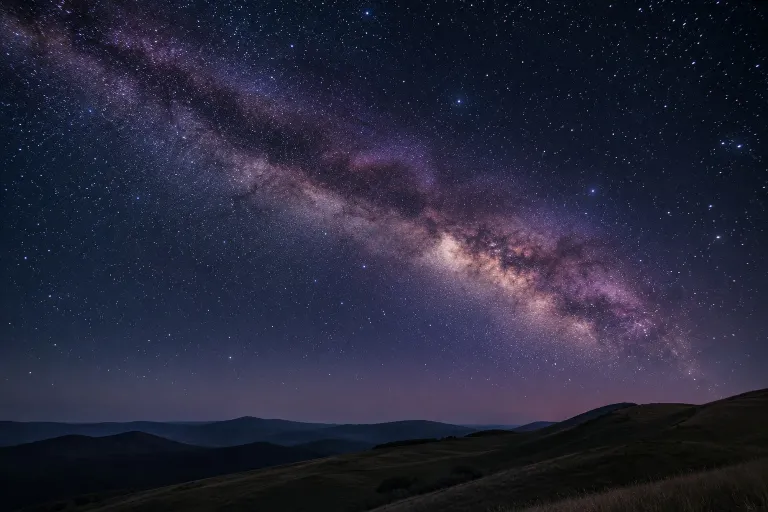
Some black holes are monsters called supermassive black holes, millions or billions of times heavier than the Sun. Almost every big galaxy has one in its center. Ours, in the middle of the Milky Way, is called Sagittarius A* (say it: “Sagittarius A-star”). It’s about 4 million times heavier than the Sun and roughly 26,000 light-years away, so it’s no danger to us.
You can’t photograph the black hole itself, but you can photograph its shadow against the glowing gas around it. In 2019, a team of scientists linked telescopes all over the world into one Earth-sized “virtual telescope” and captured the first image of a black hole, in a galaxy called M87. It looked like a glowing orange doughnut with a dark center. In 2022, they released a picture of our own galaxy’s black hole too.
Try it: make a gravity well

You need: a stretchy fitted sheet or a piece of spandex fabric, 2 or more helpers (or a laundry basket to stretch it over), a heavy ball like a grapefruit or softball and some marbles.
- Stretch the fabric tight and flat, held by helpers or pulled over a laundry basket. Small version: pull an old T-shirt tight over a big bowl and use an orange as the heavy ball.
- Roll a marble across. It goes in a straight line.
- Place the heavy ball in the middle. See the dip it makes?
- Roll marbles past the dip at different speeds. Some curve around, and some spiral in and get stuck next to the ball.
What’s happening: scientists describe gravity as heavy objects bending the space around them, like the ball bending the fabric. A black hole makes the deepest dip of all. Close to it, the slope gets so steep that even light can’t climb back out.
Keep exploring: What Is Gravity? · What Is a Light-Year? · What Is an Asteroid?
Words to know
- Black hole
- A place in space where gravity is so strong that nothing can escape, not even light.
- Gravity
- The pull that objects with mass have on each other.
- Event horizon
- The invisible edge around a black hole. Past it, nothing can get out.
- Supernova
- The giant explosion of a big star at the end of its life.
- Galaxy
- A huge group of billions of stars. We live in the Milky Way.
For grown-ups: the real science
In general relativity, a black hole is a region of spacetime from which escape velocity exceeds the speed of light. The event horizon’s radius (the Schwarzschild radius) is about 3 km per solar mass, so Earth would need to be compressed to a radius of about 9 mm, roughly the size of a marble. Stellar-mass black holes typically form from the core collapse of stars with initial masses roughly above 20 solar masses; supermassive black holes (millions to billions of solar masses) sit at the centers of most large galaxies, though how they grew so large so early is still being researched.
The Event Horizon Telescope used very-long-baseline interferometry at 1.3 mm wavelength to image the shadow of M87* (about 6.5 billion solar masses) in 2019 and Sagittarius A* (about 4 million solar masses) in 2022. LIGO first detected gravitational waves from merging black holes in 2015. Tidal forces near a small black hole stretch infalling objects (“spaghettification”). The rubber-sheet model is an analogy: it captures curvature but not the full four-dimensional picture.
Questions kids ask next
Could Earth get sucked into a black hole?
No. The nearest known black holes are thousands of light-years away, much too far to pull on us. Black holes don’t roam around vacuuming things up; they only pull in what gets very close.
What would happen if you fell into a black hole?
Near a small black hole, gravity would pull much harder on your feet than your head and stretch you out like a noodle. Scientists actually call this “spaghettification.”
How big is a black hole?
It depends. Small ones might be only a few miles across. Supermassive ones can be bigger than our whole solar system.
If black holes are black, how do we find them?
By watching what’s around them: stars racing around an invisible spot, gas glowing as it swirls in, and tiny ripples in space called gravitational waves when two black holes crash together.