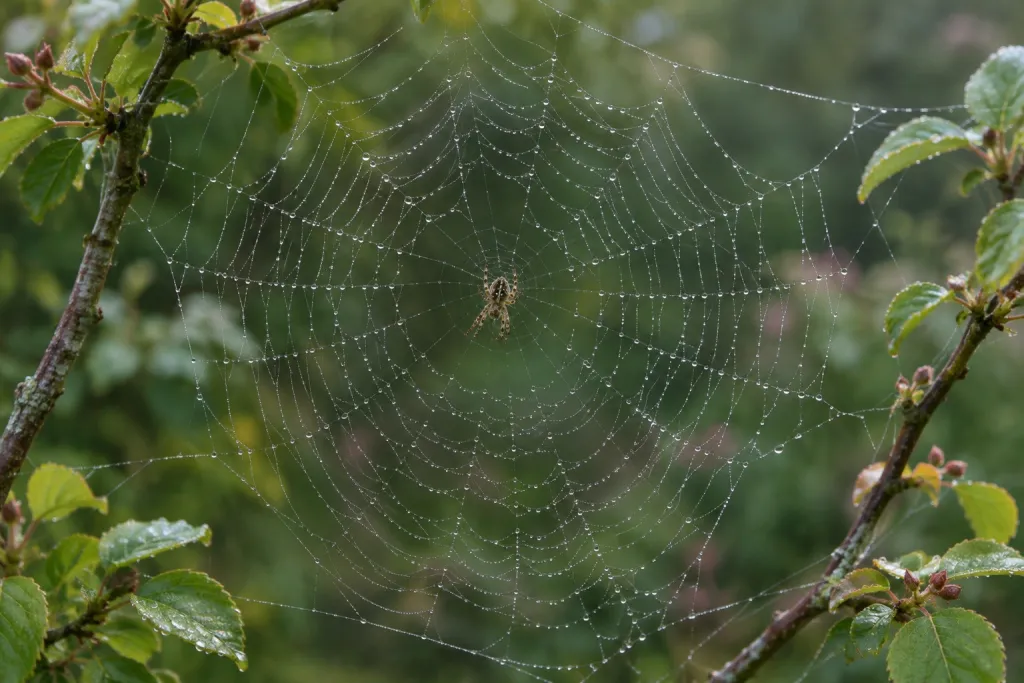
Some mornings you’ll spot one sparkling with dew between two branches: a perfect spiral web. A spider built it, often in under an hour, using only silk from its own body. No tools, no plans, no practice. How does it do it?
Where silk comes from
Inside a spider’s abdomen (the big back part of its body) are silk glands that make silk as a gooey liquid protein. At the tip of the abdomen are tiny nozzles called spinnerets. As the spider pulls the liquid out through them, the stretching lines up the proteins and the liquid becomes a solid, super-strong thread.
Many spiders can make several kinds of silk: a strong dry silk for frames and safety lines, a stretchy sticky silk for catching prey, soft silk for wrapping eggs and more. They choose the kind they need for each job.
Building a web, step by step
There are lots of web shapes, but the classic wheel-shaped orb web is built like this:
- The bridge. The spider lets out a thread and waits for the breeze to carry it to a branch or wall. When it sticks, the spider has a bridge line.
- The Y. It walks across, dropping a looser thread, then lowers itself from the middle to make a Y shape.
- The frame and spokes. It adds an outer frame and lots of spokes, called radii, going out from the center like bicycle spokes. These are all dry, non-sticky silk.
- A temporary spiral. It lays down a widely spaced spiral to hold everything steady while it works.
- The sticky spiral. Working from the outside in, it lays down a tight spiral of sticky silk, removing the temporary spiral as it goes. Then it waits in the center or hides nearby holding a signal line.
Explain it like I’m 5
A spider has tiny string-makers on its bottom. It makes lines like the spokes of a bike wheel, then goes around and around adding sticky string. Bugs fly in and get stuck, and the spider has dinner!
Why don’t spiders get stuck?
Spiders have several tricks. They mostly walk on the dry spokes, not the sticky spiral. They step carefully, touching the threads only with the tips of their feet, which have special hooks and tiny hairs that keep contact small. And some spiders have a special non-stick coating on their legs.
Super silk
- Stronger than steel? For its weight, some spider silk is stronger than steel and tougher than Kevlar, the material in bulletproof vests.
- Recycled. Many orb weavers eat their old web each night or morning to recycle the protein, then build a fresh one.
- A web is a phone line. Most web spiders can’t see well. They feel vibrations through the silk to tell if it’s a trapped bug, the wind or a visitor.
- Ballooning. Baby spiders can float away on silk threads carried by the wind, sometimes for miles.
Try it: build a sticky tape web
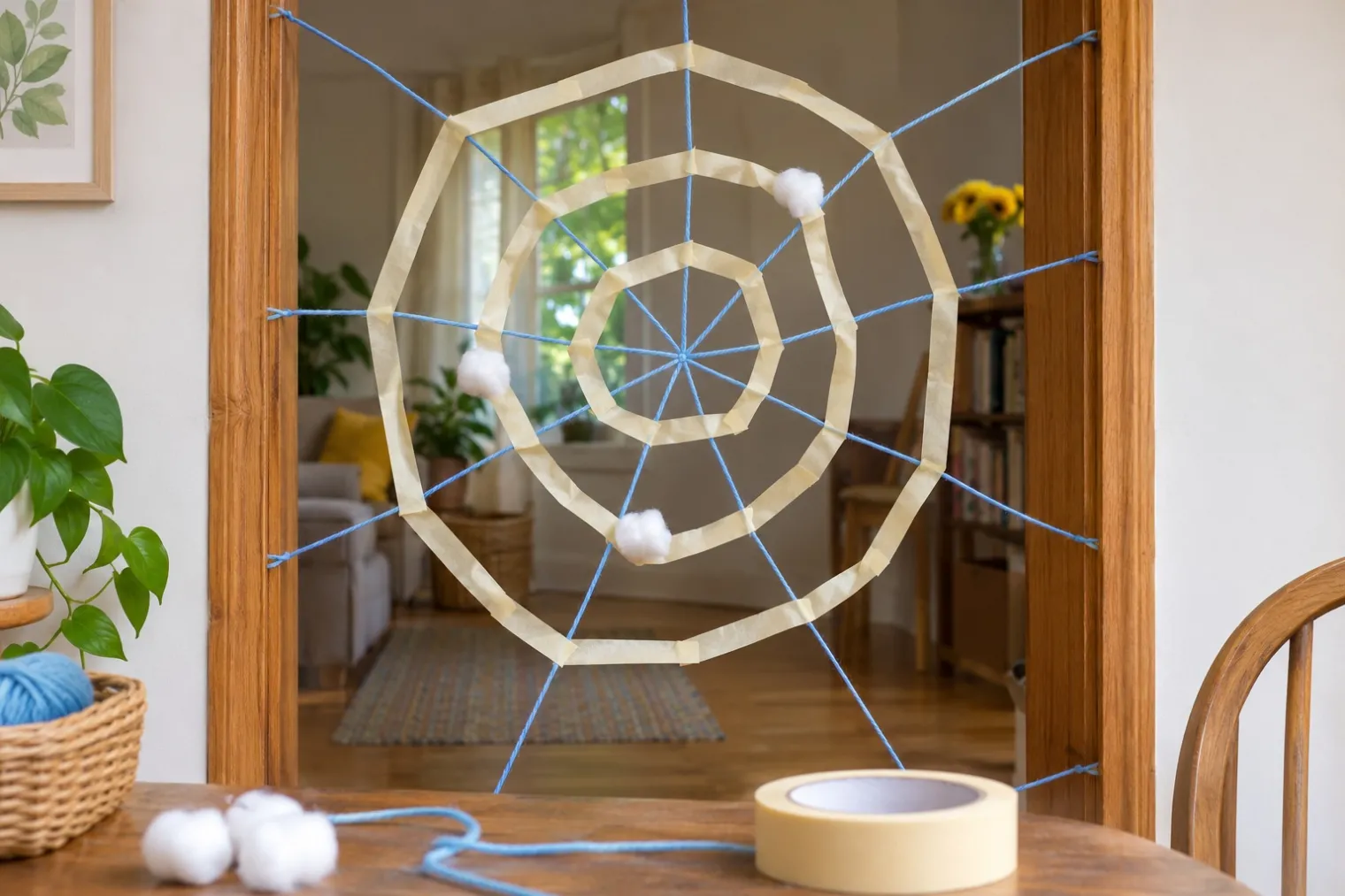
You need: painter’s tape or masking tape, a doorway, yarn or string and cotton balls or small pom-poms (your “bugs”).
- With a grown-up, tape yarn across the doorway to make a frame and spokes, like step 2 of a real web. The yarn is your dry silk.
- Now add a spiral of tape with the sticky side facing you, attaching it to the spokes as you go around.
- Stand back and toss your cotton-ball bugs at the web. Count how many get caught.
- Try to touch the web without getting stuck, like a spider: which parts can you touch safely?
What’s happening: bugs stick only where they hit the sticky spiral. The yarn spokes are safe to touch, which is exactly how real spiders move around their webs without getting trapped. Bonus: on a dewy morning, go outside and look for real webs. Don’t touch, just look!
Keep exploring: The Butterfly Life Cycle · How Do Bees Make Honey? · Why Do Roosters Crow?
Words to know
- Spinnerets
- Tiny nozzles at the back of a spider that silk comes out of.
- Silk
- A strong thread made of protein that spiders produce.
- Orb web
- A round, wheel-shaped web with spokes and a spiral.
- Abdomen
- The back section of a spider’s body.
- Prey
- An animal that is hunted and eaten by another animal.
- Arachnid
- The animal group spiders belong to. Arachnids have eight legs.
For grown-ups: the real science
Spider silk is made of proteins called spidroins, stored as a concentrated liquid dope in the silk glands. As the dope passes through a tapering duct, changes in pH and ion concentration plus shear forces cause the proteins to align and form β-sheet crystals, converting it into a solid fiber. Orb weavers (family Araneidae) can have up to seven silk gland types; dragline (major ampullate) silk has a tensile strength comparable to high-grade steel by weight and exceptional toughness, while capture-spiral (flagelliform) silk is highly extensible and coated with aggregate-gland glue droplets.
Orb-weaving spiders avoid adhesion by limiting contact with capture threads, using specialized tarsal claws and serrated setae to grip threads, and, in some species, an anti-adhesive surface coating on the legs (Briceño and Eberhard, 2012). Webs function as extended sensory organs; spiders read vibration frequencies and amplitudes to distinguish prey from wind or mates. Many orb weavers ingest and recycle the protein from old webs.
Questions kids ask next
Do all spiders make webs?
No. All spiders make silk, but many, like jumping spiders and wolf spiders, hunt without webs. They use silk for safety lines, nests and egg sacs instead.
How long does it take to build a web?
Many orb weavers can build a complete web in 30 minutes to an hour, often in the evening or early morning.
Are spiders insects?
No. Spiders are arachnids. They have eight legs and two body parts, while insects have six legs and three body parts.
What’s the biggest spider web?
Darwin’s bark spider in Madagascar builds webs across rivers, with bridge lines up to about 80 feet (25 meters) long.