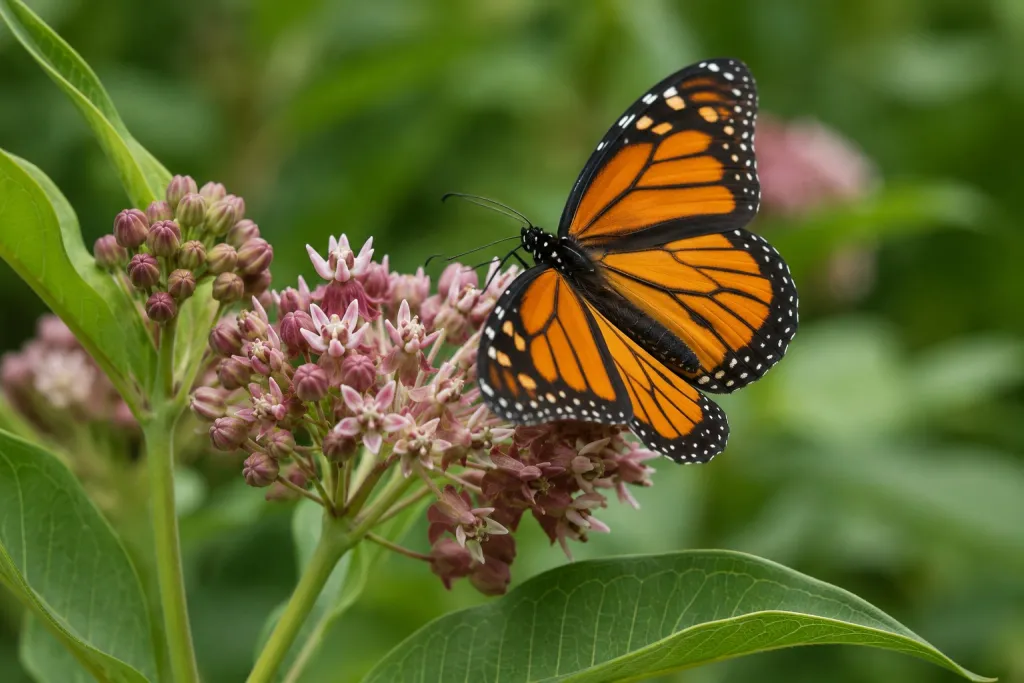
A fuzzy caterpillar munching a leaf and a bright butterfly floating over a flower look like two completely different animals. But they’re the same creature at different stages of its life. Butterflies go through one of the most amazing changes in nature.
The 4 stages of a butterfly’s life
1. Egg
A female butterfly lays tiny eggs, often smaller than a pinhead, on a plant. She picks carefully, because each kind of caterpillar eats only certain plants. Monarch butterflies lay their eggs only on milkweed. After a few days, the egg hatches.
2. Caterpillar (larva)
The baby that hatches is a caterpillar, and its main job is eating. Its first meal is often its own eggshell. Then it munches leaves nonstop and grows fast. Its skin can’t stretch, so the caterpillar molts, splitting its old skin and wiggling out in a new, bigger one, usually four or five times. A monarch caterpillar grows about 2,000 times heavier in roughly two weeks!
3. Chrysalis (pupa)
When it’s fully grown, the caterpillar finds a safe spot, hangs upside down and molts one last time. This time, a hard case called a chrysalis forms. It looks like nothing is happening, but inside, the caterpillar’s body breaks down into a kind of soup, and groups of special cells that were waiting inside it all along build brand-new wings, legs, eyes and antennae. For a monarch, this takes about 10 to 14 days.
4. Butterfly (adult)
The chrysalis splits open and a butterfly crawls out with crumpled, wet wings. It pumps fluid into its wings to spread them flat, then waits a few hours for them to dry. Now it can fly, sip nectar from flowers with its curly straw-like tongue, find a mate and lay eggs, starting the cycle all over again.
Explain it like I’m 5
First there’s a tiny egg. Out comes a hungry caterpillar that eats and eats. Then it takes a long nap in a sleeping bag called a chrysalis. When it wakes up, it’s a butterfly!
Chrysalis or cocoon?
People mix these up all the time. A chrysalis is the hard shell a butterfly forms from its own skin. A cocoon is a silk wrapping that most moth caterpillars spin around themselves. Both protect the insect while it transforms.
Amazing butterfly facts
- They taste with their feet. Butterflies have taste sensors on their feet so they can check if a leaf is the right one for their eggs.
- Monarchs are long-distance travelers. Each fall, millions of monarchs fly up to 3,000 miles from Canada and the United States to forests in Mexico.
- Their wings are covered in tiny scales, like shingles on a roof. The scales make the colors and patterns.
- Most adult butterflies live only a few weeks, but the monarchs that migrate can live up to eight or nine months.
Try it: make a pasta life cycle plate
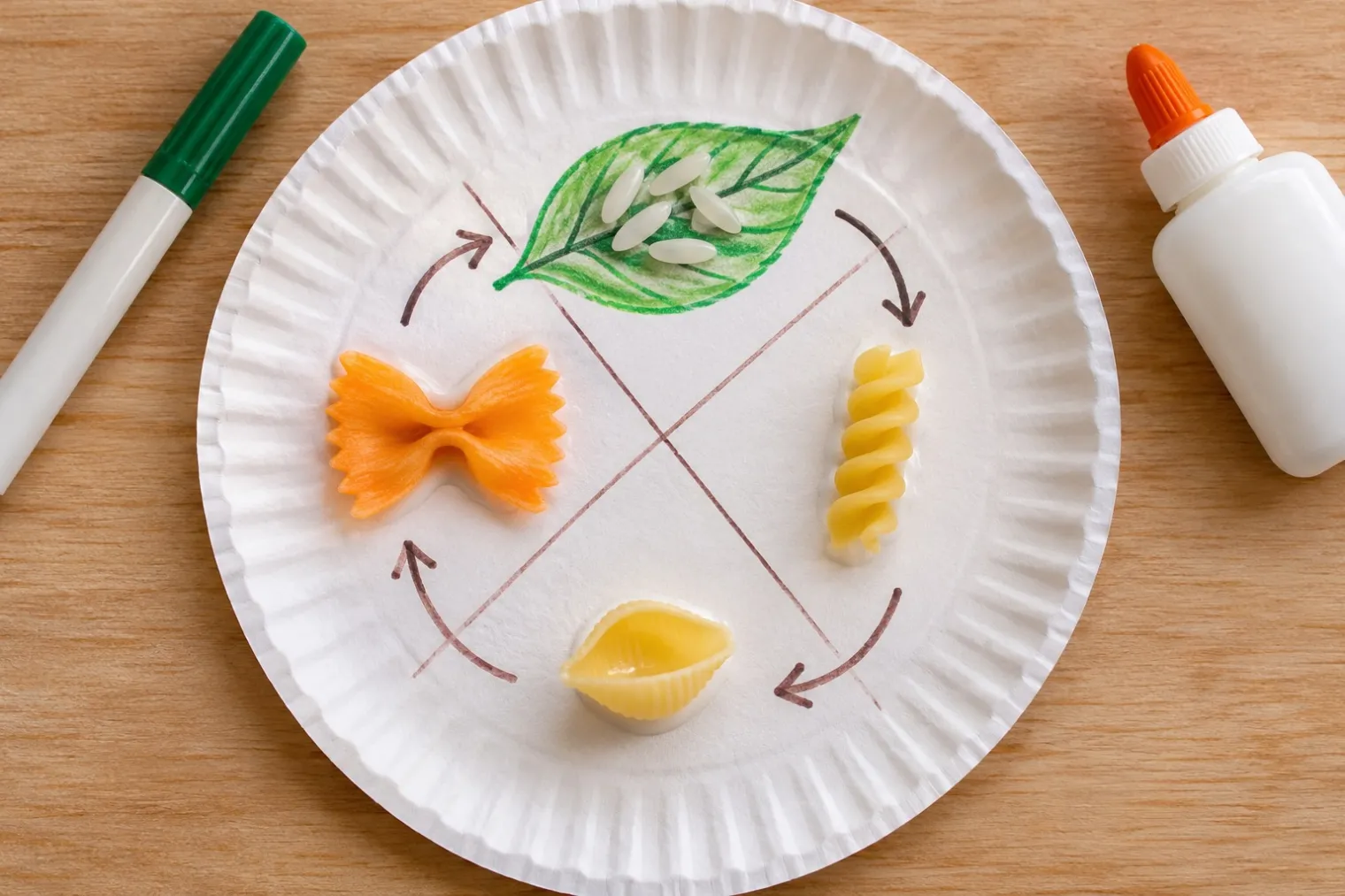
You need: a paper plate, a marker, glue, a few grains of rice, a spiral pasta (rotini), a shell pasta and a bow-tie pasta (farfalle). Markers or paint to color them are a bonus.
- Draw lines to divide the plate into four sections, like a pizza, and draw arrows going around in a circle.
- Draw a leaf in the first section and glue rice on it for eggs.
- Glue the spiral pasta in section two for the caterpillar, the shell in section three for the chrysalis and the bow-tie in section four for the butterfly.
- Label each stage and color your butterfly. Then tell someone the whole story, starting with the egg.
What’s happening: putting the stages in a circle shows that a life cycle has no end. The butterfly lays eggs, and the whole thing starts over. Want to see it for real? In spring and summer, look for caterpillars on milkweed, parsley or dill.
Keep exploring: How Do Bees Make Honey? · How Do Spiders Make Webs? · Why Are Flamingos Pink?
Words to know
- Life cycle
- The stages a living thing goes through from birth to adult and back again.
- Metamorphosis
- A big change in body shape as an animal grows up.
- Larva
- The young stage of an insect. A caterpillar is a butterfly larva.
- Chrysalis
- The hard case a caterpillar forms while it turns into a butterfly.
- Molt
- To shed an old skin so the body can grow bigger.
- Nectar
- A sweet liquid inside flowers that butterflies drink.
For grown-ups: the real science
Butterflies undergo complete metamorphosis (holometaboly): egg, larva, pupa, adult. Larvae pass through several instars separated by molts controlled by the hormone ecdysone; high juvenile hormone levels keep each molt larval. When juvenile hormone drops in the final instar, the next molt produces a pupa. During the pupal stage, most larval tissues are broken down by programmed cell death and enzymes, while imaginal discs (clusters of cells present since the embryo) proliferate and differentiate into adult structures. Some tissues, including parts of the nervous system, persist, and studies suggest moths can retain some larval learning.
Monarch (Danaus plexippus) larvae feed exclusively on milkweed (Asclepias), sequestering cardenolides that make larvae and adults distasteful to predators. Eastern monarchs undertake a multi-generational annual migration; the late-season “super generation” enters reproductive diapause and overwinters in oyamel fir forests in central Mexico. Raising caterpillars at home is a classic observation activity; release only native species where you found them.
Questions kids ask next
How long does it take a caterpillar to become a butterfly?
For a monarch, about a month from egg to butterfly. Some butterflies spend the whole winter as a chrysalis before they come out.
Can I touch a butterfly’s wings?
It’s best not to. The tiny scales rub off easily, and the wings are delicate. Let butterflies land on your hand instead.
Do all insects have four stages?
No. Butterflies, beetles, bees and flies do. Grasshoppers and dragonflies have three stages: egg, nymph and adult. A nymph looks like a small adult without wings.
Does a butterfly remember being a caterpillar?
Maybe a little! A study with moths found that adults could remember a smell they’d learned to avoid as caterpillars.