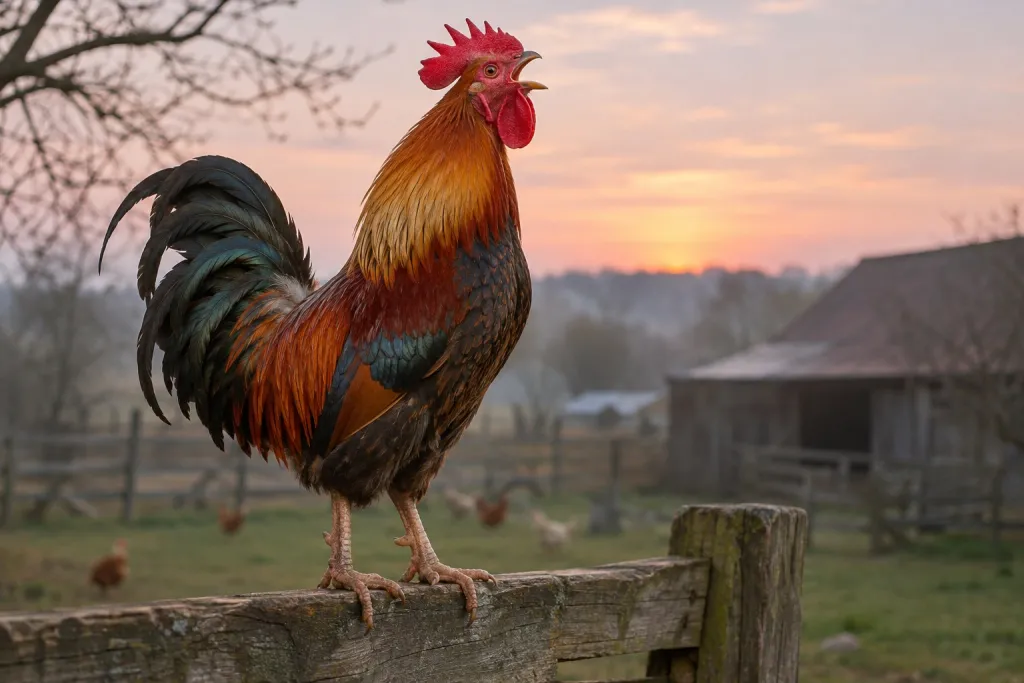
Cock-a-doodle-doo! In cartoons, the rooster crows the second the Sun peeks over the hill. In real life, roosters often start crowing before the Sun comes up. So how does a rooster know morning is coming in the dark? Scientists set out to find out.
Roosters have a built-in clock
In 2013, scientists in Japan kept roosters in a room with dim light all day and night, so the birds couldn’t see any sunrise. The roosters still crowed at about the same time every “morning.” That proved roosters have an internal clock, called a circadian rhythm, that keeps track of time on its own, roughly every 24 hours.
Light helps keep the clock set correctly, like when you set a watch. But the clock lets roosters predict the dawn instead of just reacting to it. You have a circadian rhythm too. It’s why you get sleepy at night and tend to wake up around the same time each morning.
Explain it like I’m 5
A rooster has a tiny clock inside its body. Every morning the clock says, “Wake up, it’s almost morning!” So the rooster crows to say, “Good morning, and this is MY farm!”
Crowing says “this is my place”
Crowing is also a message. It tells other roosters, “I live here, and I’m in charge.” It helps keep roosters apart without fighting. Chickens have a pecking order, a ranking of who’s the boss, and a 2015 study found that the top rooster gets to crow first in the morning. Lower-ranking roosters wait their turn, even though their own body clocks are ready too.
Roosters crow all day long
The morning crow is the most famous, but roosters crow whenever they want to make a point: when another rooster crows, when a car door slams, when a light flips on or when they spot something new. Morning is just when crowing is most predictable.
More rooster facts
- Crows are LOUD. A rooster’s crow can be over 100 decibels up close, about as loud as a chainsaw.
- They have built-in earmuffs. When a rooster opens its beak wide to crow, part of its ear canal closes and soft tissue covers its eardrum, so it doesn’t hurt its own hearing.
- Hens hardly ever crow. Crowing is controlled by hormones. Hens occasionally crow, especially in a flock with no rooster.
- Chicks start practicing early. Young roosters begin trying to crow at a few months old, and their first crows sound squeaky and funny.
Try it: test your own body clock
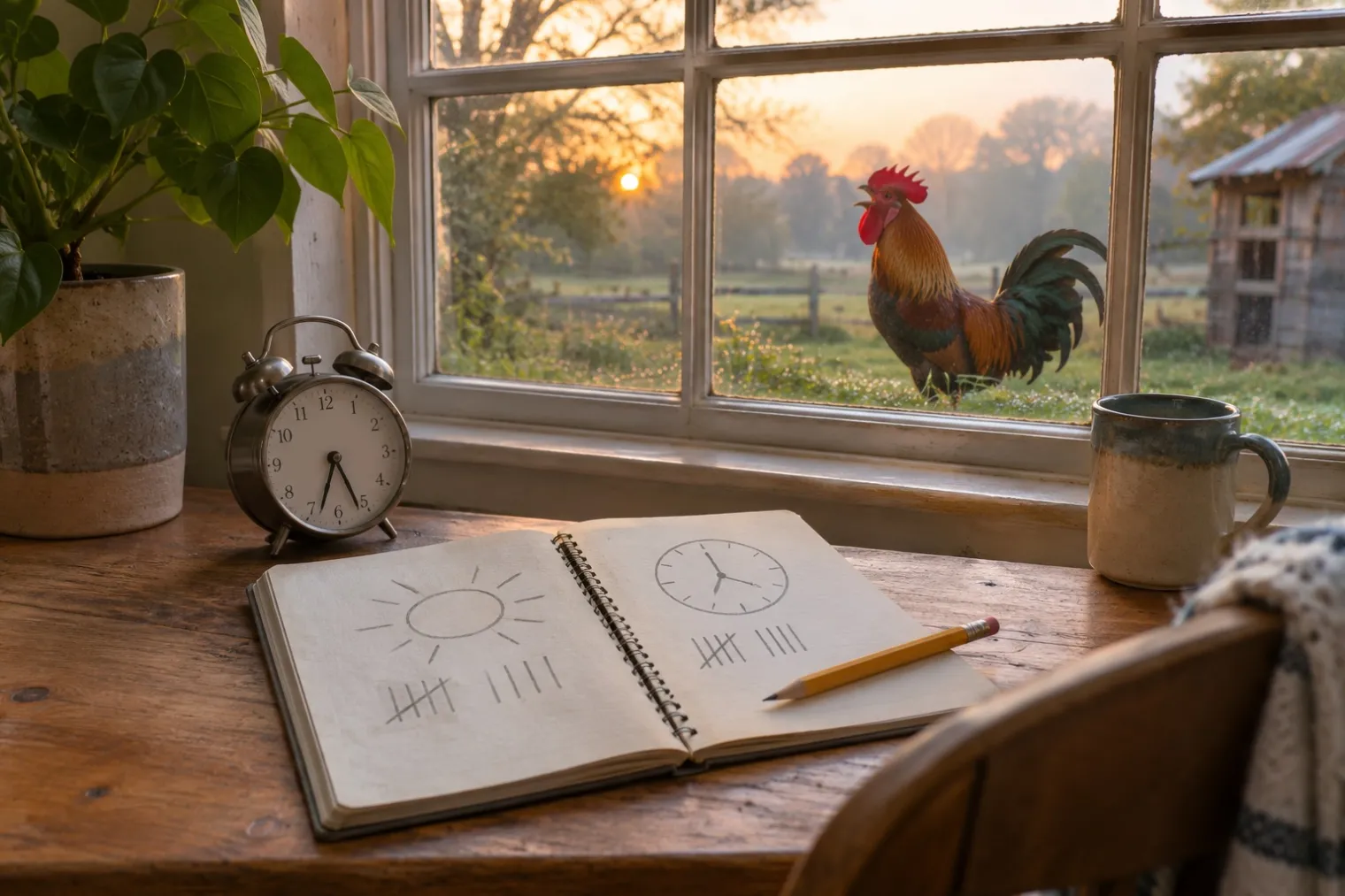
You need: a notebook, a clock and a grown-up helper.
- Make a chart with three columns: day, time I woke up and time I felt sleepy at night.
- Each morning, write down the time you wake up. On weekends, try waking up without an alarm.
- Each evening, ask a grown-up to write down when you start yawning.
- After a week, look at your chart. Are the times close to each other every day?
What’s happening: if your times line up, you’ve spotted your own circadian rhythm at work. Just like a rooster’s, your body clock gets you ready to wake up and to sleep at about the same times every day.
Keep exploring: Why Do We Need Sleep? · Do Fish Sleep? · Why Do Bears Hibernate?
Words to know
- Circadian rhythm
- A body clock that repeats about every 24 hours.
- Territory
- An area an animal claims and defends as its own.
- Pecking order
- The ranking of who’s in charge in a group of chickens.
- Decibel
- A unit for measuring how loud a sound is.
- Rooster
- An adult male chicken. A female is a hen.
For grown-ups: the real science
Shimmura and Yoshimura (Current Biology, 2013) showed that roosters held under constant dim light continued to crow with a free-running rhythm of about 23.7 hours, demonstrating endogenous circadian control. External stimuli could trigger crowing, but responsiveness itself was clock-gated, peaking near subjective dawn. A follow-up study (Shimmura et al., Scientific Reports, 2015) found that the highest-ranking rooster crowed first at dawn and subordinates delayed their crowing, so social rank shapes the timing of an endogenous behavior.
Claes et al. (Zoology, 2017) measured crows exceeding 100 dB near the head and used micro-CT scans to show that when the beak opens fully, the external auditory canal narrows by about a quarter and soft tissue covers part of the eardrum, attenuating self-generated sound. Crowing is testosterone-dependent, which is why hens rarely crow.
Questions kids ask next
Do roosters crow at night?
Sometimes. A bright light, a loud noise or another rooster crowing can set one off even in the middle of the night.
Can you stop a rooster from crowing?
Not really. It’s natural rooster behavior. Some people keep roosters in a dark coop until a little later in the morning, which can delay the first crows.
Do other birds have body clocks?
Yes! Songbirds sing a “dawn chorus” each morning, and migrating birds use body clocks to know when to fly south.
Does “cock-a-doodle-doo” sound the same everywhere?
Roosters sound the same, but people describe them differently. In Spanish it’s “ki-ki-ri-ki,” in Japanese “ko-ke-kok-ko” and in French “co-co-ri-co.”