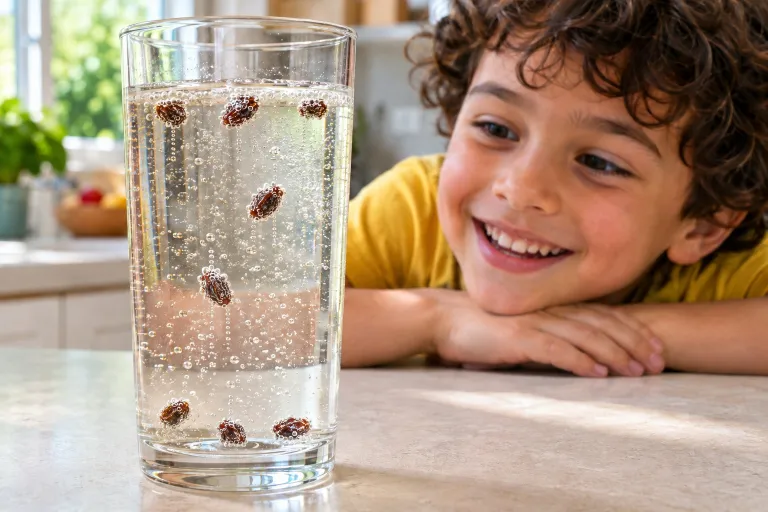
Candy canes are everywhere in December, which makes them perfect for a quick science race. Drop candy canes into different liquids at the same time and watch which one melts away first. Kids love making predictions, and the red stripes swirling off make it easy to see what’s happening.
The big idea is dissolving: why sugar disappears into some liquids, why heat speeds it up, and why some liquids can’t dissolve it at all.
Grown-up safety check
- A grown-up pours the hot water. Hot tap water is plenty. There’s no need to boil it.
- Keep the cups on a tray so spills stay put, and don’t drink the test liquids.
What you need
- 5 mini candy canesAll the same size, so the race is fair.you have this
- 5 clear cups or jarsyou have this
- Test liquids, about 1 cup eachCold water, warm water, hot tap water, white vinegar and cooking oil.you have this
- A timer and paperTo record which candy cane disappears first.you have this
Let’s race some candy canes
Set up and label the cups
Line up five cups and label them: cold water, warm water, hot water, vinegar and oil. Fill each one with about the same amount of liquid.
Add the hot water Adult step
A grown-up fills the hot water cup last, right before the race starts, so it’s still hot.
Make your predictions
Ask everyone to guess which candy cane will disappear first and which will last the longest. Write the guesses down.
Drop them in together
Start the timer and drop one candy cane into each cup at the same moment. Watch the red stripes start to swirl off.
Check and record
Every 2 minutes, look at each cup and write down what you see. Keep going until one candy cane is completely gone. Then check: were your predictions right?
Don’t stir! Stirring speeds things up and makes the race unfair.
What’s happening?
Candy canes are mostly sugar. Water is very good at pulling sugar apart into pieces too tiny to see, which is called dissolving. The sugar is still there, just spread out through the water.
Water is made of tiny moving pieces called molecules. In hot water they zoom around much faster, so they bump into the candy cane more often and carry the sugar away quicker. That’s why the hot water cup usually wins. Vinegar is mostly water, so it dissolves the candy cane too.
Oil is the surprise: the candy cane hardly changes at all. Oil molecules don’t grab onto sugar the way water molecules do, so sugar can’t dissolve in oil.
For grown-ups: a little deeper
Sugar (sucrose) dissolves well in water because both are polar: water molecules form hydrogen bonds with the hydroxyl groups on sucrose and pull them away from the crystal. Higher temperature raises the kinetic energy of the water molecules, increasing the rate of dissolving. Vegetable oil is nonpolar and can’t form those bonds, so sucrose is essentially insoluble in it, which is the classic “like dissolves like” rule. The red stripes often separate and float as thin ribbons because the colored coating dissolves at a slightly different rate from the white candy underneath.
Make it a real experiment
Keep the liquid the same, change one thing, and time each race.
- Whole vs. crushedDoes a crushed candy cane dissolve faster than a whole one?
- Stirred vs. stillHow much faster does stirring make it?
- Water vs. salt water vs. sodaDoes already-dissolved stuff slow the candy cane down?
Planning holiday science?
10 Christmas science experiments
The candy cane race is one of ten easy, festive experiments, from dancing raisins to a snowstorm in a jar.
Troubleshooting
Which liquid dissolves a candy cane fastest?
Hot water almost always wins, usually within 10 to 15 minutes for a mini candy cane. Warm water comes next, then cold water and vinegar. Oil barely touches it.
Why do the red stripes float away in ribbons?
The stripes are a thin colored layer on the outside. It loosens and lifts off before the white candy underneath finishes dissolving, so it drifts like a ribbon.
My candy canes are taking forever. Is that normal?
In cold water a full-size candy cane can take an hour or more. Use mini candy canes, or break big ones into equal pieces, for a quicker race.
Can we eat the candy canes after?
We’d skip it. Save a few fresh candy canes for a treat at the end instead.